Cambridge Photographic Star Atlas Book Review

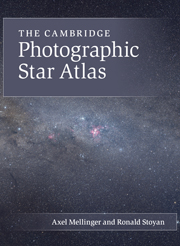
The Cambridge Photographic Star Atlas by Axel Mellinger

Photographic Star AtlasThe Cambridge Photographic Star Atlas is a large coffee table sized book which contains double page spreads, one side is a star map and the other side is a matching real image of the night sky.

The sky maps show double stars, variable stars, open clusters, galactic and planetary nebulae, globular clusters and galaxies. There are 82 large scale charts with a scale of 1 degree per cm. This means the book contains over 1500 deep-sky objects and 2500 stars.

The beginning of the book shows you how the author processed the night sky images. Axel Mellinger actually visited three dark sky sights, Texas, Michigan and South Africa in order to take the images. He created his own photographic equipment to take his images and ended up with 70 gigabytes of data. It was then semi-automated script-controlled processing that compiled and created the images.

The Photographic Star Atlas is a great book as a visual aid, as you can really see where these deep sky objects, such as the Messier objects really are in the sky, even if you live under light polluted skies.

It’s strange to actually see the photographic star maps as they were taken under very dark skies, and they look nothing like the night sky above me. But I did find it interesting to actually be able to see the deep sky objects in the book, but not in the sky. The star maps are so detailed I actually found it hard to make out the main constellation stars.

The Cambridge Photographic Star Atlas is available at Waterstones

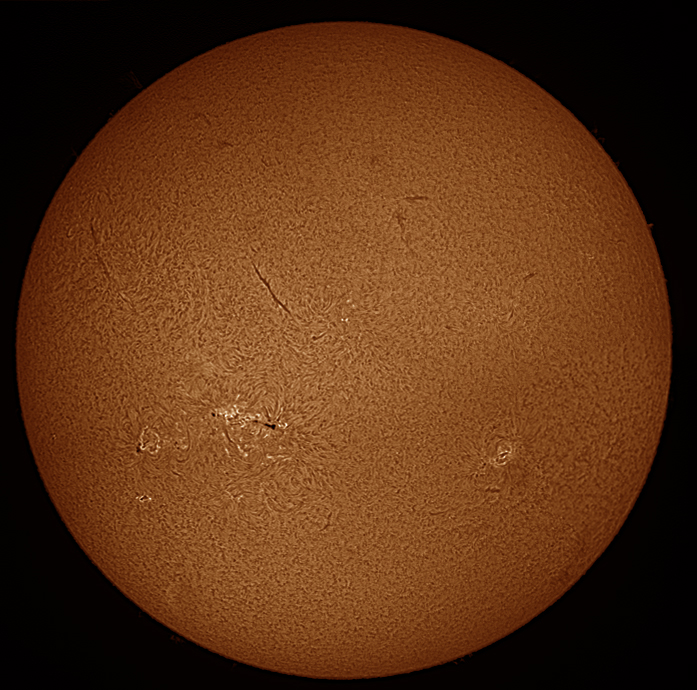
The Sun in Hydrogren Alpha with Coronado PST

This image of the Solar disc was taken on Saturday 6th July 2013. It was taken using a standard Coronado PST and an Imaging Source DMK21 AU618 Mono camera. I did use a Short ‘C’ mount adaptor in order to allow the PST to gain focus, without having to use a Barlow lens.

As the DMK21 is only 640×480 I have to take 4 videos and then process each one in turn using Registax 6. I then imported them into Photoshop and used the Photomerge software to align them all up into one image. I then gave the mono image some false colour.

Solar Imaging Talk at CAA June 2013

Below is the PDF version of the solar imaging with webcams talk I did at the Cambridge Astronomy Association on 19th June 2013.

Solar Imaging Talk (1.3mb)

Lunar Imaging Talk at CAA June 2013

Below is the PDF version of the lunar imaging with webcams talk I did at the Cambridge Astronomy Association on 19th June 2013.

Lunar Imaging Talk (850k)

Astronomy Manual by Haynes Book Review

Astronomy Manual by Haynes – The Practical Guide to the Night Sky
Astronomy Manual

This Astronomy Manual by Haynes (yes the people who publish the car manuals) has an introduction by Sir Patrick Moore with the foreword by Dr Brian May.

The Astronomy Manual begins with details about everything in our solar system. The images and diagrams are very good, and easy to read and understand. The book reminds me of a type of colourful encyclopaedia. The Sun and each planet in turn is covered in full colour with images of the planets moons and with lots of information on each planet.

The Our Perspective chapter looks at where we are in the galaxy and this chapter covers Stars, Exoplanets, the Milky Way galaxy and more. On top of these, Quasars, the different types of galaxies and the Big Bang are also covered.

There are then two chapters split into amateur viewing and professional viewing. The amateur viewing chapter starts with naked eye viewing and how to read star charts and planispheres. This chapter includes some basic star charts and then takes the reader through some of the more common constellations in more depth. There is then information on binoculars and what to look for when purchasing a pair as well as how they work and how to get the best out of a set of binoculars for astronomical use. The book then talks about the various different types of telescopes that can be purchased and how to use Go-To telescopes and how to polar align your mount. The book then covers equipment accessories such as eyepieces, filters and lots of others astronomy accessories. There is an interesting section on the various types of astronomy computer software that can also be purchased.

One very interesting section in the amateur section is how to create your own observatory, and there are details on creating roll off roof observatories or using a Sky pod, shed or a dome as your observatory.

The professional viewing chapter covers all the major high end professional scopes that are sited around the world and those in space, such as the Hubble Space telescope, Spitzer and Chandra. Gamma Ray Bursts are covered here as well as imaging in the infrared. The final part talks about the possible future of telescopes.

There are several appendices in the book including lists about the constellations, as well as simple star maps. There is also a rather nice lunar map showing the features of the moon. There is also a list of the Messier objects for reference.

It’s nice to see an up to date book on Astronomy which even includes details about astronomy apps on the iPhone and Android smart phones. The book is also very up to date when it comes to the information on DSLR and CCD astrophotography. There is also a section on Webcam imaging which is a very cheap way to get into imaging the planets and the moon.

This is a very good overall book on Astronomy, as it contains a little bit of everything you ever really needed to know. This is definitely a book for beginners as well as those who have been into astronomy for a while.

Author: Jane A. Green
RRP: £19.99

The Haynes Astronomy Manual is available at Waterstones or directly from Haynes

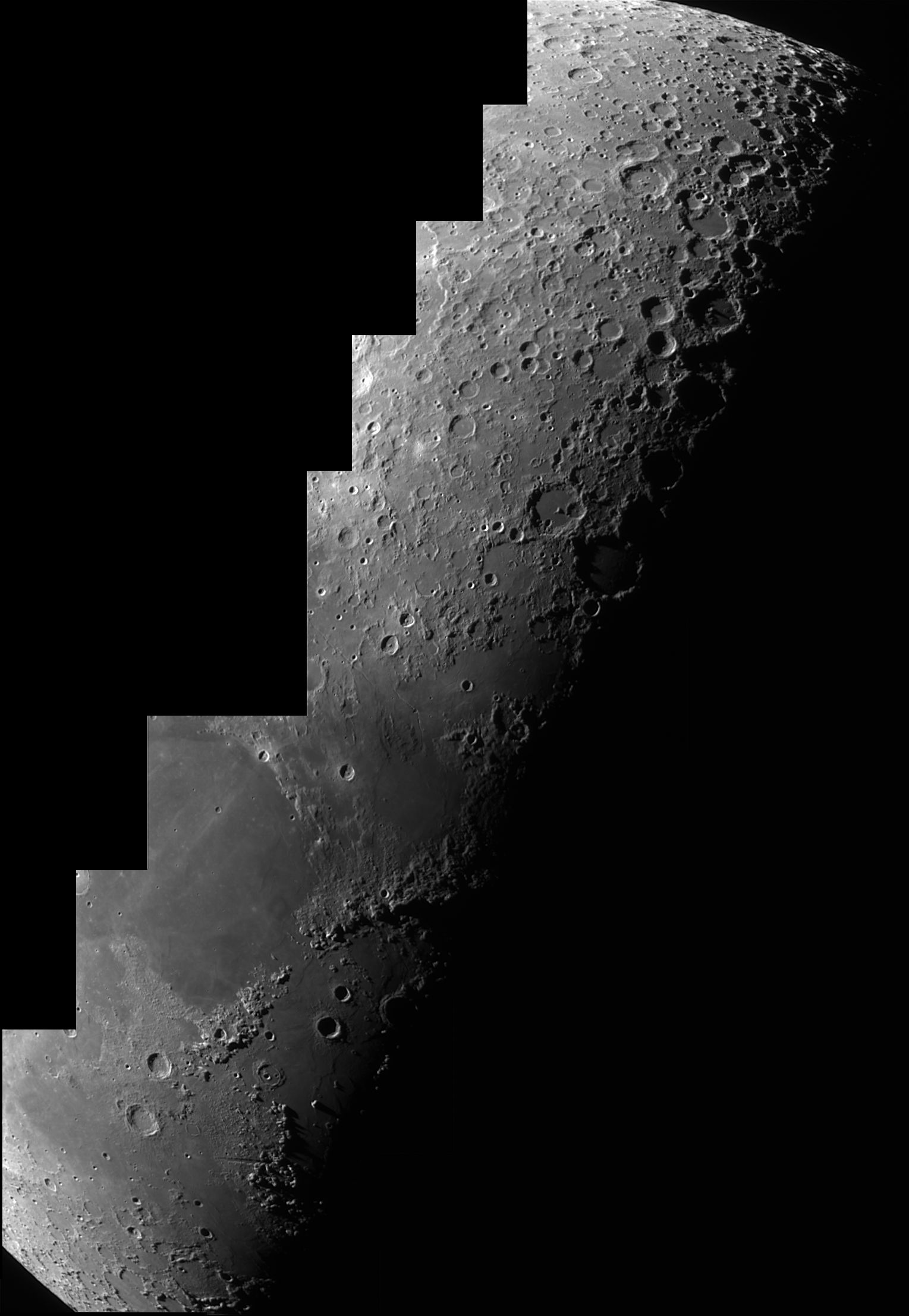
Moon Mosaic with Altair Astro 8″ GSO RC

This was my first proper night out really trying out my new GSO 8″ RC from Altair Astro. I had attached the Lakeside Focuser, collimated the scope to the other scopes, finders and red dot finder. I had also managed to get the telescope collimation as good as I could so far by using a Cheshire and by doing a star test.

I was playing around noting down the focus positions of eyepieces, my imaging set up and the DMK21. So I decided to try and do some moon video with it.

There were 8 videos, producing 8 pieces of the mosaic. I used a DMK21 618 camera on it’s own, no Barlows or Powermates were used. I processed them using Registax 6 and then started to align them manually in Photoshop, but then remembered there was an automatic way of doing it – Photomerge. Within about 30 seconds the mosaic was automatically created for me.

Moon Mosaic with Altair Astro 8" GSO RC and DMK21 Camera

How to Find Comet Panstarrs C/2011 L4 in the Sky March 2013

As of yet I have not seen comet Panstarrs myself, but I shall be looking out for it in the next few days if we ever get any decent clear skies here in the UK.

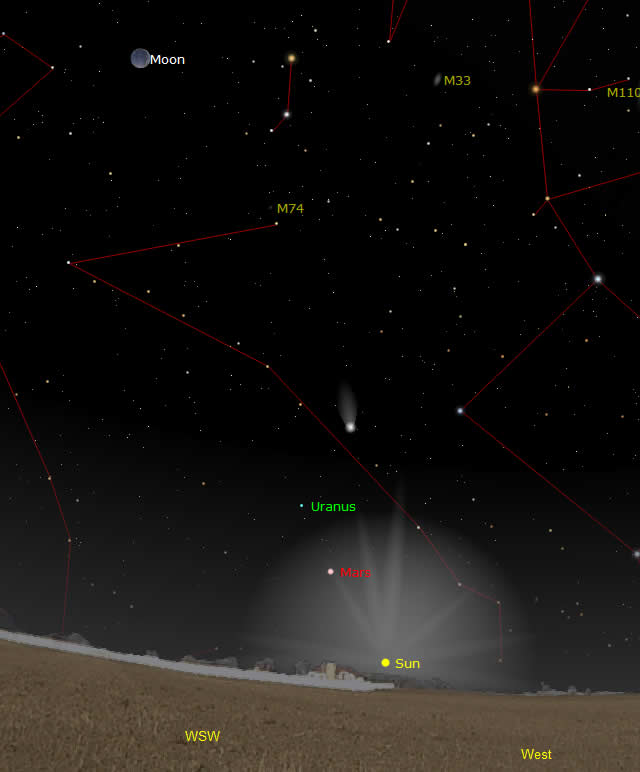
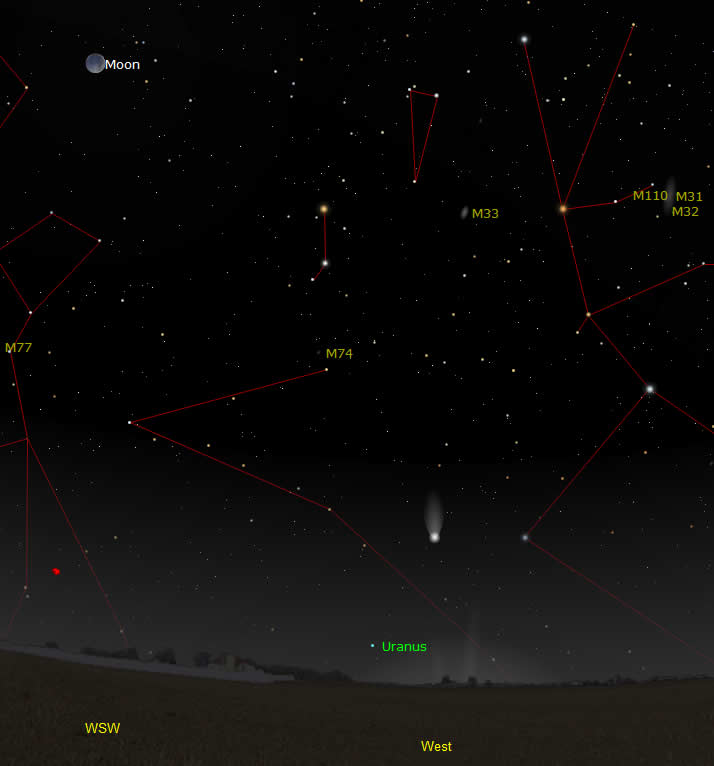
So where do you look for it? Well you need to be looking to the Western horizon an hour or two after sunset. I have added some images below to help you.

Click on the images to enlarge them.

The first image is on 15th March 2013 @ 5.15pm

Comet Panstarrs C/2011 L4

This second image is for 16th March 2013 @ 6.15pm

Comet Panstarrs C/2011 L4