Concise Catalog of Deep-Sky Objects Book Review

Concise Catalog of Deep-Sky objects – Astrophysical information for 550 galaxies, clusters and nebulae. 2nd edition.
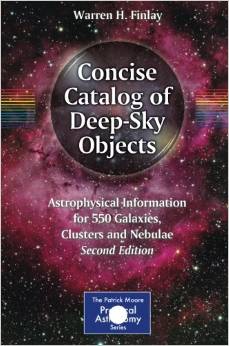
concise catalog of deep sky objects book This information book covers 520 northern hemisphere objects and 30 southern hemisphere objects. So the book covers the most common objects. This is the 2nd edition of the book, and this time the book contains images of the Messier objects.
The book begins with a small introduction describing what each piece of information against the object is about. The book is then divided into 3 sections, the Messier objects, NGC objects and the IC objects.

All 110 Messier objects are included, as well as 400 Herschel objects, 110 NGC objects and 30 southern hemisphere objects.
In the Messier section all M objects are accompanied by a black and white image.

The main information that accompanies each object is the constellation name, object type, RA and Dec co-ordinates, approx. transit date, distance from us, object’s age, apparent angular size and the objects magnitude. All objects also have a description/notes section.

Overall this is a good reference book and something you may pick up from time to time. It’s nice to see images of every Messier object in this edition, and they are all amateur, shame they are all in black and white though.

One way this book could be improved is if each object with an image was given its own page, as on a lot of objects you have to turn the page to see the corresponding image.

I think the objects chosen in each catalogue are really good. If I could have the ultimate book it would give basic information about the object, but very good astrophoto’s would accompany each object and then a write up by the imager of how that object was recorded would be perfect. But I know that’s a tall order and would take a long time to write. There is a 100 deep sky objects book, which is really good, it just needs enlarging.


Concise Catalog of Deep-Sky Objects is available at Amazon

Comet Lovejoy 2014 Data for TheSky 6

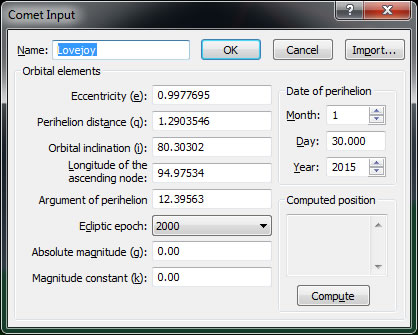
Here is some data I used for getting the comet to appear on my copy of TheSky 6, as the import from web feature no longer seems to work. I am sure this data would work in other planetarium programs as well.

comet lovejoy data

Eccentricity, Perihelion Distance, Orbital Inclination, Argument of perihelion etc.

Horsehead Nebula and Flame Nebula

Horsehead Nebula and Flame Nebula taken on 6th January 2015. Taken in Ha, 14x5min frames, on an Altair Astro 80mm Triplet telescope with Televue x0.8 reducer, Atik 460 mono camera and EQ8 mount.

Horsehead Nebula and Flame Nebula

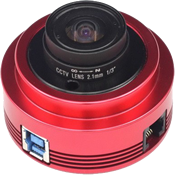
ZWO ASI120MM S USB3.0 CMOS Astronomy Camera

Well I just got my ASI120MM S USB3.0 camera through via DHL. Ordered it direct from ZWO Optical on AliExpress and paid £250, then had to pay an extra £19 on import duty etc. But still a bit cheaper than buying from 365Astronomy – they were also out of stock at time of ordering.

The video shows below me unboxing it, and what it looks like.

This is a still image of my desk at 1280×960 on the ASI120MM S with the CCTV lens attached.

ASI120MM S USB3 Camera

I used the default capture software AMCap to get this still. Remember to install the correct drivers from the CD or from the ZWO website before you plug the camera into the PC.

ASI120MM S CMOS Camera

The CD is quite good it comes with ASCOM, PC drivers and ST4 software, as well as all the different ZWO camera driver versions. There is also some PC and Mac software on the disc. PHD2 and oaCapture for the Apple Mac and FireCapture and SharpCap as well as PHD2 for the PC.

I have now installed the camera on my observatory PC. The install was easy. I also installed the ASCOM drivers as well FireCapture and SharpCap 2.

I began with SharpCap 2, but found the best fps I could get was around 70fps at 640×480 (it was 30fps at 1280×960). Other people had reported around 100fps. So I loaded FireCapture – which I must say seems to have a lot more functionality than SharpCap.

I tried my tests again in FireCapture and at 640×480 I was now getting 106fps-116fps. So it seems which software you use makes a difference, unless some other settings were different.

It appears that the ASI120MM S is a very sharp camera and so far I am very impressed with it.

QHY5 vs DMK21 for Guiding

I have always used my QHY5 for guiding, most of the time attached to a Skywatcher 9×50 finderscope and it has worked quite well.

But while at Kelling Heath this year I purchased an Altair Astro 80mm guidescope. Did I need to? I don’t know, may be a 60mm would have been a good upgrade as opposed to going for the larger 80mm. But anyway, I have now started to realise that the original QHY5 does suffer from some image degradation in the form of banding. (I do already use simple dark frames with the QHY5 camera).

Now instead of purchasing a QHY5 II Mono, I have been thinking about using my DMK21 AU618 camera instead.

I know the DMK21 sensor is half the size of the QHY5, so finding a guide star may be harder – but I bet the quality of the image will be a lot better. Plus it would mean I would not need to purchase a new camera but use the DMK21 that I already own.

So on the next clear night I shall try out the DMK21 for autoguiding and see what happens and report back.

UPDATE: 11th November 2014

Well last night I went out and tried the DMK21 for guiding. It worked OK, in Maxim DL the guiding calibrated OK. But the actual guiding itself was not that smooth, certainly not as smooth as when I use the QHY5.

I don’t think the small sensor and field of view is a major problem, as I found lots of stars in the field of view. But it could be because the DMK21 is only 640×480 – the sensor is so small you can’t bin the camera, so it lacks the sensitivity that you can get with the QHY5 camera when you bin the images as it’s 1280×1024 pixels.

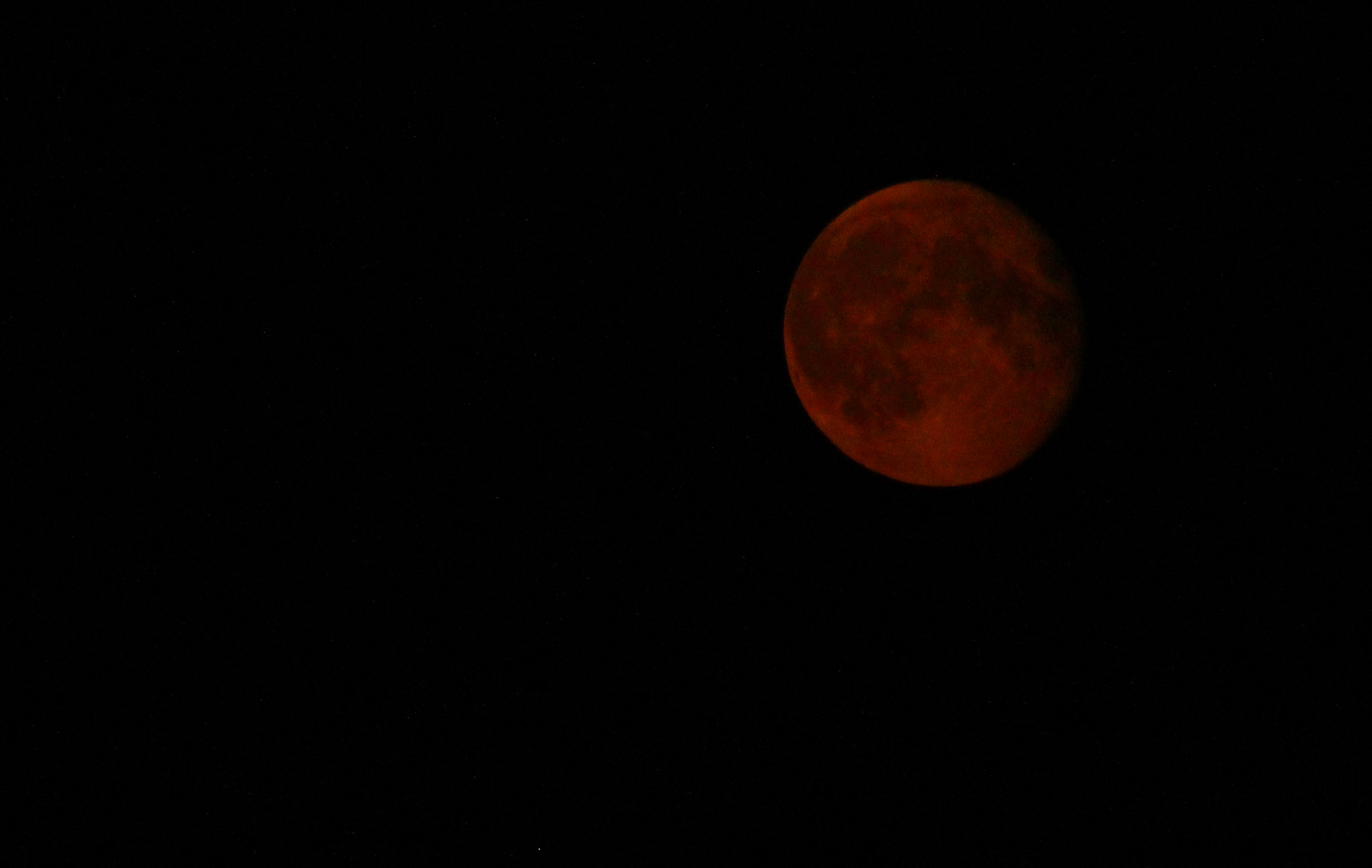
Colourful Harvest Moon Image

Harvest Moon

Here is a very colourful harvest moon taken on 10th September 2014.

I took it on a tripod with my Canon 550d on a 300mm lens.

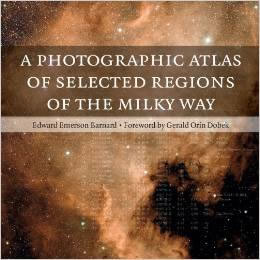
A Photographic Atlas of Selected Regions of the Milky Way

Photographic Atlas of Milky WayEdward Emerson Barnard’s A Photographic Atlas of Selected Regions of the Milky Way was originally published in two volumes in 1927. These two volumes contained a great deal of information including photographic plates of the most interesting portions of the milky way, descriptions, charts and data. At the time only 700 copies were ever printed, this made the original edition a collector’s edition.

This edition has now been reproduced which contains both volumes of Barnard’s Atlas. This edition now contains high-resolution images of the original photographic plates and charts. There is also a fold-out section with a mosaic of all 50 plates combined into a single panorama.

The main parts of the book include a catalogue of 349 dark objects in the sky, of which 182 were printed in the Astrophysical Journal in January 1919. There is then the catalogue of 352 objects in J2000 co-ordinates.

The first plate and chart is the region of the double cluster in Perseus, each section contains a description of the area and what it contains as well as the objects that are located on the plates and there positions. There is then the chart and plate which are opposite each other on the pages.

The plate images themselves are of very good quality for their age with the charts showing you important objects that can be found on the plates.

At the end of the book plate 52 contains a mosaic of 50 plates taken from the atlas. The end of the book contains a few pages about the life of Edward Emerson Barnard who lived from 1857-1923.

Overall this is a very good book, and the book still seems very much like a collector’s item.


The Photographic Atlas of selected regions of the Milky Way is available at Amazon

Moved from Vista to Windows 7 and added Samsung SSD’s

Well that was a short life for Vista on my observatory PC. I only upgraded from Windows XP Pro to Vista Business in January, but I wanted to add an SSD (Solid State Drive) to my observatory PC to speed things up, so now was a good time to install Windows 7 Professional.

Why Professional? Well, so I can control the observatory PC from the house using the in-built Remote Desktop Connection software.

I have already installed SSD’s in both my laptops and the speed increase is amazing, no more noisy spinning hard drives for me. The price of  SSD’s has also decreased. I bought a Samsung SSD 240GB for my home desktop PC and a Samsung SSD 120GB version for the observatory PC. They cost (in 2014) £85 for the 240GB and about £50 for the 120GB version.

I have decided to keep the previously used hard drives inside the PC but use them for storage of the images and video when they are being recorded by the telescopes, so leaving the SSD drives with just Windows and my astronomy programs on.


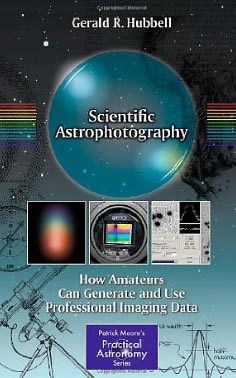
Scientific Astrophotography Book Review

Scientific AstrophotographyScientific Astrophotography – How Amateurs Can Generate and Use Professional Imaging Data

A chunky book in the Patrick Moore Practical Astronomy series at over 330 pages, as this is a serious subject of contributing to the science of astronomy.

The book is split into three main sections. The first section takes you through your equipment required for making scientific findings. This section takes you through the telescope, mount, cameras, filters and on combining the right telescope with the right CCD camera. There is also a chapter on external factors, namely the weather.

The second section talks about the areas you may be interested in following, whether its lunar imaging, deep sky imaging, planetary imaging, solar imaging or minor planetary imaging. There is then a chapter on planning your observing and imaging session. There is also a chapter which discusses imaging file formats, and how to collect and calibrate your images.

The final chapter in this section is about putting it all into practice and it lists various procedures for collimation, polar alignment, setting up your guidescope, how to focus and about getting your dark, flat, bias and light frames. This chapter also lists the procedures for imaging deep sky and solar objects – large and small.

Now once you have acquired your data part three covers processing and analysing your data. This includes astrometry, photometry, spectroscopy and planetary topography and feature analysis.

There is then a chapter on how to submit your findings to scientific organisations. The last chapter is quite nice as it talks about amateur astronomers getting access to the professional level observatories.

There are five appendices; the first covering acronyms used in the book, the second is a training syllabus, the third contains photometric uncertainty calculations, the fourth is good as it gives you example imaging setups, with a cross section of the authors imaging setup. The fifth appendix lists where to find software on the web.


Scientific Astrophotography is available at Amazon