Moon Image in Daylight

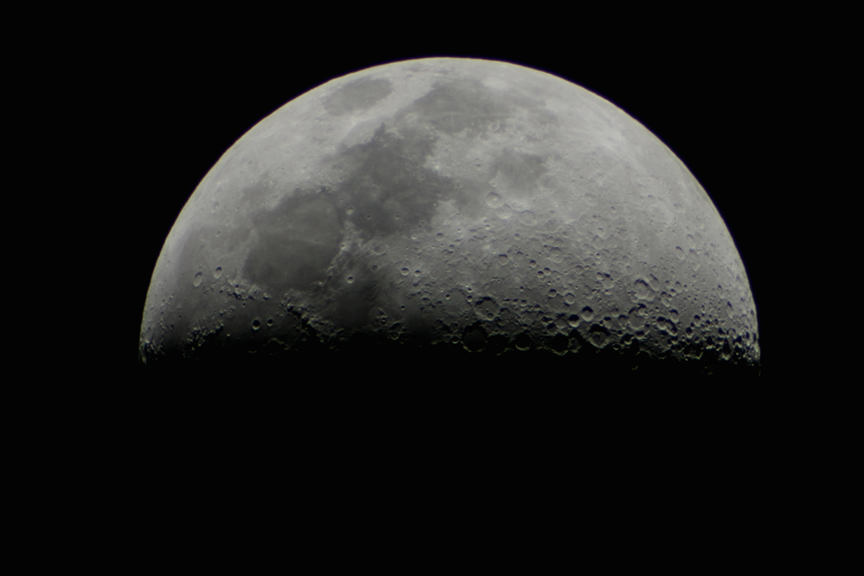
I managed to get out before the snow set in and the clouds appeared today (Sunday 21st Feb). I went out at about 4pm when it was still light, but the moon appeared directly above me.

I took this image with my cheap refractor but this time I also used my Televue 2x Barlow as well as my Canon 450D camera on ISO800 for about 1/50th exposure. I forgot to add that I also used my 1.25″ Baader Fringe Killer filter.

Click on it to enlarge it.

Moon 5pm 21st Feb 2010

Small Sun Spots

Today it’s snowing, but yesterday I managed to view the Sun and do some imaging – crazy weather!

Usually when viewing the Sun at the moment it’s a very uninteresting sinle coloured disc, but today (20th February 2010) I was amazed to see two small sunspots on the face of the Sun.

With this being such an unusual occurence lately I had to get some images.

Before I purchased my guidescope I only had solar filters for the LX200, by way of a hartmann mask and a glass ETX solar filter. Now I also have a mylar sheet type filter for my small refractor. Both provide different colours of the Sun.

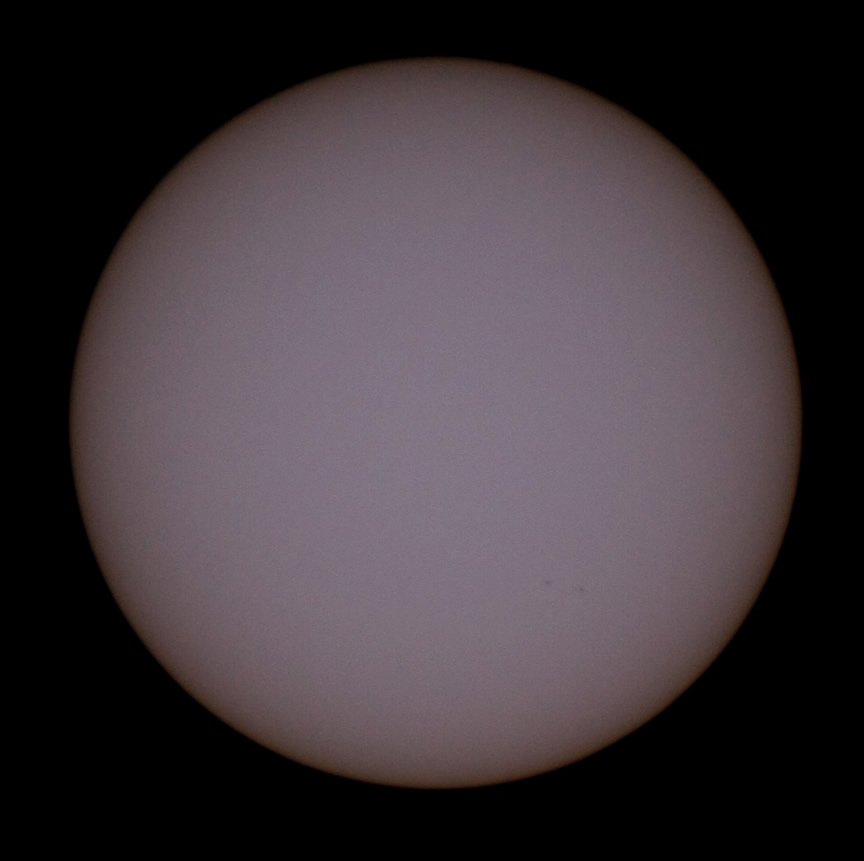
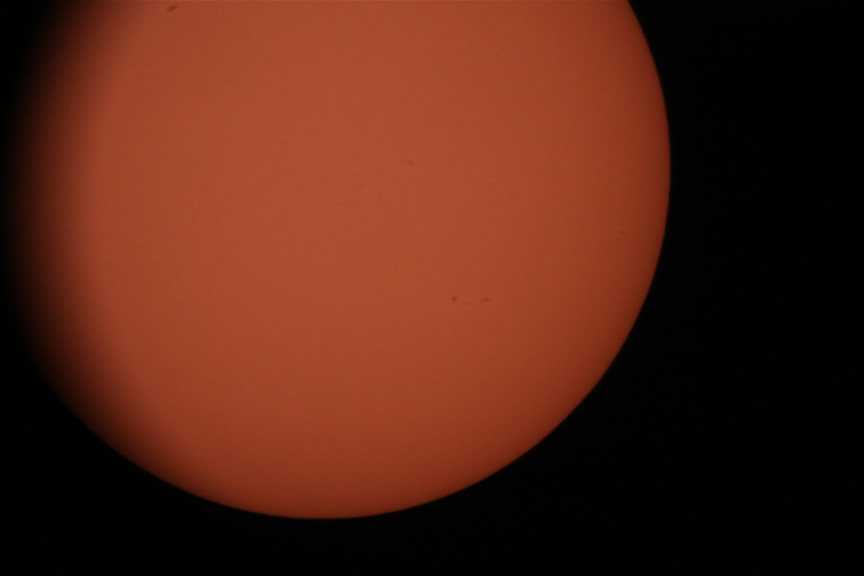
The ETX glass solar filter gives an orange colour to the Sun, whilst the mylar sheet provides a kind of white colour.

The sunspots are so small you may have trouble seeing them on these images, but they are on the lower right hand corner. Click on the image to enlarge it.

First the mylar image on the refractor:

Sunspots using mylar paper

The image from my LX200 using an ETX glass solar:

Sunspots via LX200 10" with ETX Glass Solar Filter

Great Orion Nebula Image

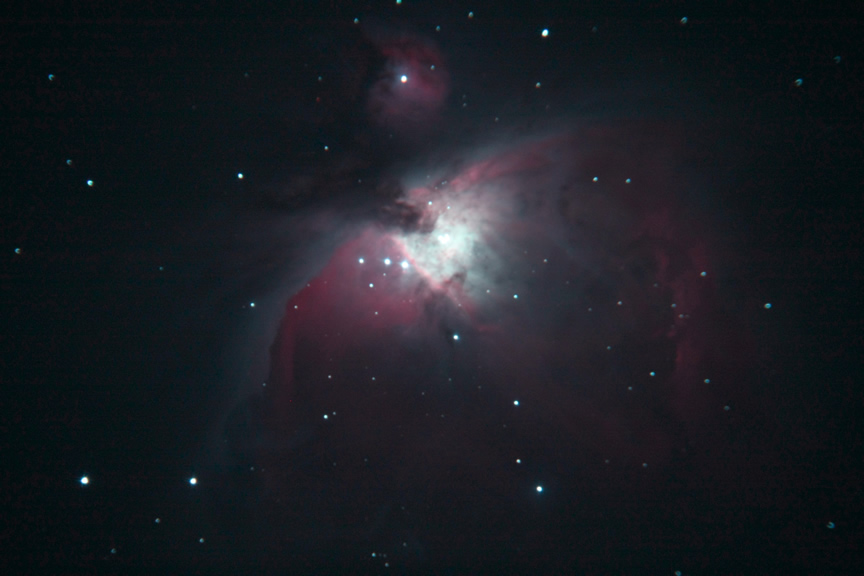
I tried guiding again the other night for the first time in ages. I went back to imaging with the LX200 and guiding with my cheap refractor. I took this image of the Orion Nebula for 2.5mins with my Canon 450D and Astronomik CLS filter attached directly to the Meade LX200 10″ scope.

The initial image did not look that good, but once I had adjusted the separate colour levels and the brightness and contrast the image got a lot bigger and came alive.

It’s definitely one of my best so far, but I am sure I could do even better in the future.

Great Orion Nebula

Pluto Turns Red

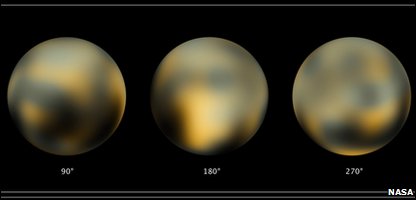
Pluto turning Red

Images taken from Hubble have shown Pluto changing colour.

Nasa says the dwarf planet on the edge of our solar system is becoming increasingly red.

Its illuminated northern hemisphere is also getting brighter.

Nasa’s scientists believe these are seasonal changes – as the planet heads into a new phase of its 248-year-long seasonal cycle.

“These changes are most likely consequences of surface ice melting on the sunlit pole and then re-freezing on the other pole,” Nasa’s Space Telescope Science Institute said in a statement.

The overall colour is probably a result of ultraviolet radiation from the distant Sun breaking up methane on Pluto’s surface. This, scientists say, would leave behind a red carbon-rich residue.

Nasa said: “The Hubble pictures underscore that Pluto is not simply a ball of ice and rock but a dynamic world that undergoes dramatic atmospheric changes.”

Stargazing with Binoculars Book Review

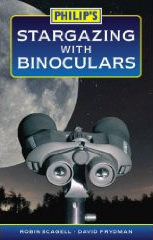
Stargazing with Binoculars BookStargazing with Binoculars with Robin Scagell and David Frydman

Stargazing with Binoculars is the latest book from Philip’s (as of Spring 2008). Using binoculars is a great way to begin your astronomy hobby before you go out and spend money on a telescope, especially now that you can buy some powerful binoculars for little money. I use a pair of binoculars myself as they are quick and easy to pick up and use, I think everybody should have a pair.

So it is about time we saw a book on astronomy with binoculars. The book does contain in-depth information on the various types of binoculars and what to look for when purchasing a pair. This includes the various models, using tripods and how to attach the binoculars with an L bracket, this information is not at the beginning of the book but actually at the back of the book.

The book also covers how to look after your binoculars and how to observe the sun with them. Stargazing with binoculars actually begins by introducing you to the night’s sky and how to find your way round it.

There is an interesting chapter entitled “The binocular observer’s year” which tells you what the best sights are to look out for month by month during the year.

The book also contains a chapter on the solar system which gives readers a general overview of the night’s sky and the hobby of astronomy.

Stargazing with binoculars is a great book as it contains some really nice colour images of the night’s sky, which are all up to date. If you are interested in astronomy and want to buy a pair of binoculars or if you already own a pair but want to get outside to look at the night’s sky, then buy this book.

Stargazing with Binoculars is available at Waterstones

Orion Nebula and Pleiades Images

Managed to get out last night at about 9.30pm until Midnight. With so many great sights in the sky at the moment in January it’s hard to know what to try and image first.

M1 Crab Nebula, M45 Pleiades, Mars, M42 Orion Nebula, Horsehead Nebula etc.

At the moment I love connecting my Canon 450D up to my £100 refractor guide scope. I just find it so easy to use and focus compare to the LX200. The worst thing on the LX200 is not seeing where you are when focusing. I like to see the drawtube on the refractor.

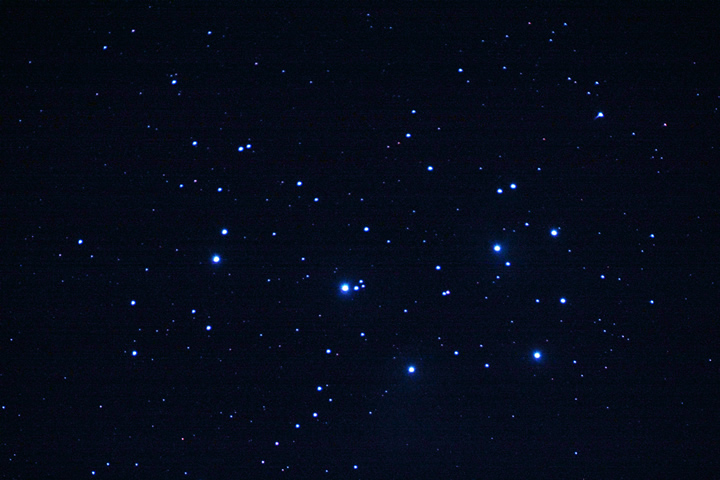
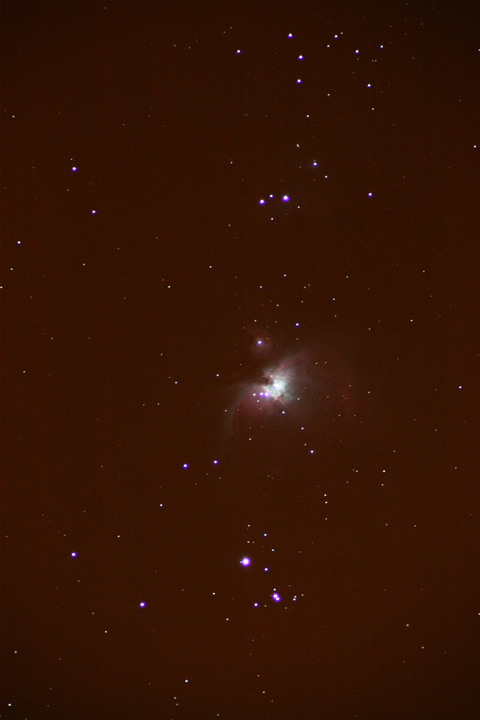
I ended up taking the pleiades and the orion nebula with the 70mm refractor.

Pleiades Image

Orion Nebula

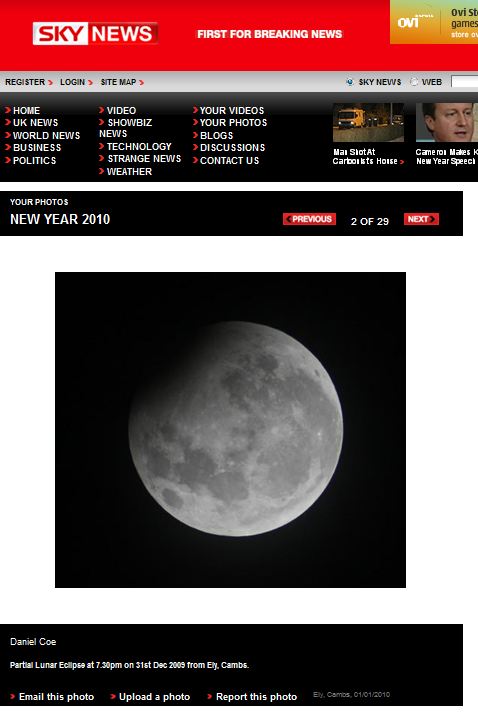
Lunar Eclipse Image on Sky News

I sent my lunar eclipse images around the internet and managed to get the photo on the Sky News website within about 12 hours. The local CAA have also responded, and so have the SPA. The SPA have requested a high resolution version, hopefully for the quarterly magazine, but we’ll see.

Lunar Moon Eclipse on Sky News Website

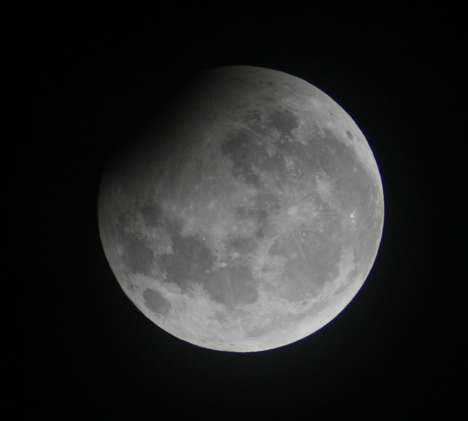
Partial Lunar Eclipse New Year’s Eve 2009

Managed to get out tonight for a while around 7.30pm, I did not think the clouds would clear. Usually whenever there is something worth looking at it’s always cloudy! But eventually the clouds went and the moon was in full view, even though it was -1 degrees in the shed.

Lunar Eclipse 31st Dec 2009

I took these images by attaching my Canon 450d to my cheap £100 guiding refractor telescope, I still think the photographs it produces are great for a £100 telescope. Images were taken mostly using an exposure time of 1/800th and an ISO400

I stayed out as long as possible to try and get the full story of the eclipse, all the way through from start to finish, but I did move my camera between the refractor and the lx200 so some later shots did get rotated as I did not put the camera back in the exactly same position.

moon-slides

The partial eclipse was not a great site to behold, but still something worth looking at.

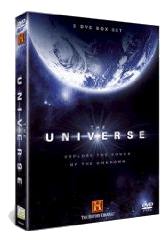
The Universe DVD

The Universe DVDOne of the best series on astronomy and the solar system for me has been The Universe from the History Channel. It is now available as a standard DVD and in Blu-Ray High Definition format.

There are currently 2 series you can buy, the first series is on 3 DVDs and so you get 600 mins of programmes. The 2nd series is even longer on 5 DVDs running for 842 minutes.

The second series of The Universe includes episodes: Alien Planets, Cosmic Holes, Mysteries of the Moon, The Milky Way, Alien Moons, Dark Matter, Astrobiology, Space Travel, Supernovas, Constellations, Unexplained Mysteries, Cosmic Collisions and Colonizing Space.

The Universe DVD series makes a perfect gift for any astronomer, space enthusiast or for educational use.

The Universe DVDs are available here.

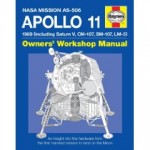
Apollo 11 Manual by Haynes

Haynes Apollo 11 Manual The Apollo 11 Manual by Haynes really caught my idea when reading the December 2009 edition of The Sky at Night magazine.

What a great and very unique gift for an astronomer, the acutal intricate manual to the Apollo 11 spacecraft in a Haynes style book.

This manual looks at the evolution and design of the mighty Saturn V rocket, the Command and Service Modules, and the Lunar Module. It describes the space suits worn by the crew and their special life support systems.

The book also tells you about how the Apollo 11 mission was flown – from launch procedures to ‘flying’ the Saturn V and the ‘LEM’, and from moon walking to the earth re-entry procedure.

Perfect for any astronomer or someone interested in space flight.

Buy the Haynes Apollo 11 Manual from Amazon with Free Delivery.