The International Atlas of Lunar Exploration Book Review
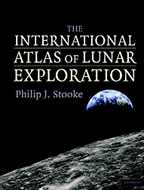
atlas of lunar exploration bookThe International Atlas of Lunar Exploration is one of the most detailed books on the lunar missions I have ever seen. If you want a book that goes into so much depth, then this is for you, that is, if you can handle the expensive retail price of around £100 for this book.

The International Atlas of Lunar Exploration provides details of every spacecraft mission to the moon since the dawn of the space age. Each mission is illustrated with a combination of maps and annotated photographs. Usefully the lunar missions are listed in chronological order through the book, so it’s easy to follow the history.

The book includes such information as how landing sites were selected.  The book also includes details on lunar missions that never happened. There is even material in this book which has never been published before together with specially created panoramic lunar photographs from every lunar mission.

This is a large sized coffee table type book which contains over 440 pages packed full of information. The panoramic photographs are truly stunning and for me a high point of the book is the detailed information and maps about the EVA routes and exactly where core samples were taken.

There are some really great moon mosaic images and details on exactly where flags, TV cameras, solar wind collectors and antenna were placed. There are even details on where the lunar landers should have landed and where they actually landed.

As you can probably tell from my lists of information, this book has everything. If your interests lie with the Moon and the lunar missions then this would make a great book for you to marvel at.
How To Stop Maxim DL cycling through filters

One of the main problems I found with Maxim DL when setting up the Autosequences was that if I set it up to do LRGB imaging and repeated each filter by say 20 times, instead of Maxim doing 20 frames in Red, then moving onto the Green filter to do 20 frames, it would do 1 frame in Red and then move onto 1 frame in Green and then onto Blue etc etc.

This seems a bit crazy and it also means your filter wheel is constantly on the move and it may wear down your filter wheel faster than you think.

Another downside to this is that you really want to take all your frames through one filter then take your flats for that filter, as the filter wheel may not move the filter back into exactly the same position again once you have moved filters.

To stop Maxim DL doing this choose the option “Group by Slot”.

It can be found by clicking on the ‘Autosave’ button on the ‘Expose’ tab then when in the Autosave Setup screen choose ‘Options’ and select ‘Group by Slot’.

Moon Images with 5x Powermate

I decided to try and push my Skywatcher ED80 Pro to it’s limit on the moon. I am really impressed with my Skywatcher ED80 Pro telescope, as it gives me some nice widefield views, and I also use a Williams Optics version 3 flattener 0.8 which gives me even more view.

The Skywatcher gives me nice views of the Sun, Moon and Deep Sky Objects. I think the only thing that an 80mm type scope is not good at is planetary imaging and small Deep Sky Objects, like the Ring Nebula or Eskimo Nebula.

I was a bit worried that my 80mm scope would not cope well at imaging the lunar surface close-up. But I was pleasantly surprised that I managed these images with the scope.

The setup included the 0.8 William Optics flattener/reducer together with my Televue 5x Powermate and the DMK21 CCD camera.

Focusing was tricky, as the moon looked liked it was underwater from the atmospheric turbulence. But once I had stacked the images using Registax (version 6 is now out) they looked a lot better.

This time I also took a flat image, by using my EL panel which I have encased between 2 A4 acrylic sheets. I took a 1 second snapshot in the IC Capture software in order to get the flat image. I then opened it up in Photoshop and checked the histogram, and it was about nearly dead centre.

For the first time I then used Registax to stack the frames of the AVI videos with a flat frame selected. The results were good, as my DMK21 camera seems to have lots of dust bunnies in it, but I think most DMK cameras must suffer from this problem.

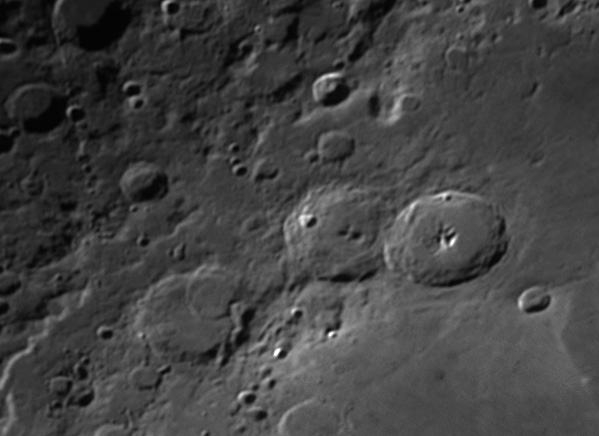
Moon with Televue Powermate

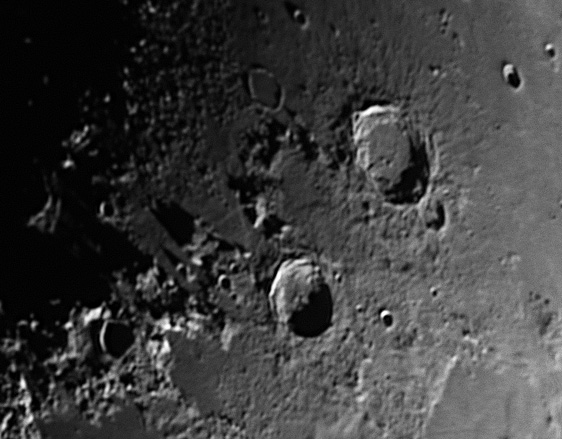
Theophilius and Cyrillus lunar craters

Second Hand Astronomy Equipment

I’m sure this is a highly emotive subject. But this is the question should you buy 2nd hand astronomy equipment?

I myself have bought and sold lots of astronomy equipment, either through AstroBuySell, Stargazers Lounge or eBay. But there seems to be so much astronomy equipment constantly on the second hand market, I wonder how many people have actually owned some of the items and how many ‘hands’ have touched them. I imagine there must be items that are constantly being passed onto the next person.

There are of course savings to be made on buying second hand equipment, which is the main reason we buy it. But sometimes it’s just nice to pay that little bit extra and have the assurance that you are buying new and that the item will come with at least a one year warranty.

The thing that makes me laugh is when people try to sell astronomy equipment when it only costs about another 10-20% to buy it new.

Selling your items not on eBay is the best thing to do as you don’t pay the eBay and PayPal commission, but I do think your items may go for a higher price on eBay just because of the number of visitors that eBay has.

You also have to watch out for dodgy astronomy sellers – they are out there. It’s always best when buying larger equipment to check the history of it, if you look on the archives in AstroBuySell or search the forum on Stargazers Lounge or search on Google, you may find some information on your item – especially if it has been bought or sold before.

Most astronomers look after there equipment very well, but I still like to have the end caps on an eyepiece and have the item boxed. That tells me that the owner has looked after the equipment, plus it means that the original box with help when I come to sell the item on.

Make sure the item works, and make sure the item is complete in everyway, it’s also advisable to see an image of the item when buying it. I have purchased a couple of items that did not work, like an illuminated reticule which did not illuminate! I asked the eBayer for a refund to help me fix it, but I did not get one. In the end I visited Maplin bought a new cable and an LED and fixed it.

If you are a seller and know something is wrong or missing, please be truthful and tell us about it, and don’t try and hide it and hope we as the buyer don’t find out about it.

Once you get hooked on the second hand astronomy items, I swear you never go back to new items unless you have to. I have lots of second hand equipment and I love it. But sometimes I wonder if I am mad, sending complete strangers hundreds of pounds for equipment I have never seen. So please think twice before buying, and if the item is over a couple of hundred pounds or so then why not visit the person and collect it – that is as long as it’s not too far away – especially with fuel costs being so high.

So should you buy 2nd hand astronomy equipment over new?

How To Clean the Meade Autostar Handset

For ages my Meade Handset on my LX200 GPS telescope has been very unresponsive to key presses. I always find myself having to hammer the keys in order to get the handset to register the key press.

But I did not want to buy a new Meade handset as they are so expensive, so I was glad to find some details on the internet on how to clean the handset.

All you need to do this is some cotton wool buds and some alcohol.

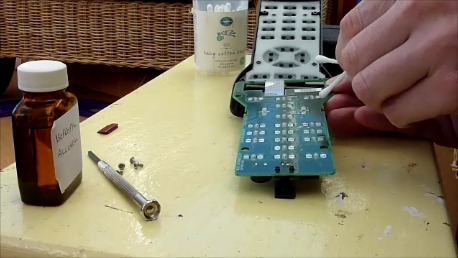
Begin by unscrewing the 4 screws on the back of the handset, then remove the rear plastic case cover which contains the red light plastic cover.

Opening the Meade HandsetYou will how find that the front of the handset and the main motherboard are joined by a ribbon type cable, so be careful not to stress this cable as the cable is not that long.

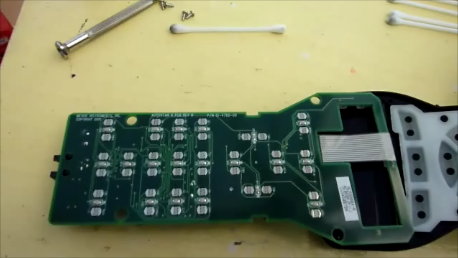
I then began by dipping my cotton bud into the alcohol and gently rubbing each of the contacts in turn and then using another cotton wool bud in order to dry and further clean the contact.

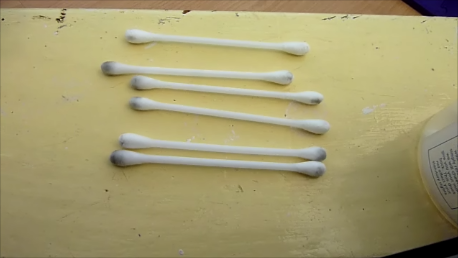
Meade Inside Handset ControllerThere are quite a few contacts to clean, so you may find yourself using quite a few cotton buds, but you should visibly see the dirt on the cotton wool buds.

After doing all the contacts on the main board, I then cleaned the black rubbery dots on the back of the keys using the same method.

Cotton Buds after cleaning the Meade HandsetAfter finishing I then put everything back together and made sure that the ribbon cable does not get put in front of the main lcd screen, as otherwise you will see the ribbon cable in the window and some of your wording on the handset will look strange. I did this first and then noticed it when I attached the handset to the telescope and turned it on. I then took the handset apart and repositioned the ribbon cable.

Once I tried the handset with the LX200 I was then amazed at how responsive the keys then were. This is definitely a quick and simple little job to undertake if your Meade handset keys are also not working so well.

I also recorded a video on what I did to clean the Meade handset, and it can be found below:

April 2011 Sunspots

As we have been having some nice summery weather in April, it gives us a great chance to get out in the garden and do some solar imaging.

I have recently had a major equipment change, and sold my LX200 (sad to see you go) and I now have an NEQ6 Pro mount instead, with my trusty Skywatcher ED80 Pro onboard.

Luckily there seems to be a good selection of sunspots now appearing. I tried imaging with a newly purchased QHY5 camera which I intend to use as a guide camera, but I thought I would give it a go on the Sun. It’s ok but not a patch on the DMK21 camera. I was struggling to get 10fps out of the QHY5.

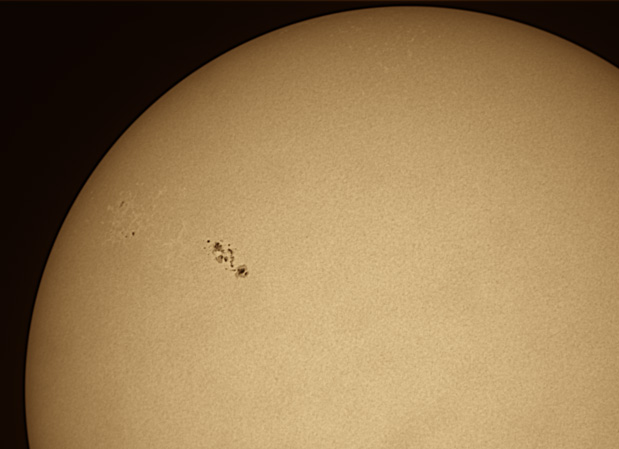
Solar Sunspot 24th April 2011This image was taken with the Mono DMK21 with a UV/IR filter and Baader Solar Continuum filter through the ED80 Pro and I used some cheap Baader Solar Filter paper which was taped to the inside of my scope plastic cover. Even though this solar paper has a scratch in it and a big fingerprint on it, it still manages to produce some great images, at about only 1 inch across. The exposure time is very low in order to get the detail. I then open it up in Photoshop and add some false colour.

My only problem at the moment is that the DMK21 has a lot of ‘dust bunnies’ in it, and I really need to take flats next time to get rid of them. As at the moment I have to get rid of them in Photoshop.

Yuri Gagarin T-Shirt

Yuri Gagarin T-ShirtCelebrate the 50th anniversary of Yuri Gagarin’s first manned space flight with a Gagarin t shirt.

The Vostok Capsule was essentially a 2.5m diameter sphere. The Vostok Rocket that it sat on was fuelled by very powerful but seriously noxious propellants: ammonium perchlorate, aluminium powder, and a polymer of butadiene as well as liquid oxygen and kerosene. A bomb by any other measure. Although Gagarin is on record as saying in his brief report that he had complete faith in Russian engineers and scientists.

Gagarin’s written report of the mission – there are thought to have only been one original and four carbon copies of the report – describes the view he was the first human to see: that of the Earth from space. Since then only about 500 human beings have witnessed similar views. Fewer than you might guess.

In his short report Gagarin remarks on the speed of the switch from light to the complete shade of the earth and the switch back again as well as the extraordinary detail of the shadows of clouds and the the geological features of the ground he was passing over. Stunning and momentous stuff for everyone at the time.

Perhaps more incredible is that fact that eight short years later Neil Armstrong stepped onto the Moon. A demonstration of the power of competition.

Celebrate a life changing event and a brave human being wear a Yuri Gagarin and Vostok Rocket or Capsule t shirt.

Buy your Space T-Shirts here

Ian King Advanced Imaging Day

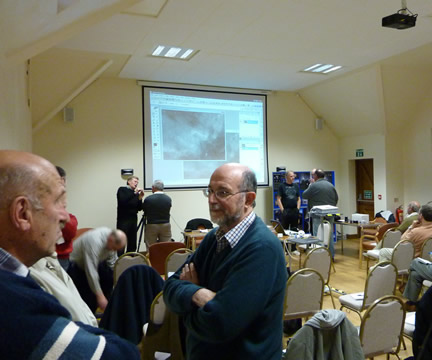
On Saturday 13th November I headed on over to a small village outside of Rugby to attend an Advanced CCD Imaging Course run by Ian King. I did not know what to expect when it came to the venue, all I knew was that it was in a village hall. Well usually village halls conjure up visions of a dark, old and very cold hall where the local scout troop meets up. But I was very pleasantly surprised to find a 3 year old village hall with all the latest mod cons.

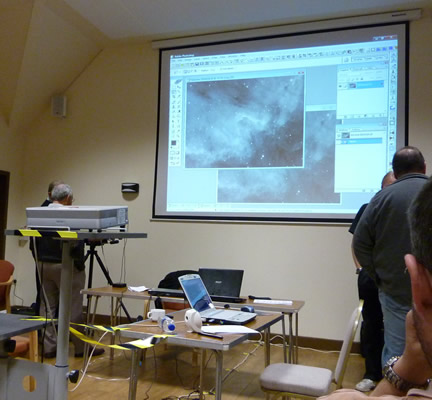
Advanced Imaging DayThe day began at 10.30am with a short introduction about what was happening in the course and then we went straight into learning about monochrome imaging with John Evans.

After a short tea break, John Evans then talked more about how he processed his monochrome images and the equipment that he uses. John was actually buying Hasselblad lenses from eBay and attaching them to QSI CCD cameras in order to take wide field images with Hydrogen Alpha filters.

Ian King then gave a talk on the latest active and alternative optics and how amateur astronomers can use them. Lunch followed the talk – which was included in the price of £35 per head for the day.
Ian then gave another talk on motorized focusers. It covered all the various models that can be purchased and what telescopes the motorized focusers fit. He also gave use a live motorized focuser demonstration by using Focus Max in Maxim DL which was connected to refractor with a motorized focuser which was pointing at an artificial star.

Advanced Astro Imaging DayNik Szymanek then took over and gave us two 1 hour lectures. His first talk included a discussion of RGB and LRGB imaging and processing and how he uses FITS Liberator. Nik took us all the way through his image processing regime, which was very insightful and really opened up for us the kind of ‘black box’ of imaging techniques the top astro photographers in their field use.

Nik’s second talk included more about processing narrowband imaging. This included processing Ha, OIII and SII images, as well as the Hubble palette and Bi-Colour image processing. He also covered the usage of the program Neat Image and other noise control programs and methods in image processing.

John Evans closed the day at 5.30pm with a short talk practices best avoided, how to progress your imaging and he also took questions from the group.

The day ran from 10.30am until 5.30pm, included lunch and all tea and coffees etc. and all for just £35 per head. We thought it was amazingly good value as we both learnt so much during the day about image processing.

Ian King runs these CCD imaging courses every now and again, and it is worth checking his website for more information. He also runs a beginners imaging day, and that is something I have now also booked.

Hidden Treasures Book Review

Hidden Treasures BookHidden Treasures is a big, heavy, nearly 600 page book which includes an original selection of 109 deep-sky objects. None of the objects are included in either the Messier or Caldwell catalogues. Together with this all the objects are supposed to be visible with a 4” telescope under dark skies.

The Hidden Treasures book is one of three books by Cambridge University Press in the Deep-Sky companion’s series. The others are called The Messier Objects and The Caldwell Objects. With the Hidden Treasure book being so good it seems definitely worth buying the other books as well.

Each of the 109 hidden deep-sky treasures is clearly labelled, with some good introductory text, photographs of the object, sky maps and sometimes drawings.

There are several appendices at the back of the book, the first one is about Caroline Herschel and it takes you through some of her astronomical findings. The other appendices provide you with basic data in a table form of the 109 objects, there are also 25 additional hidden treasures to keep you going once you get through the whole book.

It’s really worth taking your time going through each deep-sky object in this book and discovering some new sites to behold when you are out on an observing session. Overall this is a great book, as I love it when objects are clearly labelled and you can jump around the book easily. It’s also nice to just have a few pages per object and so you don’t get bogged down in lots of details. I look forward to reviewing the other books in the series.

Hidden Treasures is available at Waterstones