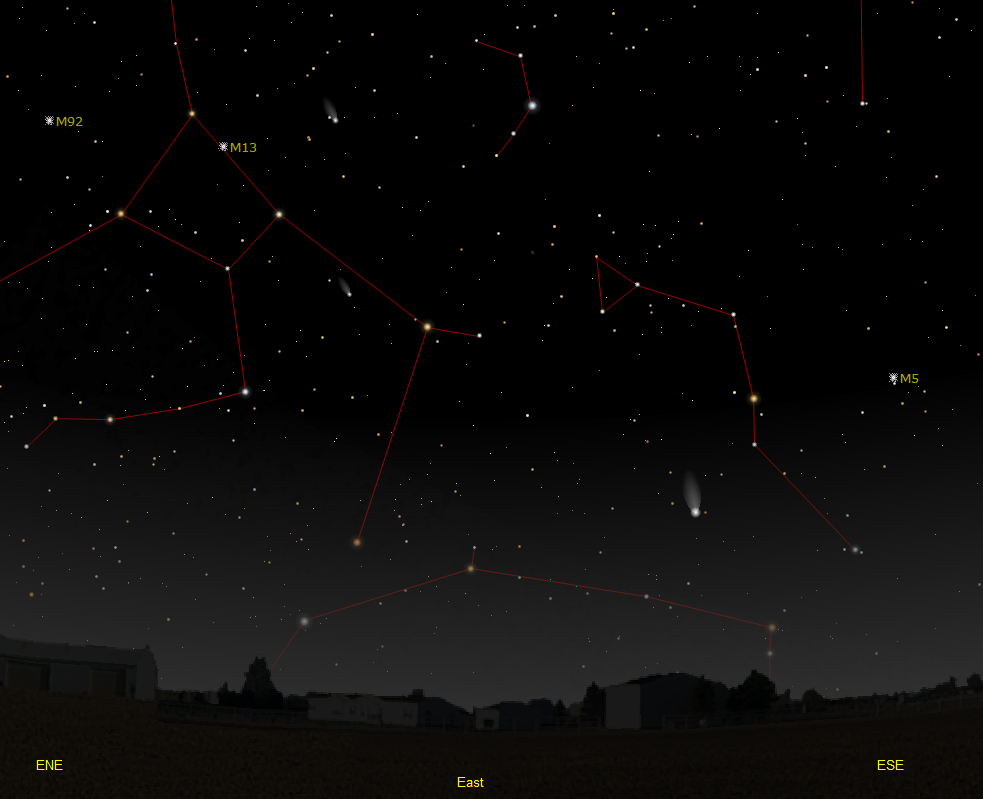
Comet ISON December 2013

(Starting from the bottom) Comet ISON, Panstarrs and Lovejoy (at the top)

Map for 6am Tuesday 10th December 2013

Comet ISON

Moon using an OIII filter on an 80mm

Moon 14052013

This was taken on 14th November 2013. I took it using my Altair Astro triplet 80mm refractor with an Atik 314L+ camera through an Astronomik OIII filter.

I took 20 frames of 1/1000th of a second (the lowest exposure the Atik 314L+ will do). I then stacked it in Maxim DL. I did not remove any darks or take any flats. I then took it into Photoshop and sharpened it and then used a high pass filter on it to sharpen it a bit more.

Not my best lunar image, you can tell the difference between doing this image on a 80mm refractor compared to an image I took using a 120mm refractor. The 120mm just gives you more contrast, light and generally a better image. You can see the 120mm moon image here: https://www.astronomylog.co.uk/2011/09/15/harvest-full-moon/

But if you want really sharp lunar images then a webcam type camera is a better idea, where you can take up to hundreds of frames a second and just take the best frames and stack those all automatically in programs like Registax. Here is an image where I did just that and created a mosaic: https://www.astronomylog.co.uk/2013/03/20/moon-mosaic-with-altair-astro-8-gso-rc/

Control your Observatory PC from your iPhone

Since I wrote the post on controlling your observatory PC remotely (and I had the letter about this published in Astronomy Now).

I have now discovered that you can now control your Windows based observatory PC from your iPhone, iPad or Android device – whether it’s a phone or a tablet device.

Why and How can I do it? Well you can do it as Microsoft have released a Remote Desktop app.

Just make sure your observatory PC is running a Pro, Business or Ultimate version of Windows XP, Vista, 7 or 8.

I have tried the app out on my Nexus 7″ Android tablet, and it works really well, even though the PC desktop does look quite small on a 7″ tablet. I think controlling your PC via a smartphone sized screen would be a bit too small.

You can download the apps on Google Play and from Apple AppStore. Search for ‘Windows Remote Desktop App’

Have a play and see what you think. Tell us how you get on.

Guiding in Maxim DL with a Finderscope Guider

At last my guiding seems to be working, after using a finder guider for a couple of years with mixed results, I think I have it cracked.

I originally used to expose my QHY5 camera on my Skywatcher finderscope every 2 seconds for guiding, and have aggressiveness setting of 4-5. I also used to use my finderguider un-binned with a calibration time of 25 seconds.

This is now my Maxim DL autoguiding set-up:

2x Binned QHY5 camera
5 second exposures
Aggressiveness of 6 and 6.5
Calibration Time: 40 seconds
Waiting time between frames: 65 seconds

These are the settings when imaging through my Altair Astro 80mm Triplet at f4.8 at 3.46 arc seconds per pixel. These settings may change when I image with my 8″ RC scope.

Lessons from the Masters Book

Just received a copy of the ‘Lessons from the Masters’ book by Springer today. I was looking forward to reading this book, and I have just read the Damian Peach chapter about imaging planets and the moon.

I shall be reading it cover to cover, as there is a lot of detailed content in the book, mainly about processing deep sky images in Photoshop. This is an area I definitely need to work on.

A previous book on astronomy Photoshop processing I worked all the way through was ‘Photoshop Astronomy’ by Scott Ireland. It will be fun finding out how these books differ.

Look out for a book review of ‘Lessons from the Masters’ soon.

Purchase your copy from Amazon now.

Maplin Telescopes

Maplin our favourite high street gadget and electronics retailer have just started to sell telescopes.

Maplin currently have a range of Danubia and Celestron reflector and refracting telescopes. The new range starts from £49 up to over £500 for the Danubia 200mm on an EQ5 mount.

They even have a nice looking brass pocket telescope as well for just over £50.

All the Maplin telescopes are available from Maplin and there is free delivery on all of them.

For more information visit the telescope page at Maplin: www.maplin.co.uk/c/gadgets-toys-and-hobbies/optical/telescopes?C=AffilWin19788

Get Your Face in Space

Fancy getting your face in space on the Big Space Balloon? If so, visit https://www.bigspaceballoon.co.uk/

SPA Convention 2013

Don’t forget to book your tickets for the Sir Patrick Moore lecture at the Free SPA Convention at the Cambridge Astronomy Association on 12th October 2013. Visit the SPA website for more details.

Cambridge Photographic Star Atlas Book Review

The Cambridge Photographic Star Atlas by Axel Mellinger
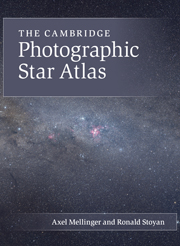
Photographic Star AtlasThe Cambridge Photographic Star Atlas is a large coffee table sized book which contains double page spreads, one side is a star map and the other side is a matching real image of the night sky.

The sky maps show double stars, variable stars, open clusters, galactic and planetary nebulae, globular clusters and galaxies. There are 82 large scale charts with a scale of 1 degree per cm. This means the book contains over 1500 deep-sky objects and 2500 stars.

The beginning of the book shows you how the author processed the night sky images. Axel Mellinger actually visited three dark sky sights, Texas, Michigan and South Africa in order to take the images. He created his own photographic equipment to take his images and ended up with 70 gigabytes of data. It was then semi-automated script-controlled processing that compiled and created the images.

The Photographic Star Atlas is a great book as a visual aid, as you can really see where these deep sky objects, such as the Messier objects really are in the sky, even if you live under light polluted skies.

It’s strange to actually see the photographic star maps as they were taken under very dark skies, and they look nothing like the night sky above me. But I did find it interesting to actually be able to see the deep sky objects in the book, but not in the sky. The star maps are so detailed I actually found it hard to make out the main constellation stars.

The Cambridge Photographic Star Atlas is available at Waterstones