At the beginning of the evening of the 12th August, I thought we we’re going to have cloudy skies as at around 9pm the heavens opened and it was raining heavily, but at around 11pm when I looked out the sky was crystal clear.
I managed to stay up until 00:30am and then I ventured outside, I stayed out until about 2am, but I must say I was slightly dissapointed as I thought there would be lots of meteors every couple of minutes, well enough to allow me to put my SLR onto bulb and run it for 30 seconds a time and hopefully catch a meteor on film, but alas this did not happen.
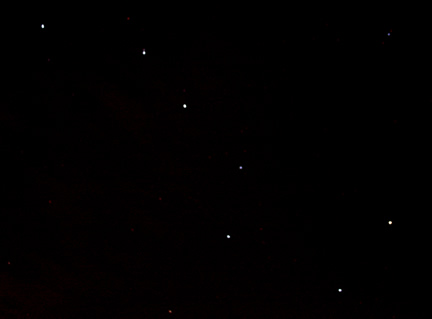
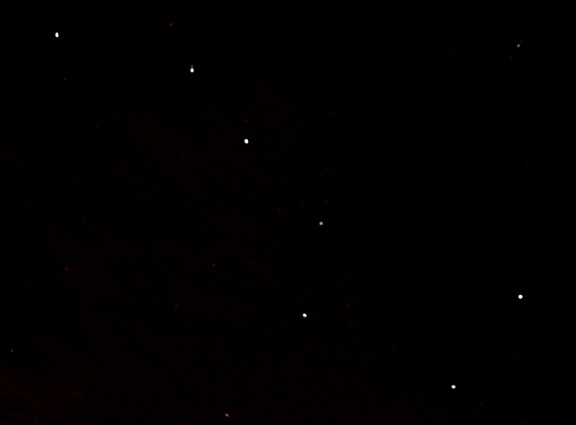
I eventually think in about 90mins I spotted about 12 meteors. It was nice to stay up late and watch Mars and the Pleiades rise over the horizon and I managed to take a picture of this below:
Pleiades at the top of the image, with Mars at the bottom, shown in between my plum tree in my garden.
After getting up today at 8.30am I noticed the postman had delivered my BBC “The Cosmos” posters from the Open University together with a OU magazine. The posters are ok, nothing amazing, there is a nice photo of the moon landing on one of them.
Saw Adam Hart-Davis discussing his new series entitled The Cosmos on BBC Breakfast TV this morning, from the clips it looks really good and a definite must watch for us astronomers.
The series spans five weeks.
First Episode of The Cosmos – Tue 7 Aug, 7:30 pm – 8:00 pm
Life in the Cosmos
Are we alone? In this edition of the cosmos-exploring series, Adam Hart-Davis joins alien hunters at the huge new telescope in California dedicated to receiving the first message from intelligent beings. He meets Frank Drake, pioneer of the search for extraterrestrials, who has calculated just how many aliens might be out there. And he reveals why microbes from Devon are being sent into space to find out if life could once have survived an interplanetary trip.
Also, Janet Sumner investigates a new way to detect life on Mars, using a probe made with living material from Earth. Dr Doug Vakoch of the Interstellar Messaging Composition Group who is working out how we should reply to a message from space. And Adam asks: what if the aliens are listening to us? He finds out how far into the cosmos our ancient broadcasts have travelled.
The Planetary System ( ISBN 080538734X ) gives you a complete overview of the solar system.It gives you a great introduction to watching the sky together with the theory behind orbits, eclipses and the history of major researchers of astronomy.
Each chapter in turn in The Planetary System then discusses each planet in turn and other major sky items, such as satellites, asteroids and meteorites.
Within each chapter in The Planetary System is what you would see when looking at the object.Seasonal cycles of the planets are discussed, together with the topography and geologic features of the surfaces of the planets. Craters and surface views are also included as are intricate details about the planets atmosphere.
The end of every chapter includes a summary with key terms learnt.It also includes review questions, quantitative exercises and additional reading.
The Planetary System is quite a large book which contains a lot of information and some great photos and illustrations in a mixture of black and white and colour.
The Planetary System includes a lot of theory and some intricate science and formulae.
This may be a little advanced for a lot of us astronomers, but the book does give you specific insights into a lot of information about our solar system and our solar systems planets.If you want to learn a lot more about our solar system and the planets then The Planetary System is a great book.
The Planetary System also comes with Voyager SkyGazer College Edition software on CDROM.
I am looking forward to the next “The Sky at Night” episode, which I am told by Windows Media Centre will be broadcast on the 4th August 2007 at 20:30 on BBC Four
1st Broadcast: Saturday 4th August 2007 at 20:30 on BBC4
2nd Broadcast: Monday 6th August 2007 at 01:10 on BBC1
3rd Broadcast: Saturday 11th August 2007 at 12:00 on BBC2
The sun never rises for astronomers using Robonet. Patrick Moore investigates Robonet, the robotic network of telescopes which spans the globe and links the cosmos directly to a laptop. In their world of permanent darkness these telescopes can react immediately to bangs in the night’ – the exotic cosmic phenomena such as gamma ray bursts which are over in the blink of an astronomical eye.
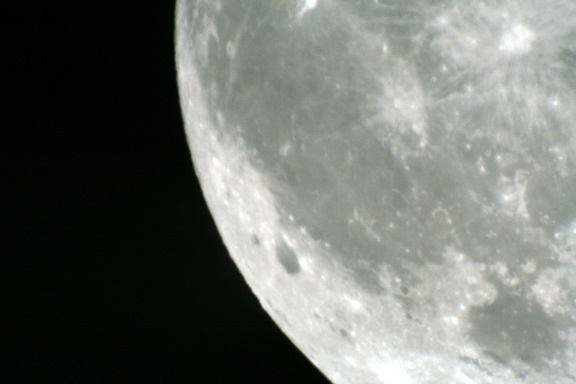
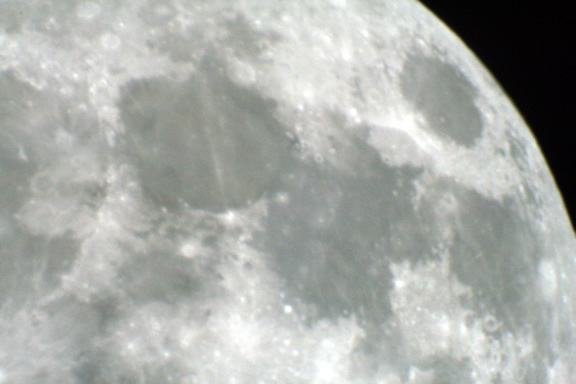
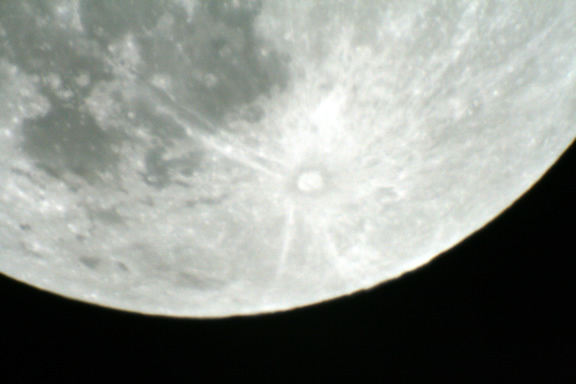
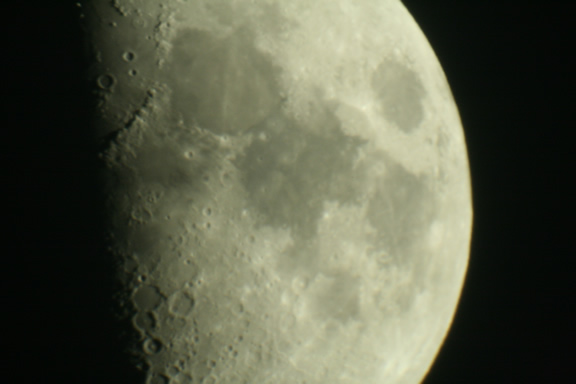
What a bright night sky, due to the full moon, which was incredibly bright tonight. The brightness of the moon literally blinded me when looking through either the viewfinder or an eyepiece. The brightness also knocked out a lot of the night sky and a number of stars became invisible.
This brought it’s own new challenges when trying to complete some photography, the webcam needed to be set to a low brightness and the digital camera required lots of experimentation to get some pictures of the moon.
Most of the pictures were taken at ISO100 at 1/25 second exposures. I then brightened them with the auto levels in Fireworks.
I also finally managed to located the Andromeda Galaxy, which through my telescope looked like a small hazy disc, but I was pleased to located it at last.
I also manually found the Ring Nebula again, it did look quite small, too small infact for me to get any photographic evidence, as I just could not get focus on either the ring nebula or the andromeda galaxy. I may try again at a later date or when I have a bigger telescope.
I stayed out until 1.30am, and at that time the temperature was about 8 degrees, and it felt cold for summer! Anyway at that time I checked Starry Night Pro and discovered that Mars was now starting to appear on the horizon. Amazing my first view of Mars, it was definitely orange coloured if not a little small in my telescope. Hopefully we will be seeing a lot more of Mars in the coming months, at an earlier time of the day, enabling me to get some photographs.
For a long time Philips web cams have been the defacto standard of web cams to use for CCD imaging of astronomy objects. Many people own or have used a Philips ToUcam web cam, the latest version of this is the Philips SPC900NC web cam.
I originally already owned a Logitech Quickcam Pro4000 so I decided to start to use this webcam and purchased a web cam adaptor for it, luckily this webcam adaptor also fits the SPC900. The Adaptor I purchased was a AC414n nose-piece. I also purchased an IR filter.
After reading a lot of information about the Philips web cam and because it was only around £45, I decided to purchase one, and try it out.
I was very happy with the Quickcam Pro4000 images of the moon, but curiosity got to me, how much better could the Philips SPC900 really be? The Logitech Quickcam was not so good when used with a barlow or an imageMate when trying to look at far off planets, so I was hoping that the Philips web cam would be a lot better.
There are modifications you can make to the webcams, but I have not modded either of them.
Philips SPC9000NC
The Philips was used together with its bundled VLounge software, and this software did introduce me to a lot of available settings such as gamma, saturation, brightness, shutter speed, contrast etc which just were not available with the Quickcam.
The Philips does seem to be a pain when it comes to starting up sometimes on the laptop, sometimes I find myself pulling out the USB cable and re-inserting it or closing down VLounge and re-starting it.
I also find that the Frames Per Second (fps) setting in VLounge seems to change on it’s own, back to 5fps, but I usually try to image at a higher fps.
The bundled software with the Quickcam is very similar to VLounge, but there are less settings to tweak with this software and web cam, only
I never have any problems in plugging in the Quickcam into the laptop, I just plug it in insert it into the eyepiece setion of the telescope and away I go, completely trouble free.
The two videos below have each been taken with the Philips and the Quickcam, to try and demonstrate the differences with the web cams. Both videos were taken within about 10minutes of each other, on basic web cam settings.
I shall try and add extra videos and stacked images from both web cams of other items in the solar system at a later date.
Philips Moon Video
This video shows a dark patch on the right, which is a house roof coming into view as the moon dipped beneath it, but the overall video is a lot darker, but I think the resolution is a lot better.
Quickcam Moon Video
I think you can see from this video that the moon was quite low, hence the astmospheric ripples, like the moon is underwater. But I was happy with the focus, detail and the brightness of the video from the Quickcam.
Overall
I think the Philips SPC900 is definitely the better webcam when it comes to functionality, there are more settings to play with and you can get better resolution and record what appears to be a darker output of the sky with it.
If you already have a Logitech Quickcam Pro 3000, 4000 or 5000 then use it and have a go. If you don’t have a webcam at all then buy the Philips SPC900, I purchased mine in the UK from Pixmania (whose stock comes from France) or they are available at time of writing from Amazon.
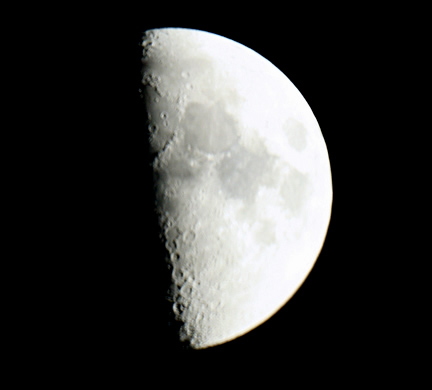
I could not believe it another clear night. I decided to out a bit earlier tonight whilst it was still light and set up. The moon was out and a nice site in my garden. I decided to try and take some video of the moon using my Philips SPC900 to try and compare the output with the Logitech Quickcam Pro4000. It was also a good time to try out my Canon SLR on the moon.
The only problem going out so early with the laptop in tow was that lots of mosquitos were attracted by the light and the taste of me! So I darted back inside to cover myself in insect repellant, which seemed to not do too much, it wasn’t until the laptop was turned off and it got darker that they seemed to leave me alone.
The video of the moons surface using the SPC900 was not great as the VLounge software kept setting itself to 15fps, which I don’t think is high enough, as the video did seem to judder occasionaly, unless the 15fps was too high and the laptop could not handle the recording, but I am sure I set the Quickcam to video at a faster frames per second than 15 and that was ok. So I only have stills to show you.
Anyway, below are some shots of the moon I managed to get with the DSLR.
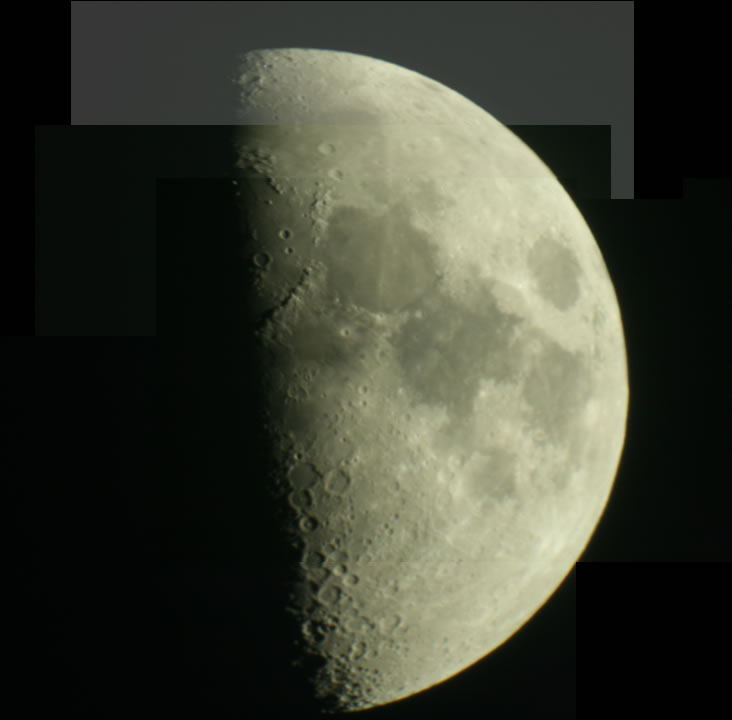
There was a lot of trial and error with taking the photos, most of the time I used a 2x barlow on the end of the camera adaptor or put an eyepiece inside the camera adaptor. Where the moon is shown whole – these were taken with no magnification at all (prime focus) just with the camera attached to the telescope.
I have also made up a collage of shots below, to make one large shot, click on the image below to see the full shot.
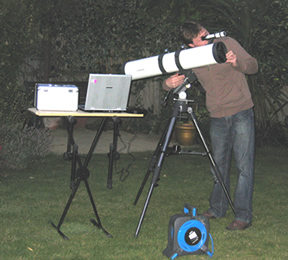
My wife also sneaked out and took a photo of me and my set up.
Astronomy for the utterly confused (ISBN 0071471588) reminds me of the dummies guide series, as the front cover is black and yellow, plus the content is similar to what you would expect in a dummies guide.
The content of Astronomy for the utterly confused is very good and gives a very good overall coverage of the basics of astronomy.
The book only contains black and white content though, including images, which is a bit of a shame as sometimes the book calls you to notice the difference in colours in images, which you just can’t see, but I suppose this does keep the cost of the book down.
At the end of every chapter is a section of questions about the chapter you have just read, luckily the answers are also included.
Astronomy for the utterly confused contains 18 chapters, which covers a wide range of astronomy topics including key concepts and basic laws, solar nebula, planets, the suns role in our solar system, astrophysics basics, stars and galaxies, dark matter and the future of the universe.
There are some nice chapters on the early astronomers in history such as Johannes Kepler who discovered the orbit of Mars was an ellipse and not a circle, as well as Galileo Galilei who was the first scientist to use mathematics and perform experiments in a manner similar to modern scientists.
There are also some nice sections in Astronomy for the utterly confused on satellites and meteors.
Overall Astronomy for the utterly confused is a good introductory book on the general topic of astronomy, this is a great book to read for a general introduction, its just a shame the pictures are not in colour.Astronomy for the utterly confused would be really good for student projects or for a good overall read on astronomy for beginners.
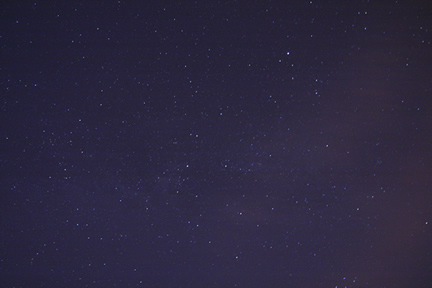
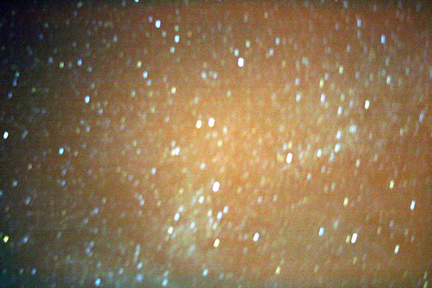
The second clear night in a row – was this possible? Tonight (19th July 2007) I decided not to take out the telescope but just take out my new Canon 400D and my remote control and tripod.
I had ideas of trying out the Bulb setting which everyone talks about and trying out some photography from a static tripod using the remote control that I purchase from eBay – actually the tripod was from eBay as well!
Anyway, I put my camera onto manual and then the bulb setting and this time remembered to put the lens onto MF – (manual focus). I then directed my camera at the heavens and took some photos at varying exposure times.
I kept darting back into the house to view the photos on my laptop under red light provided by my red torch to see how well I was doing.
The problem I had looking back was that I did not keep an exact record of what exposure times I was using etc. I must remember to takes notes next time on the settings used and exposures used etc.
Anyway below are the best three photographs I managed to make. I did play with the photos a little in Fireworks, but it appears that most people use PhotoShop instead, so I need to really look at using this, especially because it has a lot of extra plugins available, including astronomy plugins.

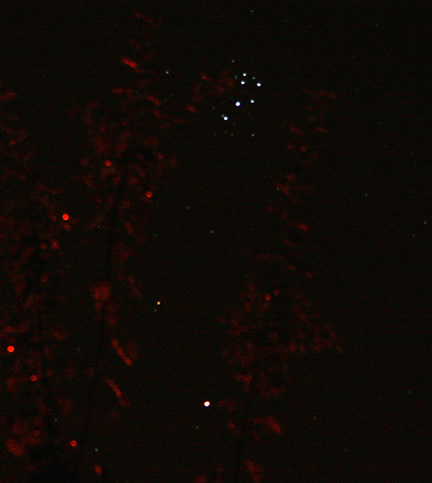 Pleiades at the top of the image, with Mars at the bottom, shown in between my plum tree in my garden.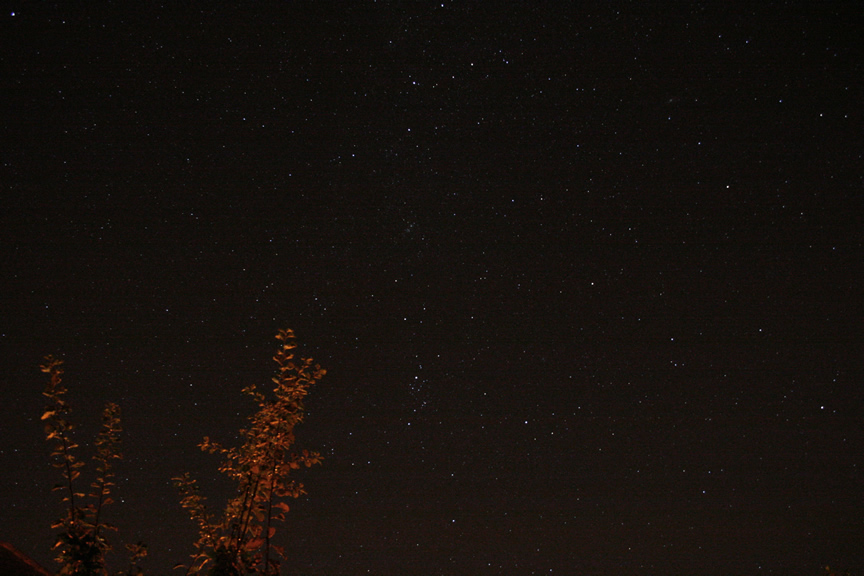
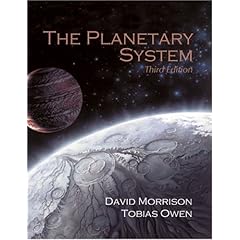 The Planetary System ( ISBN 080538734X ) gives you a complete overview of the solar system.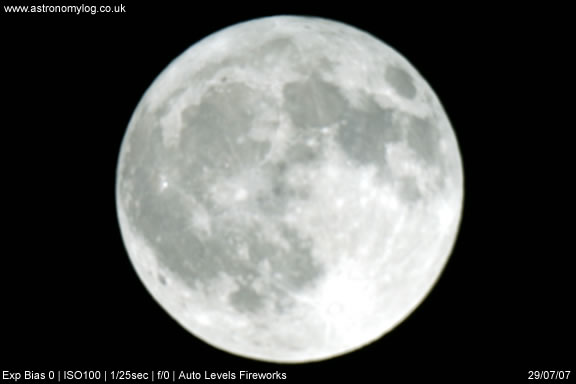
 Astronomy for the utterly confused (ISBN 0071471588) reminds me of the dummies guide series, as the front cover is black and yellow, plus the content is similar to what you would expect in a dummies guide.