Delphinus, Equuleus and Sagitta Constellations

What a great night last night, a really clear night with the odd small cloud overhead. I decided to look for the Dumbbell Nebula M27 last night, and I had a rough idea where it was, but I managed to find it after about two minutes, sometimes the night sky seems very small, sometimes massive!

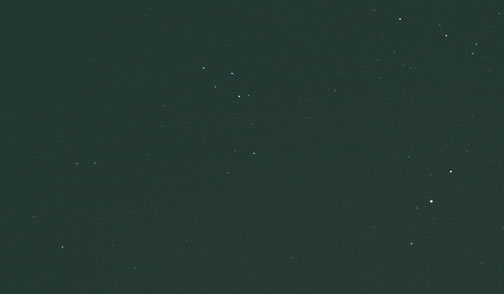
Well anyway, I managed to carry on taking pictures of the constellations and I managed to get Delphinus, Equuleus and Sagitta in this shot below:

Delphinus, Equuleus and Sagitta Constellations

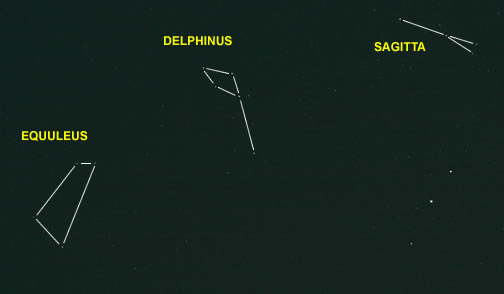
I have drawn the outlines of Delphinus, Equuleus and Sagitta over the previous photo in the image below:

Delphinus, Equuleus and Sagitta Outline Photo

Subscribed to Sky at Night Magazine

I posted last week about how you could get a free Sir Patrick Moore autobiography with 6 months of Sky at Night Magazine (see the post here), well today I took the plunge myself and ordered the magazine.

I went for the 6 month subscription for £18.95, on direct debit, but this does get me the free book and it allows me to try the magazine for 6 issues and then decide if I like it, if not then I shall just cancel my Sky at Night magazine subscription direct debit online and then perhaps try Astronomy Now for a year.

The free Sir Patrick Moore autobiography offer is still available with Magazine Group

Perseus, Triangulum and Aries Asterisms

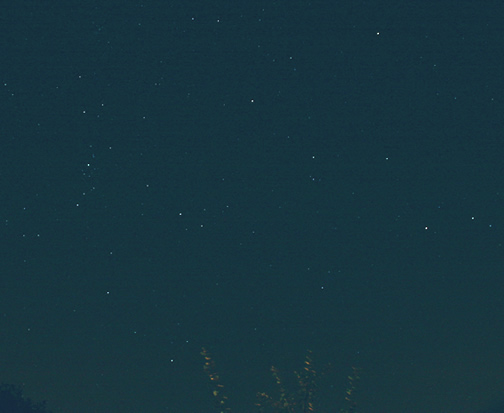
Following along from my mapping of all the asterisms in the sky by just using my Canon DLSR with an 18-55mm lens, I have now taken Perseus and learnt how the asterism is constructed via its stars, I also managed to just get Triangulum and Aries in the photo as well.

Perseus Asterism

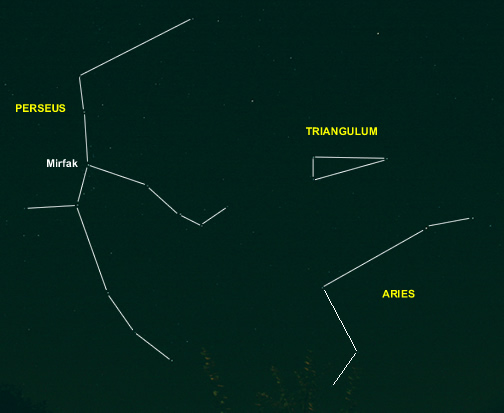
Now the picutre below has the outline of the asterisms added:

Perseus Asterism with Outlines

Pathways to Astronomy Book Review

Pathways to AstronomyPathways to Astronomy (ISBN 0072922087). The beginning of the book contains some really nice pages of various parts of the night sky constellations in full colour and what interesting sights to look out for in the sky, including M101, M81, M82, M31, M45, M57, M16 and a lot more.

Pathways to Astronomy is split into five parts, these are the cosmic landscape, probing light and matter, the solar system, stars and stellar evolution and finally galaxies and the universe.

The cosmic landscape part covers the basics of astronomy including the geometry of the moon, sun and earth as well as lunar cycles and an introduction to astronomical formulae and functions.

Part two covers Newton’s law, orbital velocities, conservation laws, the electromagnetic spectrum, and Doppler shift, focusing light and how to observe space.

Part three covers the solar system including our solar systems planets including asteroids, comets and about impacts on earth.

Path four covers the stars and stellar evolution including giant and variable stars, exploding white dwarfs, neutron stars, black holes, star clusters and about the sun.

Part five covers galaxies and the universe including details on the gas and dust in the Milky Way and the mass and motions in the Milky Way. Dark matter, cosmology and astrobiology and the search for life elsewhere are also included.

Starry Night Pro on CD accompanied my copy of Pathways to Astronomy which is an excellent piece of astronomy software.

The appendices include a wide range of tables and information about astronomy formulae and tables giving you information on stars, satellites, the nearest stars and more. Also included is the table of periodic elements. The rear of the book also includes a glossary of astronomical terms together with a fold out map of the constellations in the northern and southern hemisphere.

Pathways to Astronomy are a very large and concise book on astronomy. At the end of each chapter there are key terms, questions for review, problems to solve and a set of questions to test your self.

Pathways to Astronomy contains some amazing full colour photographs of the solar system together with some really clear and concise drawings which help to explain certain topics. If you are after a really concise book on astronomy then Pathways to Astronomy is an excellent book and an excellent study guide book.

Pathways to Astronomy is available at Amazon

BBC Sky at Night Repeated on BBC iPlayer

After using the BBC iPlayer for about two weeks now, I am finding it pretty good. So far I have downloaded The Cosmos which I forgot to record as well as a BBC Drama.

I managed to miss the first showing of The Sky at Night – Black Holes and Black Magic, now I know there are repeats of The Sky at Night during the week which is good (although The Cosmos is not repeated during the week), but I can’t wait for the repeat, so tonight I downloaded The Sky at Night onto my laptop to watch tomorrow.

The BBC iPlayer is a good idea if you have missed a show on TV and it’s not repeated, the only problem is that you can only download programmes transmitted in the past 7 days, I think they could do with setting it to 14 days or longer.

Free Patrick Moore Autobiography

Sky at Night MagazineFree Patrick Moore AutobiographyJust to let you all know I managed to find a subscription to BBC Sky at Night Magazine for £18.98 for 6 months, or £38 for 1 year + FREE Patrick Moore Autobiography.

The normal cover price of BBC Sky at Night is £4.25, but this offer makes it just £3.16 an issue plus you get a free book.

The offer is with Magazine Group and this offer is limited! Find this offer here.

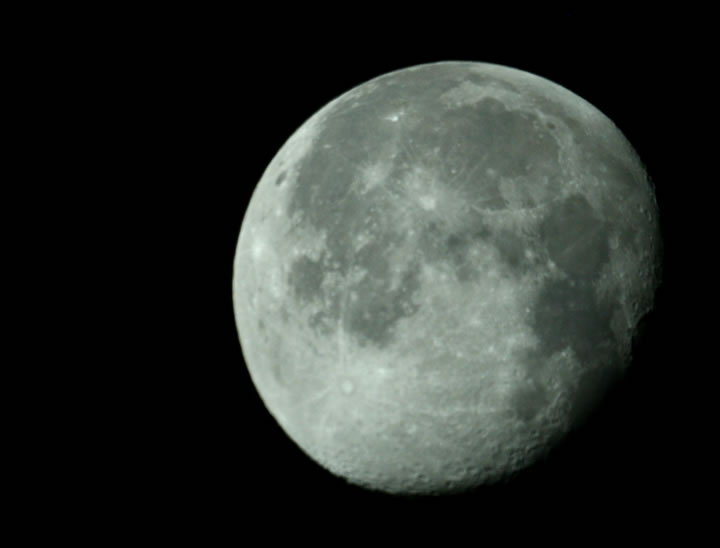
Waning Gibbous Moon

This is an image of the moon I took on 31st August 2007. I took this through my telescope on my Canon 400D by the prime focus method, which is adding the camera directly to the telescope and I did not use any extra eyepieces, just the natural magnification of the telescope.

Waning Gibbous Moon

Cygnus and Lyra Asterisms

For the first night out in a long time, it must be about three weeks since the perseid meteor shower I managed to have a clear night, and get some photos.

It’s still really good fun to learn the various asterisms, and I try to find and learn new ones every time I go out.

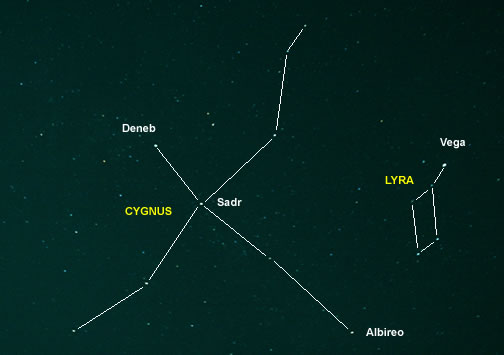
This time I concentrated on Cygnus which is a cross type asterism which lives along the line of the milky way, close by in the photo below is also Lyra which I have visited many times with my telescope to see the Ring Nebula.

Cygnus and Lyra Asterisms

The following photograph has been amended to show clearly the outlines of Cygnus and Lyra, it also points out the stars – Deneb, Sadr, Albireo and Vega.

Cygnus and Lyra Asterism Outline

UK to Track Asteroid Threat

The 300m-wide (984ft) rock, known as Apophis, will fly past Earth in April 2029 at a distance that is closer than many communications satellites.

The British design calls for a small, remote-sensing spacecraft, dubbed Apex, which could rendezvous with Apophis in January 2014.

It would spend three years tracking the rock, sending data back to Earth about the object’s size, spin, composition and temperature.

From this information, orbit modelling would enable a more accurate prediction of the risk of any future collision.

Apophis caused some consternation in 2004 when initial observations suggested it might hit Earth in 2029.

Further study by ground-based telescopes indicated there was virtually no chance of this happening, and the expectation is that the object will whiz past the Earth at a close but comfortable distance of just under 36,000km (22,370 miles).

Personally I can’t wait to be around to have a look at it in 2029, only 22 years left to wait! I can’t imagine the type of Telescope I may own then!

Attaching RA Motor Drive to MON1 Mount

After owning my Bresser Messier 130N for around two months I decided to invest in an RA Motor Drive for it. This particular RA Drive fits just the 130N and R90 telescope models. Other models of telescope in the Messier range can use another drive system which operates both the RA and Dec Axis.

I decided to buy one as I thought that the Messier RA Drive would make my job of keeping an object centered a lot easier, whether this worked or not can be discussed in another post when I actually review the RA drive, but this post will take you through how to attach your RA Drive to your MON1 telescope mount (as you can tell from the images I did this in the garden on a nice hot summer day).

Unpacking your RA Motor Drive

You should find the following contents in your box, the nice manufacturers even supply an Allen key and screwdriver!

Below you can see the hand controller, battery pack, motor, screwdriver and RA knob etc.
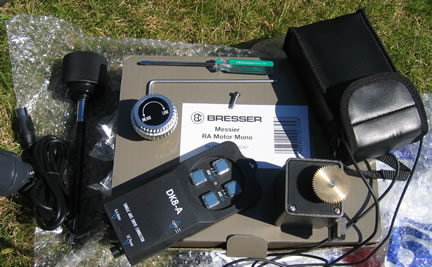
RA Motor Drive MON1 Contents

Attach the Motor

The first thing you need to do is attach the motor part to your MON1 mount.
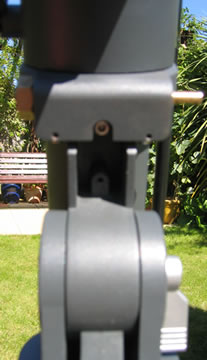
MON1 Mount Hole for RA Drive Motor

You need to first tilt up your telescope mount to reveal a screw hold underneath as shown above, this is where your Allen key screw will go.
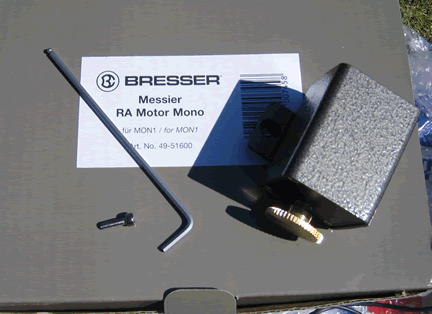
Fitting the RA Motor Drive for MON1 Mounts

Now locate the motor and the Allen key and the screw, and get ready to attach the motor.
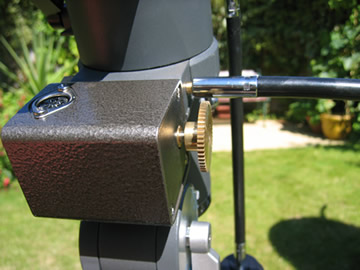
RA Motor Drive Fitted

The image above shows the motor attached by the single screw.

Remove RA Arm

Now remove your RA ‘wobbly’ movement arm, just unscrew the screw on this and remove it, so you are left with your mount looking like the image below:
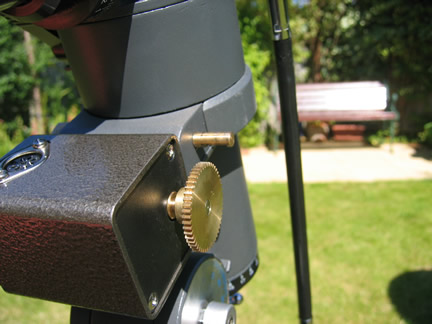
Remove RA Handle

Screw on RA Knob

Now screw onto this the new RA adjustment knob. There are two screws to this so make sure you align it up properly and screw both of them quite tightly using the provided screwdriver. The most important part to this is to make sure you get the teeth of both cogs nicely touching, not so tight so they don’t move but so they can turn each other.
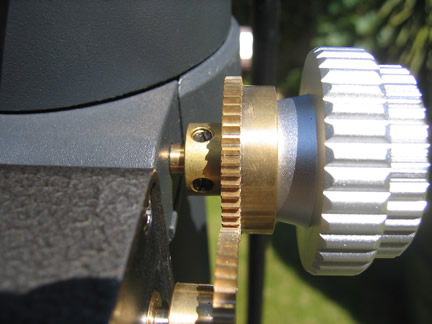
Adding the RA Cog Wheel

Attach Hand Controller

Now attach the hand controller DIN plug to the motor drive, as shown below:
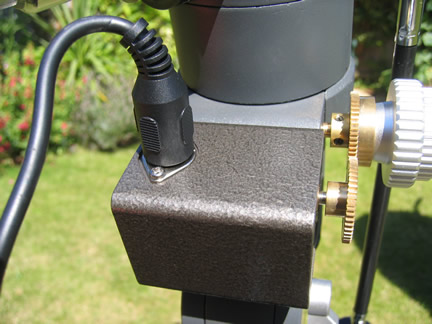
Motor Drive Hand Controller

RA Motor Drive Batteries

Finally you will need 4 x D Batteries to get the RA Drive to work, I purchased mine from Wilkinsons, and only paid about £1.20 for 4, the instruction booklet says you can use an AC adaptor but I would not recommend it.
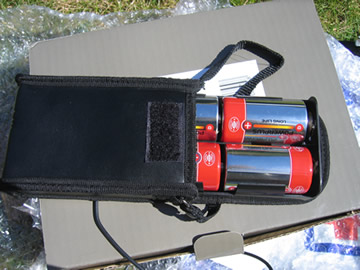
RA Motor Battery Pack

Now plug the mains lead into the hand controller and you are ready to go!

RA Motor Drive Hints and Tips

I would advise removing two of the batteries when you are not using the RA drive, as the batteries could still use a little power.

Always remember to ‘Unlock’ the RA handle when you want to manually move the telescope on its RA axis or you could damage the motor drive. It’s also important to check that the same RA handle is completely ‘Locked’ when you want to use the RA Motor Drive as sometimes it can come loose and the telescope can stop moving.

RA Motor Drive Instruction Manual

There is a very good instruction manual included in the box, which is shown below and it should tell you everything you need to know.
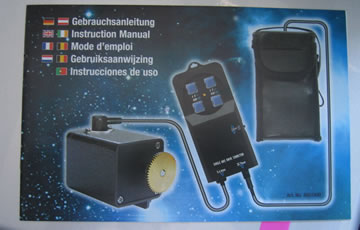

RA Motor Drive Manual Cover