Astrofest vs International Astronomy Show (IAS)

We have visited AstroFest in London for a number of years, but this year we decided to visit the International Astronomy Show (IAS) near Coventry. The IAS celebrated its fifth year in 2016 so we had to see what the IAS was all about and if we are missing out. Should the IAS takeover from Astrofest?

Location

Astrofest for me is in a good location in Knightsbridge, London. I don’t live in London, I live near Cambridge, but I find it easy to get down to North London then jump on the tube across London. I would never dream of attending Astrofest and travelling to London on a Friday so we have always attended on the Saturday.

IAS is outside Coventry and for us about a 200 mile return journey – around 2 hours with no traffic. You approach Stoneleigh Park and follow the signs and you actually park inside one of the covered halls. It’s a short walk to the entrance.

Exhibition Halls

Astrofest exhibitors are split over three floors, so you really never get a feeling of how many exhibitors there really are. The problem with the three floors is that the stands do seem crammed in and it’s difficult to move around them sometimes and actually see what is being sold – especially on the Saturday.

The IAS exhibition hall is large, open and spacious, nowhere near as crammed as Astrofest. It’s a real breath of fresh air. We attended IAS on the Friday, so it may be busier on the Saturday. But on our visit on the Friday, it allowed us to get close to the equipment and have a good chat to all stall holders. It did seem like there were more exhibitors at IAS than Astrofest, that could be because at IAS all stands are on one level. There were certainly some stall holders we had never seen at Astrofest before.

Lecture Halls

The lecture hall at Astrofest is very large and well attended – sometimes sold out. The reason may be because at Astrofest you choose your session AM or PM and the day and then you get to see all those lectures in that session compared to IAS where you pay for each one you want to attend.

Catering

The catering at Astrofest has been in decline over the years and there are only a few seats. At Astrofest you used to be able to get toasted sandwiches, tea, coffee and the odd drink, but there does seem to be less choice there now. I suppose Kensington High Street is on your doorstep so you could step out and find something close by.

At the IAS the restaurant area is large with lots of seating. There is a coffee bar and a separate fridge containing sandwiches and rolls. There is even a hot meal option, including breakfast and lunch. We paid £6 for a large fishcake, mushy peas and chips. Although you could choose anything and mix it up and just pay £6 per plate. The tills were even contactless!

Cost

Ignoring the cost of travel (as that varies for everyone) the price of entrance and two talks at IAS is just slightly more than entrance to Astrofest and an afternoon of talks (usually 4 talks).

Conclusions

Overall it’s a difficult call to say which one is better. The problem may be because Astrofest feels like home as we’ve been so many times. IAS does seem a long way to drive for us, but I do like the extra space in the exhibition hall at IAS, it is horrible being crammed in at Astrofest. The lecture halls are nicer at Astrofest and you get more talks for your money. The catering is miles better at IAS, but you don’t really have any other choice at IAS like you do being in the centre of London. At the moment I’m torn between the two, but I may be slightly leaning towards IAS. What do you think?
Canon 200mm 2.8 lens for widefield imaging

I have been trying out widefield imaging with the Geoptik adaptor and my Atik 460 mono camera using a relatively cheap Canon 75-300mm zoom lens. I have found that you need to step down the focal length to a more reasonable f6 or f7 to get some nice round star shapes. But really you want to me imaging at about f4 or f5. This means purchasing a more expensive camera lens like the Canon 200mm f2.8 or Canon 100mm f2.8.

I began looking at the beige Canon zoom lenses. I was interested in the 70-200mm 2.8 lens. Expensive new, but they can go for about £500-£600 used. I had been looking at the second hand market for a while. But what put me off is that I imaged in Ha and OIII at 100mm on my zoom lens and as you have to take apart the imaging train in order to change filters I found it impossible to not move the zoom when doing so.

This meant that the Ha images may have had a different Field of View compared to the OIII images. That’s usually not a problem you have with telescopes which are fixed. So a fixed prime lens did make more sense, plus it may be sharper.

As most of the widefield images I have taken are between 100mm and 200mm. I thought that a 200mm prime lens and a 100mm prime lens would do the trick. So I then started looking at the Canon 200mm f2.8 lens. I was trying to discount it as I had purchased the smaller version of the Telefokus to help me focus and the maximum diameter on those rings are around 78mm. I was worried that the rings would not fit around the barrel of the 200mm lens, but it turns out they do fit.

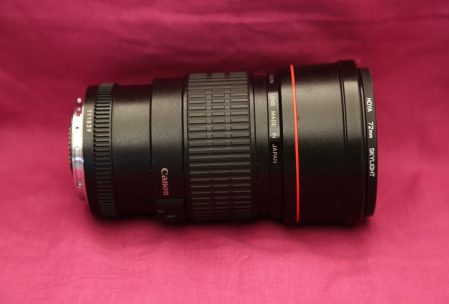
How I know is that I ended up buying a used Mk 1 version of the Canon 200mm prime f2.8 lens. I can’t see much difference between the Mk1 and Mk2, although the Mk1 does have an in-built lens hood.

The Canon 200mm f2.8 lens is a bit heavier – maybe more glass elements and a larger diameter is the reason.

I am yet to give the lens a go yet as it has been cloudy every night for the last week, but I’ll post some feedback and some images once I have used it.

canon 200mm f2-8 lens

Viewing and Imaging the Solar System Book Review

viewing and imaging the solar system

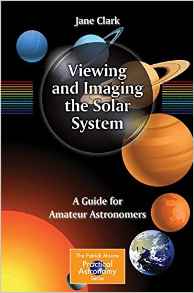
Viewing and Imaging the Solar System from Jane Clark is an easy to read beginners guide to viewing and imaging the Solar system. It explains in some detail the principles of the telescopes and the in’s and out of star maps, which are best to use in the garden on a cold dark night and which are best used indoors. One item I found interesting was the explanation of what to wear and why, which you don’t often see in Astronomy books.

‘Viewing and Imaging the Solar System’ goes on to explain telescope mounts, the different types and the advantages of Altitude – Azimuth such as a Dobsonian and Equatorial Mounts. There’s an explanation of how to carry out alignment of the Equatorial mount using polar scope.

The next chapter titled ‘Telescopes Binoculars and Light’ explains the principles of light. It covers the different types of lenses, convex and concave and it covers Eyepieces, Barlow Lenses, Binoculars and filters. The different types of telescope are described and the advantages of each type. The next chapter introduces the reader to photographing the solar system, explaining the hardware, the importance of focusing using a Hartmann and Bahtinov masks.

Photographing the Moon and planet is explained by outlining the different types of cameras such as a DSLR and Web cams. The pros and cons of each type are discussed as well. Then comes the processing of the images with the help of computer screen shots of software K3CCD and RegiStax. There is a great section on using Dark frames to remove the thermal noise on the CCD chip during processing.

The next few chapters’ deal with what you can realistically expect to see with the naked eye and a camera. The superior planets are covered in detail with the aid of the author images and explanations. Jupiter sections outlines how best to view the four moons through a telescope and observe the moons rotation of the planet with a number of detailed drawings. I will say that some of the accompanying photos were a little dark which made the surface detail hard to see clearly.

Chapter 8 completes the solar system with observing the Sun using different types of solar scope at the different wavelengths of the light. This section included white light, hydrogen alpha and details on solar spectra. The book finishes its tour of the solar system with Asteroids and Comets and observing the solar system from your armchair.

This book is quite strange as it covers a lot of different areas of astronomy. I do feel that this book is very much for the beginner. A beginner will get a lot out of reading this book, but I would prefer books that deal with specific in-depth topics.

The book an interesting read for the beginner but I feel its let down by the authors photographs.

Reviewed by Mick Jenkins

Buy from Amazon UK

Lessons from the Masters Book Review

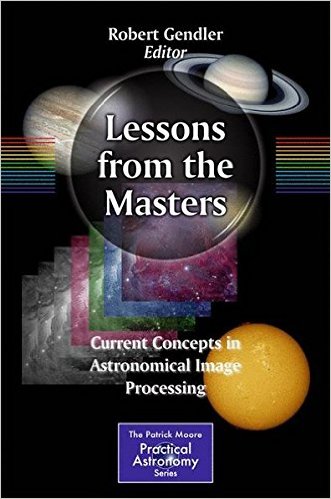
Lessons from the masters bookLessons from the Masters is an astrophotography book from Springer. Each chapter is written by different well known astrophotographers. It is good to have individual chapters, as it makes it nice to pick up the book and just read one chapter at a time.

There really is something for everyone in this book, whether you are into solar imaging, lunar photography, widefield SLR imaging, planetary imaging or deep sky imaging.

It took me a while to read the book cover to cover, but I did begin reading the chapters I found most interesting first. I then seemed to randomly pick chapters one at a time and read them.

I began with Damian Peach’s chapter about planetary imaging. Now I think his images are amazing, and I am sure there is something he does, that he is not telling us. Unfortunately I thought he could have told us some more about what he does exactly when he images. I felt the chapter was a little bit too much of an overview.

‘Lessons from the Masters’ begins with a great chapter on the theory of astronomical imaging which includes lots of equations and graphs discussing signal to noise ratio, full width at half maximum, quantum efficiency, sampling and calibration etc.

Then there are a number of chapters covering different areas of astro imaging from authors that include Tony Hallas, Don Goldman, Ken Crawford, Damian Peach and Robert Gendler.

Lessons from the masters chapters:

  • High Dynamic Range Processing
  • Intensifying Colour
  • Revealing small scale details
  • Bringing out faint large scale structure
  • Narrowband imaging
  • Widefield imaging
  • Noise reduction techniques
  • Deep Sky Imaging workflow
  • High resolution lunar and planetary imaging
  • Secrets to successful earth and sky photography
  • Imaging and processing images of the solar corona
  • Catching sunlight
  • Aesthetics and composition in deep sky imaging
  • Hybrid images: A strategy for optimising impact in astronomical images

It’s nice to see colour images throughout the book. Some of the chapters you can just read through and others are chapters that you will need to sit at your computer and work through in programs like Photoshop.

There are some great tips throughout ‘Lessons from the Masters’, I think everybody will get something out of it. It is nice that ‘Lessons from the Masters’ is a new book (published in 2013), and not an imaging book that is 10 years old. I think your astro imaging will improve after reading this book.

Buy from Amazon UK

Observer’s Guide to Star Clusters Book Review

Observer’s Guide to Star Clusters by Mike Inglis

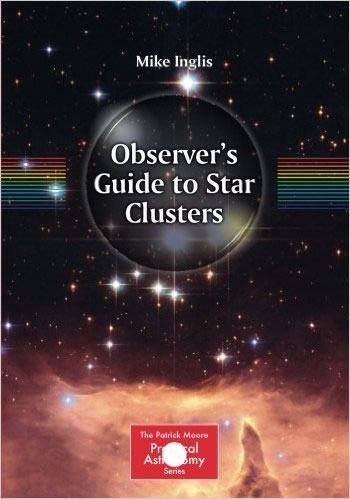
Observers Guide to Star ClustersThis book is part of the Patrick Moore Practical Astronomy Series, and it is a book which is organised by constellation. This is actually a good way to organise a book as it allows you to locate the positions of important star clusters in the 88 constellations from anywhere on Earth.

The constellation maps in the book are in black and white, this may not sound so great, but it does allow you to read the maps by the light of a red LED torch or reading light. The clusters themselves and their names or numbers are printed in bold black, against a ‘greyed-out’ background of stars and constellation figures.

The Observer’s Guide to Star Clusters book begins with an introduction to star clusters, which includes how they star clusters are classified, how to record your observations, a full list of the constellations and which constellations will be on show at certain times of the year.

A typical page of the Observer’s Guide to Star Clusters gives you fast facts about the constellation such as its abbreviation, genitive name, it’s translation e.g. Andromedae means Princess of Ethiopia, its visible latitudes, and it’s culmination date.

Then within that constellation the book lists the star clusters in turn providing the reader with the catalogue name that the star cluster is listed in, RA and Dec co-ordinates, the visual magnitude, the approximate number of stars in the cluster, the concentration class and finally the level of difficulty to finding it. There is then a small description about the cluster by the author.

The index at the rear of the book lists each star cluster by its catalogue name, so for example by its NGC or Messier number.

When I first flicked through the book, I felt a bit let down by the endless lists and black and white constellation map drawings, but I can see how this book will help out the astronomer who wants to locate both easy and hard to find star clusters – a lot of which are NGC numbers. It is very handy to have the book ordered by constellation – that I love, the only thing that could be improved here are the star maps. Overall, the Observer’s Guide to Star Clusters is a useful astronomy title.

Buy Observer’s Guide to Star Clusters from Amazon UK

Lunar Rover Users Manual Book Review

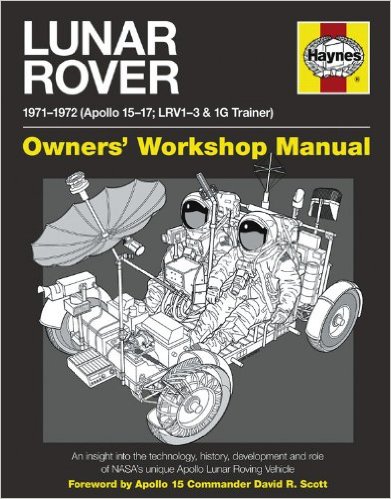
Lunar Rover Workshop ManualThe Haynes Lunar Rover Owners’ Workshop Manual contains a foreword by Apollo 15 Commander David R Scott.

This Haynes Lunar Rover users manual covers the Lunar Rover from 1971-1972 and tells the complete story of the lunar vehicle that cost over $38 million to manufacture. It begins with early drawings, all the way to the Rover in use on the Apollo missions.

The Lunar Rover, the most expensive car in history.

This book really does bring together a great number of images never really seen before in one place. This is such an interesting book, which contains some early science fiction drawings and actual early NASA drawings of what the lunar rover could have looked like. There are even details on a lunar motorbike that was also developed at the same time as the lunar rover.

The Lunar Rover made the most of the EVAs, by taking the astronauts further than they had ever been before across the lunar landscape. The book includes the maps of where the LRVs went and what occurred.

The nice thing about the lunar rover users manual book is that you will also find a good range of lunar images with the rover in the background. The 3 rovers are still on the lunar surface 40 years later.

The book contains some really good cross sectional diagrams of certain areas of the lunar rover, as well as early test shots of the rover in action.

If you are interested in the Moon and the lunar landings, then get this Haynes book on the lunar rovers, you will not regret it.

Buy the Lunar Rover Workshop Manual from Amazon UK

International Space Station Workshop Manual Book Review

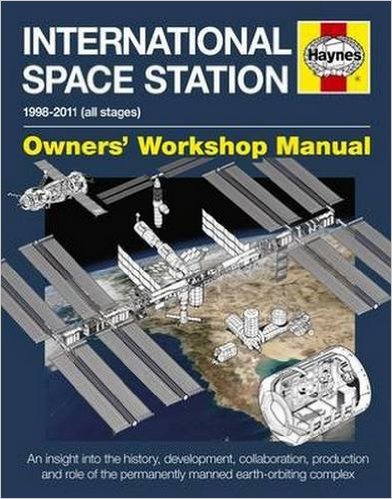
ISS Owners Manual BookThis is another excellent Haynes astronomy manual. Haynes has produced several astronomy titles including the Lunar Module and the Space Shuttle.
The author David Baker worked with NASA on the Gemini, Apollo and Shuttle programme between 1965 and 1990. His work has put him in good stead to write this ISS book.

Don’t worry this is not like a Ford Fiesta Haynes manual which tells you how to service your car, so it will not tell you how to build or service your own ISS. But this book does contain everything you would ever want to know about the ISS, including a lot of very good cross sectional diagrams.

The International Space Station book contains over 300 images and technical illustrations. The ISS book takes you all the way through the history of the ISS and charting its creation from how it was built on Earth and then assembled in orbit.

The International Space Station manual begins with an introduction, then there is a chapter called ‘a permanent place in space’, then ‘phase one mission to Mir’, ‘phase two assembly’, ‘phase three permanent habitation’, ‘phase four final assembly’ and a ‘legacy’ chapter.

The Haynes International Space Station book has some really great colour images in it. It’s great to find out how each part was added to the ISS. If you are interested in the ISS then this really should be a book you should get.

Buy ISS Owners Manual from Amazon UK

Cambridge Photographic Moon Atlas Book Review

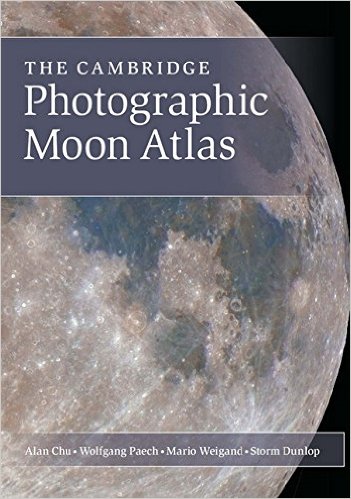
cambridge photographic moon atlasThe Cambridge Photographic Moon Atlas covers 69 regions of the lunar landscape in large format images with corresponding charts. The book itself contains 388 high-resolution photographs of the lunar surface.

The Cambridge Photographic Moon Atlas is not just an atlas though, the book begins with a great data section on the moon and the introduction section covers the structure of the moon, chemical composition, the moon evolution, determining the age of craters, changes to the moon by erosion and topography.

There are a few pages on how to best observe the moon, descriptions about libration, there is also information on what telescopes to use as well as photographic observational techniques. This includes the best type of CCD cameras, mounts, filters and telescopes to use. There is even a page on how to process your lunar images using AviStack or Registax.

After the 30 page introduction the book takes you through all sections of the moon. The book is divided into easy to read sections, regions with more features get more pages and more ‘zoomed-in’ detailed pages.

Each feature of the lunar surface is nicely labelled with sections having good descriptions and lunar co-ordinates of where to find them. There are even measurements of a lot of the lunar features such as the diameter of craters in km.

Each section also shows you the feature at various times of the month, so you can see the multiple lighting of the feature of the surface.

The Cambridge Photographic Moon Atlas is a great moon atlas and very up to date with each image looking very impressive. If you are looking for a moon atlas book, also have a look at The Clementine Moon Atlas. That is a very similar book which has images and a chart for each lunar region. It also has more labels on each section.


Buy Cambridge Photographic Moon Atlas from Amazon UK

Apollo 11 Owners Manual Book Review

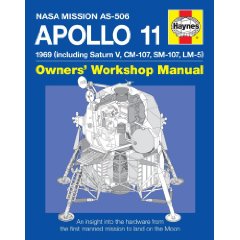
Haynes Apollo 11 ManualThe Haynes Apollo 11 Owners Manual is an intriguing book and one of the first Haynes books to move away from the automotive sector. Don’t expect pages and pages of cross sectional diagrams of the Apollo 11 module and Saturn V rocket. There is much more to this book than that.

The first thing that hits you is the number of excellent colour photos and images that have been included in the Apollo 11 Owners’ Manual book.

The Apollo 11 Owners Manual begins with an introduction about the space race and how the Apollo 11 mission began as well as information on the Apollo 11 prime crew, backup crew and flight directors. There is then a chapter on the Saturn V rocket, which of course could not be left out of an Apollo 11 manual. This chapter includes information on Saturn 1, Saturn 1B, Saturn V and Apollo 4.

Following on we come to a chapter dedicated to the command and service modules. This includes information on electrical power, the life support systems, food, toilet stops, personal hygiene and what changes were made after the horrific fire which occurred during testing.

The guidance, navigation and control system gets it own chapter in the book and so does how communication was made from the moon. In the Lunar Module chapter the descent and ascent stages are discussed. There is also information about Apollo 4, 5, 8, 9, 10 and of course Apollo 11.

The important space suit get its own chapter as well, here they discuss the water cooled garment, the pressurised inner suit, the outer protective suit as well all the other parts of the suit in great details such as the helmet and visor, gloves and boots, life support backpacks. Not to be left out is the waste management side of things and food and drink.

In one of the last chapters there is information on the post-Apollo 11 missions with details on Apollo 12-14, Apollo 15-17 and Apollo 18-20. There is also few pages on the misconceptions and conspiracy theories that we did not actually go to the moon. The book also asks and answers the question “Why did we stop going to the moon?”

There are several appendices with a table on the Apollo missions, a field guide to the Apollo hardware, the timeline of the race to moon and a table on what happened to the Saturn V rocket stages from the 15 planned Apollo flights.

Overall the Apollo 11 Owners Manual is a brilliant book which does contain detailed drawings and cross sections of the Apollo spacecraft but it also has lots more to offer than that. There are early black and white pictures of the astronauts and in-depth details on each part of what made the Apollo missions a success. There are also some pleasing images from the lunar surface. If you are intrigued by the Apollo 11 spacecraft and the Apollo missions and want to learn what went into landing us on the moon so many times then this is a great read, highly recommended.


Buy Apollo 11 Owners Manual from Amazon UK

Lunar Imaging and Widefield Imaging Talks

Last night I did a quick couple of talks at the Cambridge Astronomy Association on lunar imaging and widefield imaging using a Geoptik CCD to lens adaptor.

The lunar imaging talk covered the top 10 tips when lunar imaging, a demo of stacking a lunar video using Autostakkert and Registax. I then also talked about how to complete a lunar mosaic by using Photomerge in Photoshop and Photoshop Elements or in the free Microsoft Image Composite Editor (ICE).

The widefield imaging talk concentrated on my use of the Geoptik adaptor, but I also introduced the other Canon and Nikon lens adaptors that are on the market. I then mentioned filters, backfocus and focusing. I finished up showing some Ha example images that I have taken.

If you would like to see the talks, PDF versions of the talks can be found below:

Lunar Imaging 2016 – 2MB
Widefield Imaging 2016 – 190k