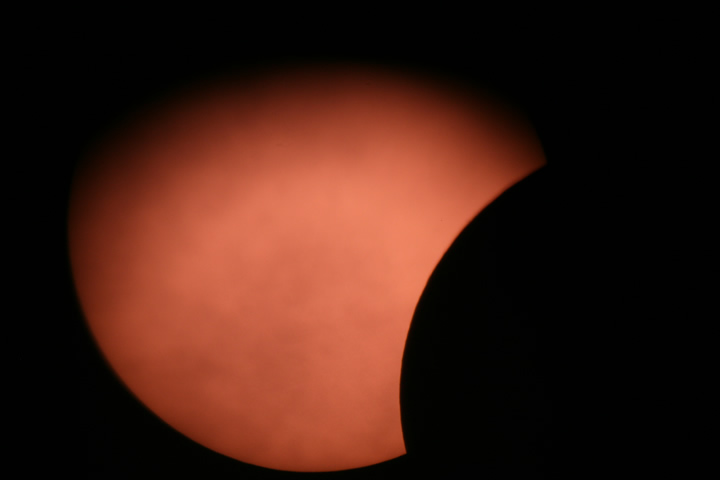
Partial Solar Eclipse in the UK, August 2008

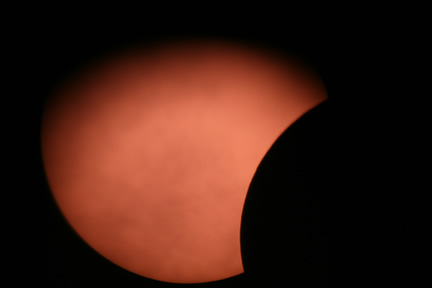
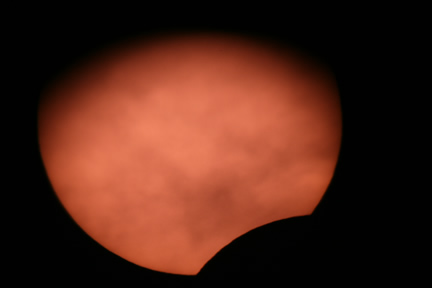
I managed to get outside early enough to start taking some images today with my Canon DSLR and using a Meade f3.3 focal reducer and LX200 telescope. 

I did begin trying to use a webcam to record the whole event, as I would have liked to have had a video of the whole event, but with a lot of cloud and not being able to see the laptop screen outside, I gave up and used the digital camera instead.

My images show a mirror image as the moon passed the sun on the top left, and not the bottom right, maybe next time I should flip the images first in a paint program before displaying them.

Early Partial Solar Eclipse

Partial Solar Eclipsed, UK 1st August 2008

Spotting the International Space Station

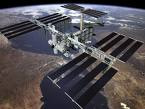
International Space StationIt has been an evening ritual just lately to find out when the ISS is passing overhead (via the heavens-above website) and then rush out and spot it. It’s amazing actually how bright it is, and how lots of people have not thought it was some sort of UFO.

After spotting it a couple of times, I then decided I wanted to try and get some images via my webcam and LX200, which can track satellites. I have seen video on YouTube from other people with similar telescopes and the video looks really good.

I began by downloading the latest ISS data from the Meade website, (which actually just links to another website) and installed it into Autostar.

I then read the LX200 manual about tracking satellites and I thought originally the LX200 would do everything for me and track automatically, but unfortunately this is not the case.

You actually have to allow the telescope to move in the path that the satellite is moving, but start your tracking once you see the object in the viewfinder, so really a bit hit and miss.

So far I have not managed to get it right, and track the ISS, but I’ll keep trying and see if I can get some video.

Make a Focal Reducer Case

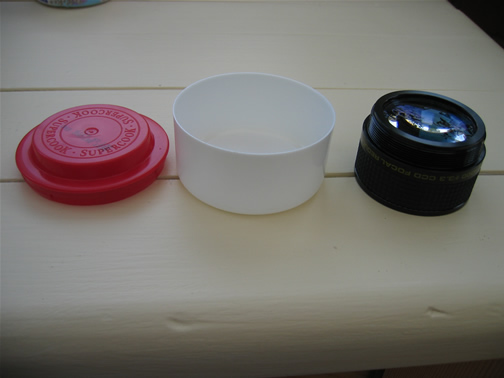
I recently purchased a Hursch f6.6 focal reducer which just came in a cardboard case type box with a cleaning cloth. I also have a Meade f3.3 focal reducer but this came in a plastic bolt case.

I put a wanted ad for a plastic focal reducer bolt case on astrobuysell and I also called into ScopesnSkies to see if they had one, but they did not. 

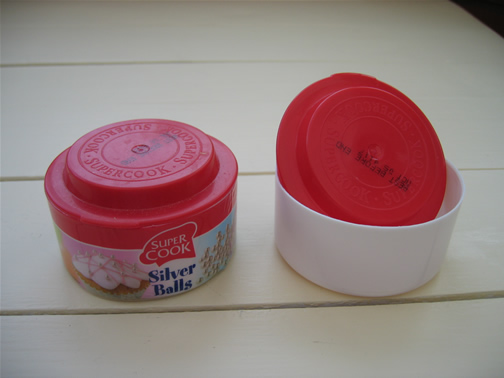
Supercook CaseBut last week I saw some cake decoration boxes in the kitchen, and thought they may be perfect!

They are the half size cake decoration boxes that contain sugar stars, silver balls etc. from companies such as Supercook and Dr Oetker. So I removed the outer packaging and cleaned the inside out.

Focal Reducer and Case

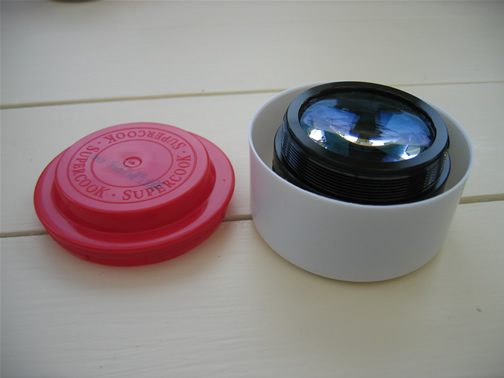
Focal Reducer in Makeshift Case

I then cut out some thin foam and glued it into the case and then placed my focal reducer in and it fitted perfectly. The focal reducer does only fit one way up though, but is now airtight.

Stars Dancing with Black Holes

Stars Dancing with Black Holes was the title of Marc Freitag’s talk at this months meeting of the Cambridge Astronomy Association.

Marc began by explaining what actually is defined as a black hole; known to have a most extreme case of gravitation, where the mass is concentrated in one point and it is surrounded by a spherical horizon.

Marc also had an interesting slide detailing the flow and gravity pull of a black hole which included details on subsonic flow, supersonic flow and about the sonic horizon.

There is believed to be a black hole at the centre of our Milky Way.

We were told that the effects of Massive Black Holes (MBH) on stars can be used to reveal the presence of Massive Black Holes and determine their properties. We also learnt that stars around Massive Black Holes in a spherical nucleus produce a rosette orbit and that as a star is close to an MBH you get a Keplerian ellipse.

Stellar Massive Black Holes are the end product of evolution of stars greater than 20 to 30 suns, and they are only 1-2 stars in 1,000.  This version accumulates around the Massive Black Holes.

One interesting future piece of research is to be the LISA spacecraft which is being designed to measure the mass and rotation of Massive Black Holes. IT will measure Gravitational Waves (GW) which are emitted when a black hole passes a massive black hole.

A Gravitational Wave is a contraction of space in one direction and an expansion in the other direction. Gravitational Waves also produce contraction and expansion of space itself.

The LISA spacecraft consist of three spacecraft that will form the shape of a triangle in space in an orbit similar to that of the earth.  The distance between the spacecraft will be 5 million km apart.

LISA will detect gravitation waves by comparing distances between “test masses” in different directions using lasers. A similar research project on the ground has been executed called LIGO in the US and VIRGO in Italy.

Overall the talk was very in depth and I got a bit lost half way through with all of the formulae and physics, but the talk was littered with interesting images, simulations and videos.

I look forward to see the launch of LISA in the future, and to see if it will be possible to detect gravitational waves as well as if it will be possible to keep the three spacecraft evenly spaced across space in order to constantly create a perfect triangle.

Water Widespread on Mars

An article in Nature says that wet conditions probably persisted for a long time on the Red Planet.

Researchers from NASA found evidence of vast lakes, flowing rivers, and deltas on early Mars, all of which were potential habitats for life.

The data comes from the NASA spacecraft on Mars.

But surely we all expected this outcome, didn’t we?

Especially when the spacecraft is digging on the north iced pole of the planet.  I think the major breakthrough would be finding some microbes and genetic substance of marsian frozen creatures.

Philip’s Deep Sky Observer’s Guide Review

Deep Sky Observer’s Guide BookDeep Sky Observer’s Guide is an astronomy pocket book by Philip’s covering all of the major deep sky targets.

The book begins with an introduction to the astronomy area of deep sky objects, and an introduction to the basics of sky watching and the sorts of equipment that can be used, including binoculars and various telescopes.

The book also tells you where and when to observe, as well as about sketching and how to plan a nights observing.  Over three quarters of the book is given over to listing all the main deep sky objects which can be observed. 

Each deep sky object entry gives a description of the object together with RA and Dec positions and a note of where you can find the object on the sky maps at the back of the book. The book also contains some colour images of the objects.

The rear of the book contains a chapter on the history of deep sky observing including descriptions about the early observers. The book also contains star charts and maps as well as summary lists of the deep sky objects, their magnitude, what page in the book they are on and what month of the year is the best for viewing them.

Overall, Deep Sky Observer’s Guide is a great little book if you are interested in deep sky targets and want to be able to draw up a list of objects to observe and where to locate them in the nights sky and when via the sky maps and summary lists.

Deep Sky Observer’s Guide is available at Waterstones

Imaging Jupiter via Webcam

This has been the first time I have imaged Jupiter with my Meade LX200 telescope, as last year when Jupiter was visible I had my Meade Bressier telescope.

Jupiter is not at a great location at the moment, as it is situated quite low in the sky, so atmospheric turbulence is a problem.  Also at the moment I have to wait until 12.30am for the planet to be high enough and within view as I have a house next door which covers the planet before this.

I used my Philips Webcam and used two different programs to capture the video, I used QCFocus and Philips VLounge software. I like QCFocus as it saves the video as .AVI files, whereas my copy of VLounge saves in .MPG, so I need to convert the video into .AVI in order to load it into Registax, which is a hassle.

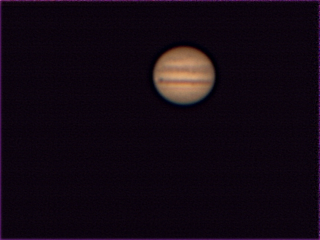
I began just connecting the webcam straight to the telescope for the first capture, but as you can see from the image below, that the size of the planet is quite small.

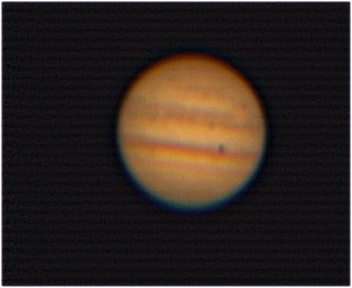
I did want to try and catch the shadows of one of Jupiter’s moons on the image, but the black circle you can see on these images is actually a mark or dust spot and not what I thought was one of the moon’s shadows.

Jupiter via Webcam

The second image involved adding a Meade Telenegative 2x Barlow lens to the telescope in order to get a larger image on the chip of the webcam.

Jupiter via Webcam with 2x Barlow and Diagonal

I did also tried adding the standard Meade diagonal after the 2x Barlow but this made the image nearly completely fill the chip on the webcam but the image was over magnified and out of focus, I have not included an image of it here.

Next time I will try different combinations of may be a f6.6 focal reducer with a barlow, I think I will also try and image using the Meade DSI II that I have.

My Whipple Museum Visit

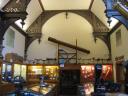
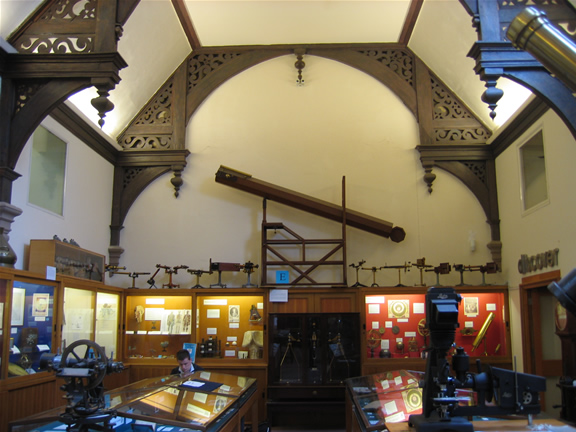
Whipple Museum Main Room in CambridgeWhilst having a day off in Cambridge I decided to visit the Whipple Museum. It took a few minutes to find the entrance behind a wooden door from the street and then up a flight of stairs, but it’s worth hunting the museum down, admission is free.

The Whipple Museum opens up Monday – Friday 12.30 – 4.30pm only, so don’t visit on a weekend or in the morning during the week!

The Whipple Museum’s collection includes scientific instruments, apparatus, models, pictures, prints, photographs, books and other material related to the history of science. Obviously the most interesting part for me was the collection of telescopes and astronomy related items.

The Whipple Museum was founded in 1944 when Robert Stewart Whipple (1871-1953) presented his collection of scientific instruments to the University of Cambridge.
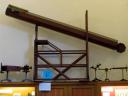
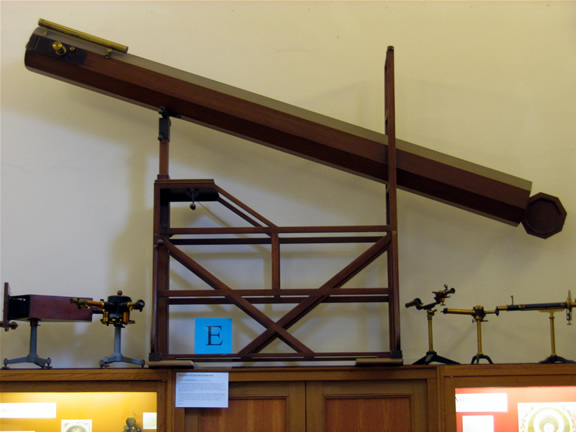
Newtonian Reflecting William Herschel TelescopeThe main telescope I wanted to see was the William Herschel Newtonian Telescope which is hard to miss in the main room.

The telescope takes its name from William Herschel (1738-1822), who achieved public acclaim and royal favour through his discovery of the planet Uranus. He originally called the planet the Georgium Sidus (Latin for ‘George’s Star’), to honour King George III in 1781.

A few years later George III requested that Herschel make a number of telescopes. The Whipple Museum’s example is one of five 10ft reflecting telescopes made in response to that request. Following Herschel’s standard design, the King’s cabinet maker constructed the mahogany stand and tube. Herschel made the optical parts himself.
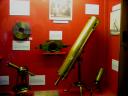
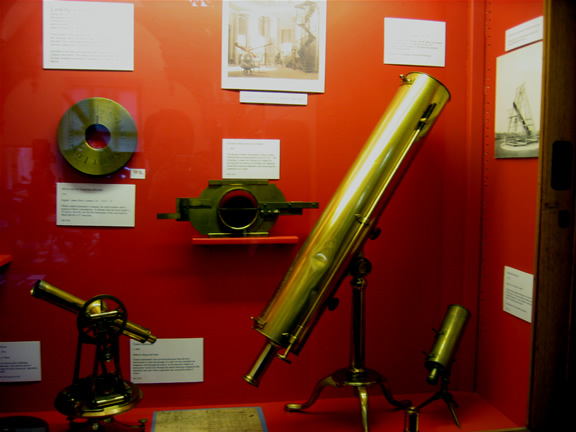
Mirror Cell and Brass TelescopeThere was also a telescope by James Short dated 1758. Short was known for his observations of comets, transits of Venus and the Northern lights.

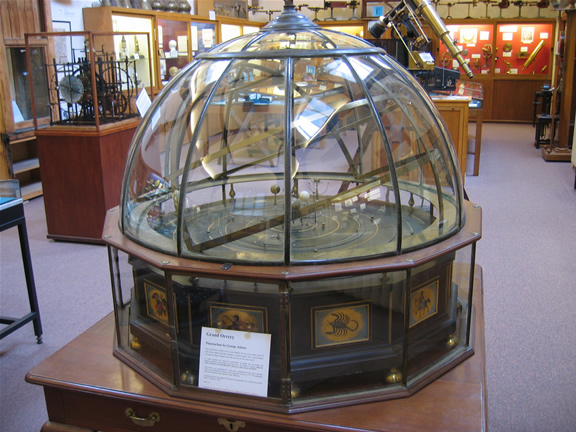
Near the entrance of the museum is also a grand planetarium, aptly named the “Grand Orrery Planetarium” made by George Adams. 
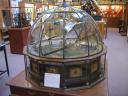
Grand Orrery PlanetariumAn Orrery is a moving model of the motions of the Earth, Moon, and Sun. Orreries can be used to demonstrate phenomena such as day and night, the seasons, lunar phases, and eclipses.

The planetary model known as the ‘orrery’ takes its name from Charles Boyle, the fourth Earl of Orrery. The London instrument maker John Rowley (circa 1668-1728) made the first orrery for Charles Boyle around 1713, but planetary models have existed since ancient times.

The grand orrery, displays the Sun in the centre, and the 6 planets known at the time with their satellites (four around Jupiter and five around Saturn). Saturn is the outermost planet, shown with its ring and the five satellites discovered by Christiaan Huygens and Giovanni Domenico Cassini between 1655 and 1684. The planets Uranus, Neptune and Pluto had not yet been discovered when this orrery was made.
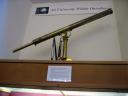
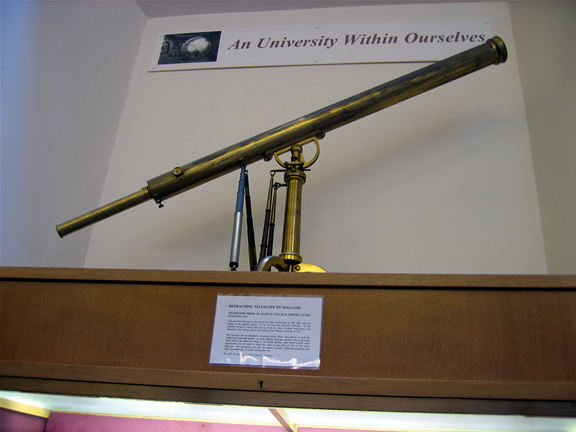
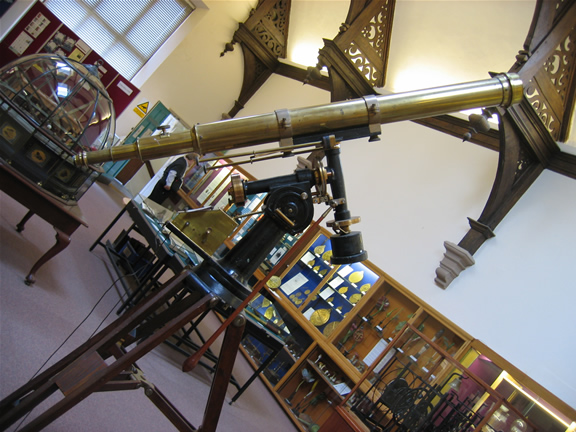
Dollond Refracting TelescopeThere was also a refracting telescope from the Dollond workshop built around 1800. This was used in St. John’s college observatory, until it was loaned to the Whipple museum in 1951.

The telescope has an altazimuth mounting and there was a mahogany case not on display contains additional eyepieces and filters to protect the eyes when viewing the sun.
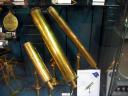
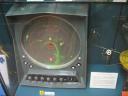
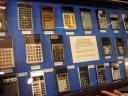
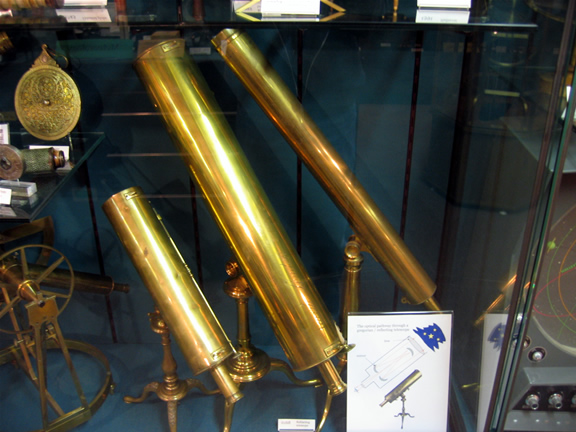
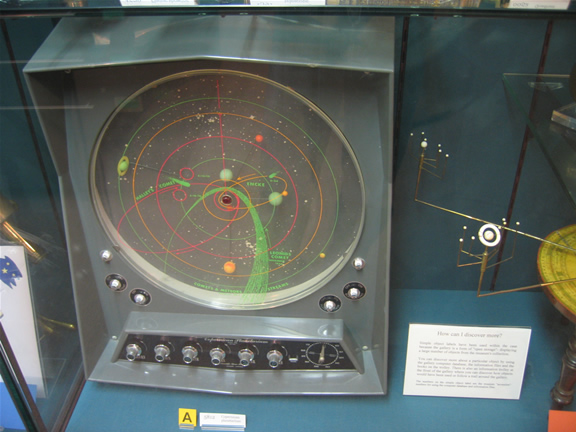
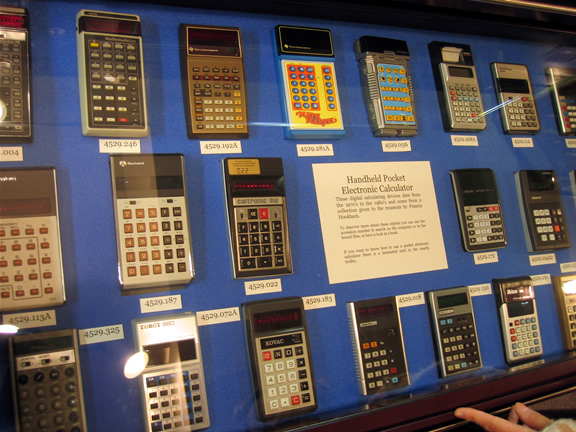
Gregorian and Reflecting Telescopes Copernican Planetarium History of Calculators Drawer 

There were many other astronomical items such as other electric planetariums, mirror cells, other brass telescopes.  The funniest thing though must have been the collection of old calculators in the second room, there are several drawers in this room, which you can open.  There were several drawers of calculators, many of which I remember, including a “Little Professor” calculator.
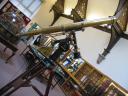
Brass TelescopeWe stayed about an hour in the museum, unfortunately the upper room was closed on the day of our visit, so we only viewed two of the rooms.

If you want to know more about the museum the University has set up a really good web site, just search for the “Whipple Museum” in a search engine.

If you are in the Cambridge area though, drop in to the Whipple Museum, it’s definitely worth a visit.

Purchased a Meade DSI Pro II

I managed to sell my Meade DSI Pro I on eBay, I then purchased a Meade DSI Pro II from Telescope House over the final May Bank Holiday weekend when they gave me an extra 10% off the retail price.  Though I thought the price for the DSI Pro II was already a good price at £299, in fact the best I could find on the net.

I would have loved to have purchased a DSI Pro III, but there was no way I was going to spend £600 on a Deep Sky Imager, that’s the price of a new laptop, maybe in the future the price will come down and I may upgrade.

Anyway I have used the new Pro II version a couple of times and I can tell that it is slightly better than the first version, obviously there are more pixels that can be captured.

I was amazed to find out that there was no Autostar CD in the box, there was only an instructional DVD, which is the same as on the Meade website.  My first version did come with an Autostar CD, but maybe now they just expect you to download the latest version.

This is exactly what I did, as my original DSI came with something like Autostar v3, and I am now running something like v5. One of the main differences to the DSI software is that it now contained a field telling me the temperature of the CCD.

Now I think I have too much choice of what to use to image, do I use the DSI, Canon DSLR or Webcam? I am also thinking of purchasing a High Definition Camcorder to video our new child, but I’m sure I’ll want to somehow attach the camcorder to the telescope as well.

Sun Observer’s Guide Book Review

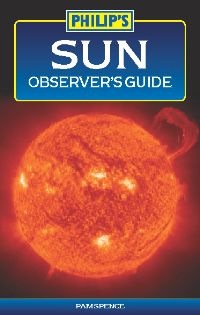
Sun Observer’s Guide BookThe Philip’s Sun Observer’s Guide is written by Pam Spence and is one of Philip’s pocket type astronomy books. This is the first solar book I have read, I am interested in solar observation as I it allows me to use my telescope in the day as well as just at night. 

The book first of all describes the structure of the sun including information on sunspots and solar winds.  There are then chapters on the types of instruments to use to observe the sun, including telescopes, pinhole cameras and filters.

How to observe the sun, walks you through how to safely view the sun with your telescope or binoculars by making homemade projections systems. 

A good section of the middle of the book is given over to telling you how to make observations and record the observations as well as how to analyse your findings.

As you would expect there is a chapter on solar eclipses and the book describes the theory behind the various types of solar eclipse.  There is also a small section on taking images of the sun, unfortunately it only talks about traditional SLR cameras, and not digital cameras, but it does provide some useful information on the types of shutter speed to use at various ISO levels and focal ratios dependent on the type of eclipse you are imaging.

The last section of the book tells you about the professional solar astronomy that is being conducted around the world. At the rear of the book is a useful list of past, present and future dates of eclipses and what you will see in differing parts of the world. 

Overall the Sun Observer’s Guide is a great little book, with some great images, and it provides the reader with a good all round knowledge of the sun and how to view it.  It would have been nice to see a bit more content on imaging the sun and various filters that could be used with a scope, but this book was never meant to go into that greater detail, but instead give the reader a good all round knowledge of the sun, which it does admirably.

Sun Observer’s Guide is available at Waterstones