
Discovering the Solar System Book Review

Discovering The Solar SystemThis is the second edition of Discovering the Solar System (ISBN 0470018313) and is said to be essential reading for all undergraduate students for whom astronomy or planetary science are components of their degrees, but also suitable for people with a keen interest in astronomy.

A small amount of scientific knowledge is assumed in addition to the familiaritiy with basic algebra and graphs.

Discovering the Solar System is definitely not a book for those who want to see amazing pictures of the cosmos as this book is mainly textual with very few images, those that are included are in black and white, although the book does include a number of tables and diagrams to aid your understanding of the subject.

Discovering the Solar System contains 12 chapters and it begins by covering the Sun and its family, then the origin of the solar system including solar nebular theories and the formation of satellites and rings of the giant planets.

Further chapters discuss small bodies in the solar system such as asteroids, comets and meteorites. There are two chapters covering the interiors of planets and satellites from a observational and theoretical basis including gravitational and magnetic field data to the models of individual bodies, such as the terrestrial planets, satellites and the giant planets.

The following three chapters then cover the surfaces of planets and satellites including methods and processes such as processes that produce the surfaces of planetary bodies, weakly active surfaces of the Moon, Mercury, Mars and icy surfaces. Then there is a chapter on looking at active surfaces of the Earth, Venus, Io and Icy surface moons.

The final three chapers discuss the atmospheres of various objects including the planets and satellites, rocky and icy-rocky bodies and finally the atmospheres of the giant planets.

Overall Discovering the Solar System is a very technical and in-depth book containing a lot of mathematical equations and examples. It also includes essay style questions at the end of every chapter with answer guides in the back. The book also contains in-depth glossary at the rear. A great book on the theory behind our galaxy.

Discovering the Solar System is available at Waterstones

Google Sky Review

Last night I managed to download the newly update version of Google Earth which includes the new Google Sky add in. I had the previous version of Google Earth installed on my laptop, and the upgrade was seamlessly easy.

Google Earth starts with the image of the Earth and you the have to click on the ‘Sky’ button the toolbar to access Google Sky.

I was then presented with a horizon free view of the sky. Some parts of the sky look like a patchwork quilt of images, where you can see the joins of the images.

You can search for objects or zoom-in on them using the on screen controls. It is also possible to see the astronomical constellations by playing with settings.

The movement of the ‘sky’ is very smooth via the online streaming. I did find it difficult to find planets using the search facility, and the in-built ‘planets in motion’ facility where you can see planets orbiting in time was not that great as I managed to get overlaps of a lot of images, unless that was the intention of the program.

I was amazed to see RA and Dec settings on the screen, so the program is usable when using setting circles.

A lack of the horizon is a dissapointment, but I think Google Sky is not trying to be the new Starry Night Pro, but it is a very good tool in order to get a general education in astronomy for beginners, so is a good educational tool.

The Google Sky images are also very good and of high quality, well done Google on this free tool.

If I find out more about the program and features I shall add them to the review.

BBC iPlayer Beta Review

I know this is not completely related to Astronomy, but it is sort of when I am trying to watch The Cosmos which I missed on TV the other day.

After waiting for 6 hours for an email saying I could try the BBC iPlayer, I then logged in and tried to download The Cosmos, but I have been having problems.

When I first logged in, every screen after that was asking for my username and password, I think I was asked 3 times for my details before I got to the section where I could download a TV program.

I then found I had to download a client iPlayer to watch the TV programs, for that I needed a second username and password. How many usernames do I need? Hopefully when the BBC release the iPlayer fully they will remove one of the username and password pairs.

I was doing all this on Windows Vista, but found I required Windows XP, so I moved to my laptop to download the program. The download was quite fast, the 124mb program took less than 5 minutes. I then turned off the laptop last night, as I was going to watch the program with the laptop attached to my TV the next day.

I then rigged everything up to watch The Cosmos and the BBC iPlayer told me I did not have the rights to play the video – great, DRM problems! I then tried to re-download the program, but it kept failing, so I deleted my original program and then it downloaded successfully – this time with DRM rights intact.

There appears to be bugs in the beta, but at the same time the Channel 4OD player is flawless and works really well, I can choose to download or stream programs from Channel 4OD, and as long as I have a ‘good’ signal from my wireless router I can watch streamed programs from 4OD on my laptop with no problems and only login once!

But instead the BBC have gone with downloads only, which are fast, but if you download the content the BBC don’t want you to keep the file for longer than 30 days plus if you have watched your downloaded program once then the BBC iPlayer program will be useless after 7 days, so DRM is used, which I don’t like, can’t you just keep the download as long as you want? You can if you record the program off of the TV.

Missed The Cosmos Episode 3 – Repeated?

I had set my Windows Vista Media Center to record the whole series, but somehow I turned the computer off whilst it was recording – I think! Anyway I don’t seem to have the episode.

After looking at the OU website, someone says in the forum that The Cosmos is repeated on the BBC iPlayer for 7 days.

So I have applied for a BBC iPlayer account – but will I get one? So far after 5 hours no email.

The BBC seem to repeat everything else, but not a repeat of this during the week, as far as I can see, but they do repeat The Sky at Night, typical!

BBC iPlayer Update

I have now been sent my new BBC iPlayer account, I had to wait about 6 hours for my email.

I have just logged in and YES! The Cosmos Episode 3 is in BBC iPlayer!!

I am about to sit back and watch.

Second Update

BBC iPlayer does not work on Windows Vista! ahhh, so I will have to use my laptop and watch it on that or I could connect the laptop to my TV via an S Video connection.

Google Sky a replacement for Starry Night?

Google have apparently launched Google Sky, I saw it on BBC Breakfast this morning when they spoke to Sir Patrick Moore about it.

The funny thing is I did not know the name of the product this morning so I searched in Google for many possible names including Google Galaxy, Google Solar System and others. But it’s actually called Google Sky. The problem is now I still can’t find the URL for it, is it released yet?

I also understand it is a plug-in/add-on for Google Earth and that the images are taken from Hubble.

Imagery for the system also came from six research institutions including the Digital Sky Survey Consortium, the Palomar Observatory in California and the United Kingdom Astronomy Technology Centre.

I can’t wait to give it a go and see if I need to stop using Starry Night. Somehow I don’t think it will replace Starry Night Pro. Especially after I looked at Google Mars and Google Moon which in my opinion were not that great.

The good thing about this launch is that it also allowed me to find other programs such as Stellarium, which is a free open source tool that gives people a chance to access more than 210 million stars, in addition to planets and moons.

I now need to download Stellarium and try it out, as the screenshots look very good.

Astrophotography Book Review

AstrophotographyAstrophotography ( ISBN 0540083127 ) begins with a brief introduction to the solar system, planet rotation, and our night’s sky. The book then covers astrophotography equipment, such as various cameras, film, lenses and tripods.
There is a nice section that runs you through what’s involved in a night’s photography such as preparations and ending the photo session. Astrophotography then contains several chapters on photographing the moon, the sun, the stars and the planets in turn.

Each chapter contains some great information on how best to photograph your subject and it suggests when and how to photograph including the best lenses and exposures to use. The book also contains information on how to build your own Haig equatorial camera mount.

There is an interesting chapter entitled “The Earth is a planet too!” which talks about other photography opportunities on our planet including taking shots of aurorae, rainbows, coronas, moonlight and twilight shots etc.

Astrophotography also contains information on taking photographs of meteors, satellites, aircraft and comets. There is then a chapter on processing your film, which is only of information to you if you use a non-digital camera.

Finally the last chapter is about digital photography, and new motorized and GoTo telescopes and what they mean to astrophotography. There is also information on performing afocal photography, which is where the camera is held or fitted to the eyepiece of the telescope. The use of CCD cameras and web cams are also discussed.

This edition of Astrophotography is the updated edition of 2002. I think one main area that disappointed me about this book was that I expected it to go into great detail about digital astrophotography, web cams and how to get the best out of pictures by using software such as photoshop.

Unfortunately the book does seem dated as it mainly covers 35mm film photography with just some information on digital photography at the end of the book. I think the book could do with a complete re-write. A lot of the information about astrophotography is common between whatever camera you use, but I would have thought that most astronomers now use digital cameras and laptops etc.

Otherwise astrophotography is a good book containing a lot of information about how to take photos of our solar system and the colour photos are really good. Overall Astrophotography is a good book on the introduction to film and digital photography, but it could have included more information on the latest imaging technologies and astrophotography imaging techniques.

Astrophotography is available at Waterstones

BBC The Cosmos – Episode 3

BBC The Cosmos – Tue 21 Aug, 7:30 pm – 8:00 pm 30mins

The third episode in the series asks how far out into space and back into time could we see?

Adam Hart-Davis travels across Chile’s ultra dry Atacama desert to the world’s largest telescope, the appropriately named Very Large Telescope, to discover how this massive machine is revealing incredible new sights from across the universe.

Meanwhile, astronomer and engineer Dr Maggie Aderin visits the strange telescope in Tuscany that will soon reveal the cosmos using gravity waves – predicted by Einstein, but until now too weak to detect. She also joins the team at the Hubble Space Telescope who produce the most famous images of space by mixing art and science.

It will be good to see the team at the Hubble Space Telescope and see how they get their photos.

Solar System Observer’s Guide Book Review

Solar System Observers GuideThe Solar System Observer’s Guide (ISBN 0540088277) is one of many of the great astronomy books from Philips. The book is around 250 pages long, with some great colour astronomy photos throughout and the book is thoroughly readable.
Solar System Observer’s Guide begins with a basic introduction to our solar system and how the human eye works. You are also introduced to the various types of telescope and how they work as well as how binoculars work. There is also some information on astronomy drawing, using a web cam and astrophotography.


Each chapter in turn then covers the planets in our solar system including (in order in the book) Mercury, Venus, Mars, Jupiter, Saturn, Uranus, Neptune and Pluto.


Each chapter gives you full data about each planet including its orbit and about the globe, as well as how to find the planet in the sky and what you will see in your telescope. Each chapter gives you a great introduction about each planet with many of the colour photographs included being taken by named astronomers.


After the planet chapters there are chapters on comets, meteors, our moon, the sun and about aurorae.


If you are after a handy sized book which gives you a general introduction to the solar system then consider the Solar Systems Observer’s Guide.


This book would also make a great astronomy book purchase for a child’s school project, especially at the prices that Philips charge for their books.

Solar System Observer’s Guide is available at Waterstones

My First Copy of Astronomy Now Magazine

Whilst in town this morning waiting for the bank to open, I wandered into WHSmith and looked at the astronomy magazines. There only seems to be two astronomy magazine choices either The Sky at Night or Astronomy Now.

The Sky at Night is slightly more expensive as it comes with a CD/DVD disk on the cover, but after flicking through the content Astronomy Now seemed to be the better purchase at £3.25

After looking through it, it’s typical that the new copy comes out tomorrow! Isn’t that always the way!

Annual subscriptions are £33 a year for Astronomy Now and £38 for Sky at Night, should I subscribe to either?

I’ve got to say I like the content in Astronomy Now and the images are brilliant and the articles look easy to digest.

Using an SLR Camera for Prime Focus Astronomy

Prime Focus is the name given when you take the lens off of the camera and insert it directly into the telescope. In order to do this you will require a number of extra astronomy adaptors.

T-Ring

The first one is the T-Ring which screws directly into the neck of the camera. Not an expensive part to purchase, mine for my Canon 400D was around £10. But they do all differ, so make sure you get the correct make and model to match your camera.

Check out Pixmania who stock T-Ring adaptors for Nikon and Canon SLR Cameras.

1.25″ Camera Adaptor

This optional adaptor is used for prime-focus and eyepiece-projection astrophotography with SCTs and refractors. It can also be used successfully with many Newtonian telescopes that either have removable sections on the eyepiece holder (to allow the camera to reach focus), or by employing a 2x Barlow lens to extend the focus point.

The rear section screws onto the nosepiece and is designed to hold a 1.25” eyepiece (ideally a mid-focal length Plossl, say a 12.5 to 20mm) for eyepiece-projection photography, with a thumb screw to lock the eyepiece in position, or you can just leave this part on without an eyepeice inserted.

The 1.25″ adaptor comes with the nosepiece and cost me around £15.

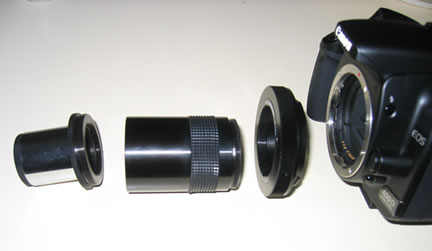
The image below shows how the pieces fit together, with the camera, then T-ring, the 1.25″ camera adaptor and then the nosepiece adaptor.

SLR Camera Parts in a row with eyepiece adaptor

Nosepiece Adaptor

This adaptor can either be used together with the 1.2″ Camera Adaptor above (and it usually comes with the above adaptor anyway) or on it’s own with the T-Ring.

This nosepiece adaptor allows any digital or film interchangeable lens SLR (single lens reflex) camera to be attached to any 1.25” eyepiece holder. So you just slot this part into the telescope.

The front nosepiece section – which is usually threaded can also take standard filters. Using the nosepiece alone allows simple prime-focus photography and you can also use it with a Barlow lens to increase the image scale.

You can purchase a nosepiece separately (the chrome part) and it will cost about £6.

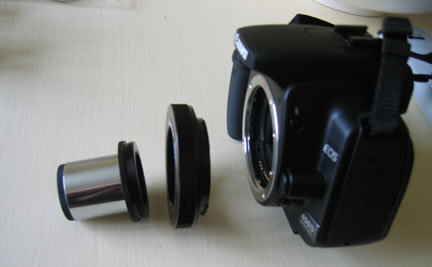
The image below shows the SLR camera then the T-Ring and the nosepiece, I also have a moon filter at the front of the nosepiece:

SLR Eyepiece Camera Adaptor

So all in all the cost of adapting your camera for telescope photography is not expensive at all and really easy to setup, it’s just the cost of a good SLR digital camera in the first place is the expensive bit.