Comet Lulin 2009 Images

Around 9.30pm last night it actually cleared, so I headed outside after a cup of tea. Looking for the Comet using binoculars with Stellarium the previous night helped greatly, as I now knew the vicinity of Comet Lulin.

Comet Lulin was already in the Autostar Handset database, and I had made sure that I update the catalogs during the day time via the LX200 RS232 port and my laptop. The only problem I had was that after aligning the LX200 and then doing a GoTo to Comet Lulin, it was not in the eyepiece.

This meant just scanning the sky for Lulin, I found it best by using the attached LX200 8×50 viewfinder very useful for this. I then began by Syncing the Comet, but I found this did no good as the telescope did not track Lulin.

I started attaching my 300mm Canon lens to my camera and then attaching the camera to the top of the LX200, commonly known as ‘Piggybacking’. I then used the full 300mm and tried various bulb timings, my images below are what I actually got.
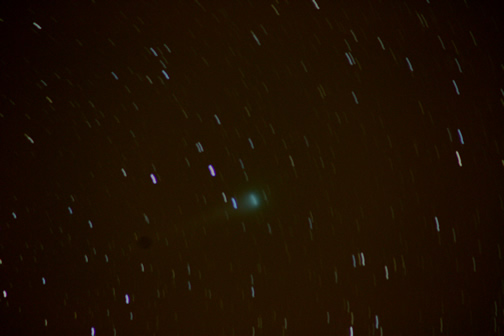
Comet Lulin March 2009

I did then try taking images by attaching the camera directly to the LX200, ‘prime focus’. I also tried my new Meade Off Axis Guider, but found that what I saw through the camera viewfinder was not what I actually saw through the eyepiece on the top of the guider, strange!

I did try taking some photos of Lulin using this method, but the images were very blurry, as the comet was moving pretty fast.
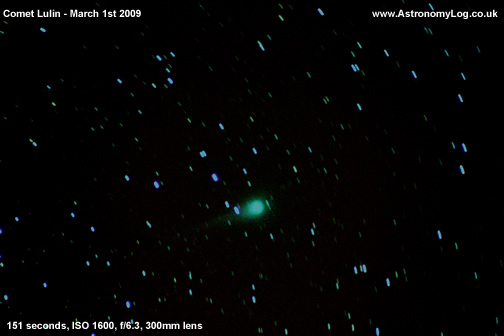
Comet Lulin March 2009

SPA Convention 2009 Lecture Tickets

I received my ticket to the Sir Patrick Moore lecture at the 2009 SPA Convention today. Sir Patrick Moore is not the one speaking but Dr Katie Joy is. The talk is entitled “The Past, Present and Future of Lunar Exploration”, a talk I am looking forward to.

I just really wanted to thank the SPA for doing such a great job of getting the ticket to me in the post together with a full agenda for the Society for Popular Astronomy Convention day at the Institute of Astronomy in Cambridge on 7th March 2009, as all I did was send them an email!

So if you are interested in any of these talks:

  • Introduction to Moon Dust and Meteorites
  • Epic Moon: A History of Lunar Observation
  • An Impact Cratering Tour of the Solar System
  • Meteorites: Unravelling Cosmic Mysteries

as well as astronomy trade stands, tours of the on-site telescopes, then head along, as it’s all free.

Satellites Collide over Siberia

Just to put everyone in the picture, 2 satellites have collided 500 miles up over Siberia.

The collision involved an Iridium US commercial satellite, which was launched in 1997, and a Russian satellite launched in 1993 which was believed to be nonfunctioning and out of control.

The Iridium craft weighed 1,235 pounds, and the Russian craft nearly a ton.

“There have been four other cases in which space objects have collided accidentally in orbit”, NASA said. But those were considered minor and involved parts of spent rockets or small satellites. NASA also said “It was just a matter of time before a larger collision occured”.

I know a lot of people are looking for images of the actual collision between the two satellites on the internet, but I am sure there are none on the internet at the moment, please tell me if I’m wrong.

Although if we can locate and see the lost NASA toolbag in the sky, then I’m sure we may be able to track ad see parts of the two satellites if the pieces are large enough.

Want to Buy an SPC900 Webcam. But Where?

Exactly. It seems to me that Philips have stopped producing our beloved SPC900 Webcams. Amazon, Play and Pixmania used to stock them online, but no longer do. So what now? I suppose you could always look on eBay.

Does this mean that the price of second hand SPC900 Webcams will increase as they become harder to get hold of.

I did discover the new range of Philips SPC webcams and wrote a blog post about them. But is the SPC1300 or SPC1330 the new astronomy webcam? Do the old 1.25″ adaptors fit these webcams? Or do we need to get the glue out and try to fit the old adaptors to the new webcams?

The SPC1300 is a 2 Megapixel CMOS camera, the SPC900 was a 1.3 Megapixel camera.

If anybody wants to try the SPC1330 they are stocked at Amazon or Play.com – both offer Free Delivery.

Or will this see the end of us using Philips Webcams for Planetary Imaging, do we now need to go back to Logitech webcams?

Find Comet Lulin in Stellarium

I am starting to get quite excited about having Comet Lulin to image, so if your like me and want to know how to plan your observing or astrophotography then you’ll need to know how to find Comet Lullin in the sky.

I began using an old version of Starry Night Pro, but that would not show me the comet. So I decided to install Stellarium again on my laptop. By default Comet Lulin is also not in Steallarium, but I did find a way to map it into Stellarium.

Install Stellarium, if you have not already

Located the ssystem.ini file in the data folder where you installed Stellarium

Edit the file and place the following text at the end of the file:

[Lulin]
name = Lulin
parent = Sun
radius = 1000
oblateness = 0.0
halo = true
color = 1.0,1.0,1.0
tex_halo = star16x16.png
tex_map = nomap.png
coord_func = comet_orbit
orbit_TimeAtPericenter = 2454842.1414
orbit_PericenterDistance = 1.212289
orbit_Eccentricity = 0.999987
orbit_ArgOfPericenter = 136.8614
orbit_AscendingNode = 338.5353
orbit_Inclination = 178.3730
lighting = false
albedo = 1
sidereal_period =

Then save the file and re-start Stellarium

Use the search facility in Stellarium to locate the Comet Lulin

Lulin is also in the Meade Autostar database as C/2007 N3 Lulin, so if you are outside already it should GoTo it, otherwise just connect your telescope to a computer and do an update within the Autostar program.

Stars in their Death Throes by John Eldridge

This month’s CAA talk was entitled “Stars in their Death Throes” by John Eldridge. John went over the life span of stars and how they go nova.

He mentioned that Supernova give off enough light to be seen for about 4 to 5 months, such as supernova 1987A and supernova 2003gd in M74.

When stars are born they are hot and blue in colour and are made of helium and hydrogen. At this point other gas and dust is blown away.

The Red Supergiant then gets a carbon oxygen core and then an iron core is created, the centre is then hotter and denser than before. After this the star then collapses down to  a supernova, at which point nickel is produced. 

We were also told that Betelgeuse is actually a Red Supergiant, so think of that next time your are observing it.

The talk about Supernova was very in-depth and quite complicated for me, and I was lost at some points, but none the less a very good talk with lots of good movies of the life span of stars up to the point when they go nova.

Starmen TV Programme on BBC4

Did you see the “Starmen” programme on the BBC? What a great astronomy programme, so good I had to watch it twice.

It was about us amateur astronomers and how important we are to keeping an eye on what is going on in the sky. I think my favourite part was actually seeing everyone’s astronomy kit, as well as the observatories that everyone had in their back-garden.

Terry Pratchett even appeared on the programme with his own bespoke observatory, the dome was actually made from wood.

It was amazing to know just how many people have astronomy as a hobby, and that so many people go to work all day and then stay up all night sitting beside a telescope.

Usually the only amateur astronomy on TV is on The Sky at Night, I would like to see more amateur astronomy on the BBC, perhaps we need a new Astronomy TV series which reviews astronomy equipment, teaches us the night sky, and instructs on how to use the kit in order to undertake astrophotography etc.

The History of Spaceflight by David Bryant

On December 19th I attended the Cambridge Astronomy Association Christmas talk, which was entitled The History of Spaceflight by David Bryant. The CAA also laid on Christmas cake to have with our teas and coffees and we also had an annual competition/quiz where we had to guess what 15 strange objects were used for. I found these difficult to guess, but after hearing the actual answers I think I could have actually won as most of my guesses were correct, nevermind there is always next year!

David gave a personal insight into the history spaceflight. He showed us lots of photos of himself together with many famous astronauts, including ten Apollo astronauts of which seven have visited the Moon.

David started by talking about the history of rockets including the use of rockets by the Chinese Mongols in the 13th Century and the Congreve Rocket in 1805.  He also discussed how rockets work, such as how liquid fuel and liquid oxidizer are pumped together.

He also mentioned the v2 and A4 rockets of World War II and how gyroscopic guidance was introduced. Werner Von Braun was said to be a major influence in US missile design in the 1950’s and 1960’s including working on the Redstone and Saturn rockets. It was also mentioned that Sergei Korolev turned the v2 rocket into the R7 rocket.

David’s presentation was good as it included a lot of video content of shuttle and rocket launches. It was good to learn all about the various NASA launches that have been made.

Overall, David was a very interesting speaker and very funny as he told lots of jokes, a speaker I would like to hear more from.

How To Use a Computerised Telescope Book Review

How To Use a Computerized Telescope BookHow to Use a Computerised Telescope introduces topics which are common to all computerised telescopes, but the book mainly covers the Meade ETX, LX200 and Celestron Nexstar ranges.

How to Use a Computerised Telescope begins by telling you about how the sky moves and how computerised telescopes track the stars in altazimuth and equatorial modes. It also includes details about the on-board GPS on the telescope and how to steady telescope mounts, wedges, and permanent mounts and how to best align a telescope. There is also a good section on factors that can affect pointing accuracy.
 
There is a whole chapter given over equatorial mounts and wedges and how to align the telescope using both methods.

The 5th chapter covers telescope optics and the different kinds of telescope as well as a useful section on how to collimate an SCT or Newtonian telescope.

Chapter 6 covers everything about eyepieces, including the different types such as Plossl, Radian, Kellner, Nagler and more. There is also information on power formulas and details on Barlow lenses, focal reducers, filters, sun filters and finders.

Chapter 7 is all about astrophotography and it tells you about the equipment you can purchase and how to attach your camera to the telescope either by piggybacking, prime focus, afocal and positive projection. There is also information on CCD cameras, webcams, and how to perform effective focusing.
 
Chapter 8 is all about troubleshooting, and it lists lots of problems you may come across and possible solutions for them.

The final three chapters are then given over to information about three main telescopes, these are the Meade LX200, Celestron Nexstar 5 and 8 and finally the Meade ETX and LX90 ranges.

These chapters carry a lot of information about each telescope such as about the menu options available on each handset and what the commands actually do.  There are also some wiring diagram on how to make serial and USB cables for the LX200 and Nexstar telescopes.
 
At around 225 pages there is a lot of information in this book, especially applicable if you have a Meade LX200, ETX or Celestron Nexstar telescope.  I learnt a lot about how to use my LX200 from this book and How to Use a Computerised Telescope is also a great book to have and read if you did not like or understand the manufacturers manual that accompanied your telescope.

How to use a computerised telescope is available at Waterstones

Astronaut Loses Tool Bag on Space Station

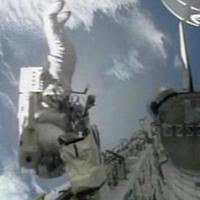
Astronaut loses toolbagA spacewalking astronaut accidentally let go of her tool bag after a grease gun inside it exploded, and helplessly watched as it floated away with everything inside.

It was one of the largest items ever to be lost by a spacewalker, and occurred during an unprecedented attempt to clean and lube a gummed-up joint on a solar panel.

Heidemarie Stefanyshyn-Piper was just starting to work on the joint when the mishap occurred.

She said her grease gun exploded, getting the dark grey stuff all over a camera and her gloves. While wiping off herself, the white, backpack-size bag slipped out of her grip, and she lost all her other tools.

“Oh, great,” she mumbled.

Ms Stefanyshyn-Piper and her fellow spacewalker, Stephen Bowen, then went on to finish their tasks in six hours and 52 minutes by sharing tools.

Mr Bowen had his own tool bag with another grease gun, putty knife and oven-like terry cloth mitts to wipe away metal grit from a clogged joint at the space station.

“Despite my little hiccup, or major hiccup, I think we did a good job out there,” Ms Stefanyshyn-Piper said after returning to the space station.

Flight controllers were assessing the impact the lost bag would have on the next three planned spacewalks.

Earlier, the spacewalkers spotted a screw floating by, but were too far away to catch it. “I have no idea where it came from,” Ms Stefanyshyn-Piper told Mission Control.

So, look out for a NASA toolbag landing in your backgarden soon! No, not really I think it will burn up in the atmosphere or actually stay in orbit forever!