Search:

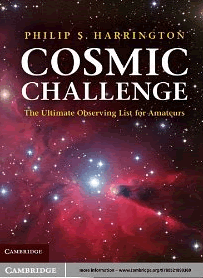
Cosmic ChallengeCosmic Challenge contains nearly 500 pages and lists over 500 star targets for you to find. The book is aimed at both beginners and advanced astronomers alike, as the book contains a mix of Solar System and deep-sky targets to hunt for.
The first 25 pages of the book tell us about our own eyes and how they work, as well as information on binoculars, collimation, using baffling/flocking, eyepieces, the best filters to use on what objects and the things to think about when it comes to your observing site. This includes information on the jet stream, the Pickering seeing scale, the Bortle scale of darkness and more.

Cosmic Challenge is then split into objects you can hunt out with your naked eyes, binoculars, small telescopes (3 to 5 inch) and giant binoculars, medium telescopes (6 to 9.25 inches), large telescopes (10 – 14 inches) and very large/monster telescopes (15+ inches).

I think it was a great idea to divide the book up this way, as you don’t want to find yourself looking for an object like Palomar 1 with a 3 inch telescope. Having the naked eye chapter also means you don’t even need a telescope to benefit from Cosmic Challenge. Then if you do decide to invest in some large binoculars or a larger telescope you can then come back to this book and try hunting some more elusive targets.

There are also then subsections within each size of telescope required, informing you in what season the object is visible.
Each of the 188 targets in the book are well laid out and begin with a large title with RA and Dec co-ordinates, the name of the constellation and magnitude information. There is then a diagram within the constellation (if applicable) of where to find the object. Each target also contains a very nice description of the target and it’s background plus tips on how best to view it.

There are three appendices. The first appendix is called the cosmic challenge, this displays all of the 188 targets into a large table for easy reference. The second appendix is a guide of suggested further reading whilst the last appendix supplies you with 100 challenging double stars to try and locate.

Cosmic Challenge is a very fun book, what makes it so good is that the layout is very pleasing on the eye and objects are really easy to find in the book (maybe not so easy in the sky!). Another great thing about Cosmic Challenge is that the book has longevity as I mentioned before. As you could use the book at various times of the year as the sky changes, and again if you decide to upgrade your telescope aperture. Also you don’t even need any astronomical hardware to use this book, just your own eyes as it contains 21 naked eye challenges.

Cosmic Challenge is available now from Amazon with Free Delivery

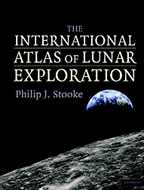
atlas of lunar exploration book The International Atlas of Lunar Exploration is one of the most detailed books on the lunar missions I have ever seen. If you want a book that goes into so much depth, then this is for you, that is, if you can handle the expensive retail price of around £100 for this book.
The International Atlas of Lunar Exploration provides details of every spacecraft mission to the moon since the dawn of the space age. Each mission is illustrated with a combination of maps and annotated photographs. Usefully the lunar missions are listed in chronological order through the book, so it’s easy to follow the history.

The book includes such information as how landing sites were selected.  The book also includes details on lunar missions that never happened. There is even material in this book which has never been published before together with specially created panoramic lunar photographs from every lunar mission.

This is a large sized coffee table type book which contains over 440 pages packed full of information. The panoramic photographs are truly stunning and for me a high point of the book is the detailed information and maps about the EVA routes and exactly where core samples were taken.

There are some really great moon mosaic images and details on exactly where flags, TV cameras, solar wind collectors and antenna were placed. There are even details on where the lunar landers should have landed and where they actually landed.

As you can probably tell from my lists of information, this book has everything. If your interests lie with the Moon and the lunar missions then this would make a great book for you to marvel at.

The International Atlas of Lunar Exploration by Philip J Stooke is available from Amazon

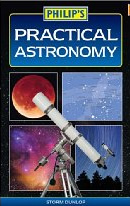
Practical Astronomy BookPractical Astronomy is a straight forward guide to the hobby of astronomy. If you are a beginner to astronomy then this is a perfect book to pick up and read.
The book begins by introducing you to astronomy and teaching you the night’s sky and how to guide yourself about.  There is also a chapter on choosing the right astronomy equipment for you, including information on various telescope types. Practical astronomy ends the first section entitled “Introducing Astronomy” by advising you on how to record your observations via cameras and web cams. This section of the book also contains a section containing star charts.

The second part of Practical Astronomy works through “Exploring the Sky” and the book gives a chapter to viewing the moon, sun, observing planets, outer planets, the stars and deep sky objects.

Each chapter takes you through each type of object with full colour images, tables and diagrams.  This type of book is perfect for the beginner as it gives the reader an insight into the hobby of astronomy as most areas of amateur astronomy are covered. There are also star charts and moon maps included as well as a small glossary and resources list.

Practical Astronomy by Storm Dunlop is available at Amazon

The Brightest Stars Book The Brightest Stars book is all about twenty-one of the brightest stars visible from Earth. The Brightest Stars instructs you how to find the stars and the best way to see them.
Each section about each star contains information about the history of the star and legends that are connected with each star. There are also information on star distances, mass and composition. The book also includes star charts.

The Brightest Stars begins with a chapter on stars in the sky which asks the question How Bright is Bright? There is also information on the locations and yearly motions and names of the stars. The final part is about how to see stars better when looking at the skies, using your eyes and telescopes.

Chapter two is entitled Stars in the Universe which includes parts, structure, distances, and motions of stars in the universe, as well as the varieties of stars and the lives and death of stars.

The following stars are contained within the book; Sirius, Canopus, Alpha Centauri, Arcturus, Vega, Capella, Rigel, Procyon, Achernar, Betelgeuse, Beta Centauri, Alpha Crucis, Altair, Aldebaran, Spica, Antares, Pollux, Fomalhaut, Beta Crucis, Deneb and Regulus.

There are six appendices in total and a glossary in the book; with the appendices you get the positions of the stars via RA and Dec co-ordinates as well as magnitude measurements. You also get the masses of the stars and a list of the 200 brightest stars. There are also many other star information tables in the appendices.

The Brightest Stars is a great book if you want to learn a lot more about stars (obviously), the books images are in black and white though but it is nice that each star is given it’s own section which makes the book easier to read.

The Brightest Stars book can be ordered now from Amazon

Digital Astrophotography BookDigital Astrophotography is a very clear, up to date and concise book on how to accomplish digital astrophotography.  The book details four main ways to take images, either via a digital compact camera, a webcam, with an SLR/DSLR or via a CCD camera.

It was refreshing to read a book which was up to date with some really nice colour screenshots and image included.  Most of the other books on astrophotography have not been updated, as they only discussed using either early webcams or manual SLR cameras.

Each chapter of Digital Astrophotography covers digital compact cameras, SLR cameras, webcams and CCD imagers. In each chapter you get information on the type of equipment, what to look out if you are considering a purchase, and how much you will likely pay (in dollars) for the equipment. Finally there is a table detailing the advantages and disadvantages of each piece of equipment.

Each piece of equipment is then covered in detail, including how to set up your piece of imaging equipment and how to take images, and how to process them. For example in the webcam chapter you are instructed how to set up and use the Philips SPC900 webcam and how to use VLounge, Registax software and Photoshop in order to obtain your finished images.

The final part of the book takes you through using the software program AstroArt to manipulate your astrophotography images. There is also a website to accompany the book which contains images you can download to practice on and follow the examples with.
 
Overall Digital Astrophotography by Stefan Seip is a brilliant book and one I read cover to cover.  If you are after a beginner’s type book about digital astrophotography and you want to learn how to image using a compact camera, webcam, DSLR or CCD imager then I can recommend this book.

Digital Astrophotography is available to buy here