Archive for September, 2008

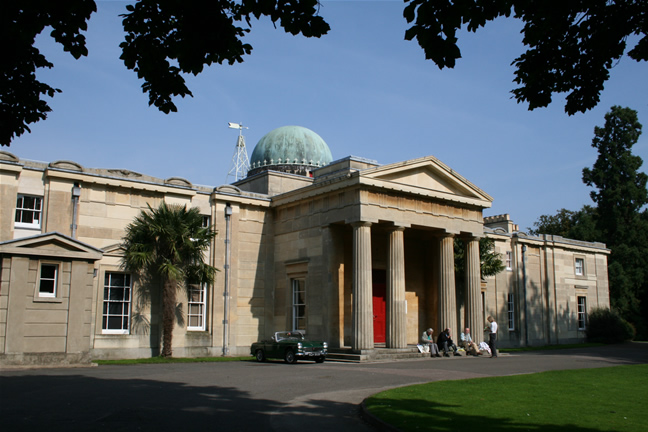
I decided to attend my first Federation of Astronomical Societies Convention which provided me with my first whole day of astronomy talks, held at the Cambridge Institute of Astronomy on Saturday 21st September 2008.

The first talk was by Andy Fabian entitled “The Power of Black Holes”. Andy talked about the possibility of their being a black hole in the middle of our galaxy which can be viewed on ly in infrared as there is a bulge in the middle of our galaxy. He went through the history of who discovered black holes, such as John Michel who in 1784 was the first to work on the possibility of a black hole. He also talked about astrophysical black holes which have olny mass and spin and about gravitational red shift.

The second talk was by Nik Szymanek entitled “Photographing the Night Sky”, which was really why I attended the whole day, and his talk did not disappoint, with lots of amazing astrophotography images in the talk and his talk also contained an 8 minute video. I think in the future I would like Nik to get a bit more technical and actually tell us exactly how to take his type of magical photographs.

Another talk was by Barrie Jones entitled “The Seach for Extra-Terrestrial Life”. This talk covered the search for Exoplanets, which are mainly found by radial velocity. He also told us about what needs to exist on the planet to allow us to find a habitable planet, such as temperature, carbon and water together or ozone and oxygen photosynthesis or oxygen and methane.  For us to find technically intelligent aliens they need to have binocular vision, hands and brains.

The final talk was by Somak Raychaudhury entitled “Einstein’s Outrageous Legacy - Black Holes, Cosmic Illusions and Dark Energy”, but I did not stay for this, as I think I had already seen the speaker at a Cambridge Astronomy Association night.

There were lots of stalls in the main foyer, including stalls from Astronomica, Green Witch, Cambridge University Press, Nik Szymanek and many other book stalls as well as stalls from the national and other local astronomy clubs.
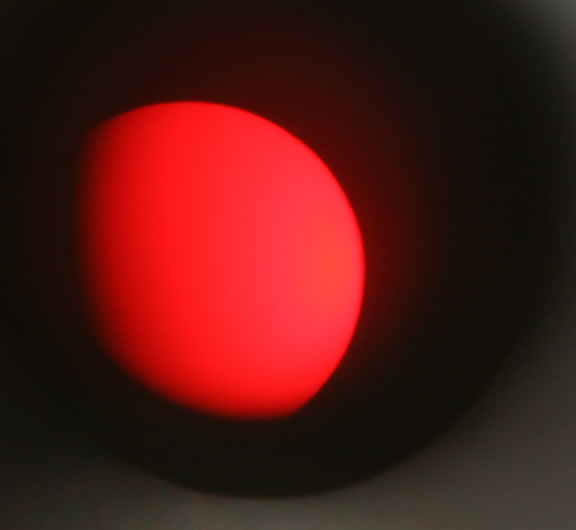
The Sun through a Coronado PST TelescopeGreen Witch set up a Coronado PST telescope outside which many people used to get their first view of the Sun, this is the image I managed to get by putting my Canon 400d up to the eyepiece of the Coronado PST.  There was a really good solar flare coming from the Sun but this does not seem to have come out on the photograph.

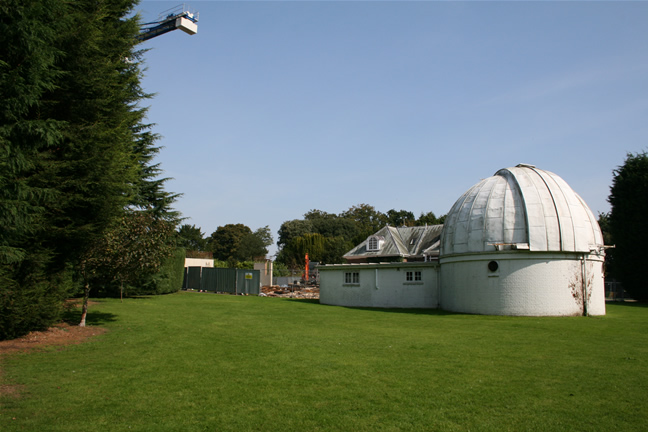
Tea, Coffee, soft drinks and biscuits were served all day long, never have I drunk so much tea in one day! The weather was perfect and during lunch there was a tour around the on-site telescopes. Here are some photographs I took of the various domes, namely the Northumberland, 32 inch, Schmidt camera telescopes as well as the Institute of Astronomy library building.
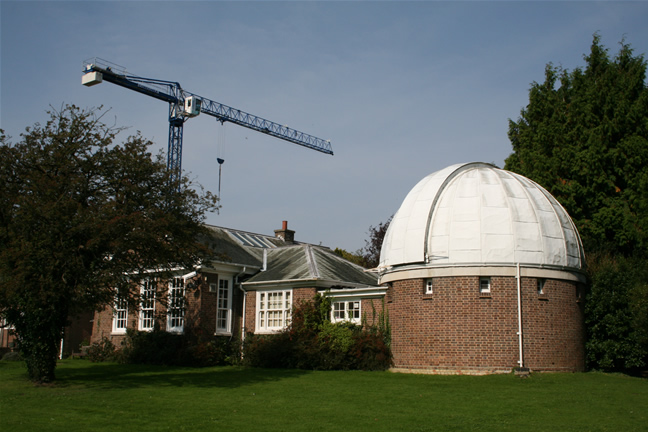
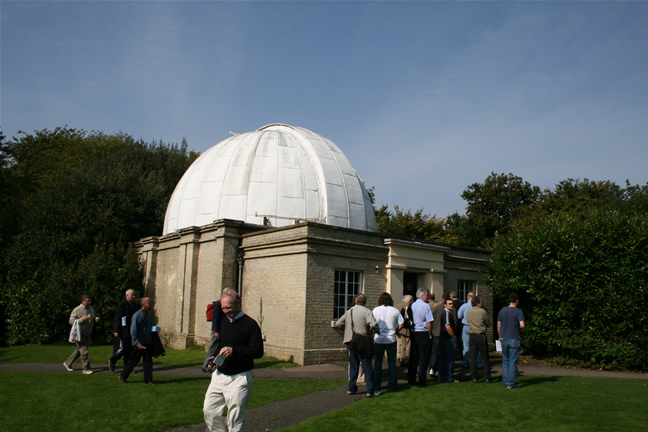
Schmidt Camera Dome Northumberland Telescope Dome Institute of Astronomy Library Building 36 Inch Telescope Dome

There was also an imaging competition, as well as a raffle. Overall a good day out and I am glad I attended, especially as the location of the day was local for me.
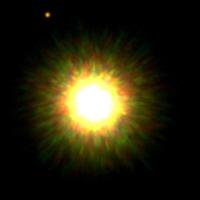
New Sun and PlanetAstronomers have captured what is believed to be the first image of a planet orbiting another Sun.

A dramatic photograph shows the star, 500 light years away, as a blazing fireball. At the top left of the picture is an orange speck that scientists strongly suspect is a giant planet.

Astronomers have calculated that the “companion” is eight times more massive than Jupiter and a long way out from the star - 330 times the distance of the Earth from the Sun. To classify as a planet, the object must be orbiting the star.

Canadian astronomer Dr David Lafrenicre, from the University of Toronto, who led the Gemini Observatory team that made the discovery, said: “This is the first time we have directly seen a planetary mass object in a likely orbit around a star like our Sun. If we confirm that this object is indeed gravitationally tied to the star, it will be a major step forward.”

Until now the only planet-like bodies to be photographed outside our Solar System have either been drifting freely in space or orbiting “brown dwarfs”. These are dim pseudo-stars which are too light to maintain the hydrogen-burning fusion reactions that power the Sun.

Since the 1990s astronomers have detected more than 300 “extra-solar” planets in other star systems.

The most common method used is to look for the way a planet’s gravity causes its parent star to “wobble”.

Another technique is to measure the drop in brightness of a star when a planet moves in front of it. Powerful space telescopes due to be launched in the next 10 years will make it easier to “see” planets outside the Solar System. The technology should also make it possible to analyse their atmospheres for signs of life. The image captured by the Gemini Observatory provides a first taste of what may be to come.

Could this planet be a new home for us? Could the planet be the correct distance from the Sun to be inhabitable?

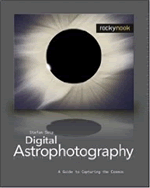
Digital Astrophotography BookDigital Astrophotography is a very clear, up to date and concise book on how to accomplish digital astrophotography.  The book details four main ways to take images, either via a digital compact camera, a webcam, with an SLR/DSLR or via a CCD camera.

It was refreshing to read a book which was up to date with some really nice colour screenshots and image included.  Most of the other books on astrophotography have not been updated, as they only discussed using either early webcams or manual SLR cameras.

Each chapter of Digital Astrophotography covers digital compact cameras, SLR cameras, webcams and CCD imagers. In each chapter you get information on the type of equipment, what to look out if you are considering a purchase, and how much you will likely pay (in dollars) for the equipment. Finally there is a table detailing the advantages and disadvantages of each piece of equipment.

Each piece of equipment is then covered in detail, including how to set up your piece of imaging equipment and how to take images, and how to process them. For example in the webcam chapter you are instructed how to set up and use the Philips SPC900 webcam and how to use VLounge, Registax software and Photoshop in order to obtain your finished images.

The final part of the book takes you through using the software program AstroArt to manipulate your astrophotography images. There is also a website to accompany the book which contains images you can download to practice on and follow the examples with.
 
Overall Digital Astrophotography by Stefan Seip is a brilliant book and one I read cover to cover.  If you are after a beginner’s type book about digital astrophotography and you want to learn how to image using a compact camera, webcam, DSLR or CCD imager then I can recommend this book.

Digital Astrophotography is available to buy here