Archive for : May, 2008

Introduction to Astronomy – Week 6

This was the final Wednesday night on the Introduction to Astronomy course and a bit of a shame it was all over.

This week we had a talk by Roderick Willstrop entitled “History of the Telescope”. Roderick took us through 400 years of the main developments of Telescopes and the major telescopes that have been built, including Space Telescopes.

Roderick went through a long list and dates of the major advances over time, these included:

Name Date Comments
Ham Lipperschey 1608  
Galilei Galileo 1609  
Johannes Hevelius 1647 Convex and Concave lens at eyepiece end
Isaac Newton 1668 Reflector
James Hadley 1721 1st successful 6″ reflector with 5ft tube
Chester Moor Hall 1733  
John Dolland 1759  
William Herschel 1776 7ft reflector, Uranus discovered on 13th March 1781, 40ft Reflector in Slough, 20ft Reflector in Bath
Pierre Louis Guimand 1799 Flint Glass, 9.6″ Refractor 1824 Dorpat Observatory Russia
Joseph von Fraunhofer 1824 9.6″ Dorpat refractor designed by Fraunhofer in Berlin, discovered Neptune 1846
Edward Cooper 1834 Built 13.3″ refractor built at Markree Castle, Ireland
Duke of Northumberland 1838  
Rev. John Craig 1852 25″ reflector
William Parsons 1845 6″ reflector at Birr Castle
William Lassell 1861 48″ reflector in Malta
Andrew Common 1879 36″ reflector
James Lick 1888 36″ telescope with 58ft focal length on Mount Hamilton
George Ellery Hale 1897 40″ telescope with 63ft focal length
Paris Exposition 1900 49″ refractor
Hale Telescope 1948 200″ telescope
BTA Russian 1975 6m and 40″ thick mirror
Multiple Mirror Telescope 1987 6 x 1.8m mirrors (72″) which was re-built in 2000 with a single 6.5m mirror
Keck I 1993 2 x 10m mirrors in 36 segments
Keck II 1996  
South African Large Telescope 2005 11m telescope
Large Binocular Telescope 2005 8.4m mirrors

Hopefully I wrote all these notes and dates correctly, although there may be some errors, if anyone wants to correct me, feel free to do so.

After the talk, we went out and visited the 3 mirror telescope (3MT) which Roderick actually designed.

The Three Mirror Telescope (3MT)
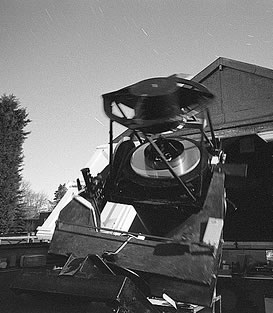
Three Mirror Telescope at CambridgeThe Three Mirror Telescope (3MT) has been developed at the Institute of Astronomy by Dr. Roderick Willstrop. Its optical design is unique because it is the only form of telescope which combines the three advantages of a wide field of view, very small sharp images, and all-reflection optics.

Reflecting telescopes have been built with apertures up to 10 metres, but they have fields of view limited to 40 arc minutes (Ritchey- Chretien two-mirror design) or 1 or 2 degrees with a 3- or 4-lens Wynne corrector near to the focus of the main mirror. Schmidt cameras can give fields of view of 7 or 8 degrees, but their apertures are limited to about 1.3 metres because they use a thin glass lens large enough to cover the whole aperture.

The 3MT has a field of view 5 degrees in diameter, and the ray- theoretical image size is less than 0.33 arc seconds everywhere, and less than 0.1 arc seconds over the central 1 degree of the field. Because no lenses are needed the images are perfectly achromatic, and furthermore it is possible, in principle, to build this telescope with a larger aperture than any Schmidt camera.

The design is based on a simpler one discovered in 1935 by the French optician Maurice Paul and rediscovered independently in 1945 by the American James Baker. The original Paul-Baker design had a paraboloidal primary mirror, a convex spherical secondary mirror and a concave spherical third mirror. If the aperture of the primary mirror was f/4, it would have given acceptable images, and a field of view of about a degree.

The good performance can be explained as follows: if the second mirror were a convex paraboloid (instead of spherical) the light from a distant star would be made parallel again after the second reflection. (This arrangement of two coaxial and confocal paraboloidal mirrors was described by Mersenne in 1636.) The third mirror would then also have to be paraboloidal to focus the light, and the field of view of the whole system would be no larger than that of a single paraboloidal mirror. The essential feature of the Paul-Baker design is that the second mirror is spherical, so the light is not exactly parallel after the first two reflections, but is deviated in just the same way as by the corrector lens of a Schmidt camera. Then the third mirror must also be spherical to focus the light, and a large field of view with sharp images is obtained. This telescope has also been called the Mersenne-Schmidt.

Baker suggested that the Hale 200-inch (5.08 metre) telescope might be given a wider field by using two auxiliary mirrors. It would not have been acceptable to enlarge the central hole in the irreplaceable 200-inch primary mirror. The third mirror, 2.1 metres (84 inches) in diameter and weighing one or two tons, would therefore have been mounted directly above it, so the system was never built. The field of view could have been just over 1 degree. In the f/3.3 Hale telescope, it would have been necessary to modify the shape of the secondary mirror to retain small, sharp images.
Introduction to Astronomy – Week 5

This week we had a talk by Lindsay King entitled “Galaxies – The Universes Building Blocks”. This week Lindsay went beyond the local group of galaxies and looked at different types of galaxies and clusters of galaxies. She then also looked back in time to the youngest galaxies at the limits of observation and showed how these most distant objects are detected.

The talk began with a look at Hubble’s galaxy classifactions as well as a mention to Fritz Zwicky who studied the Coma Galaxy Cluster in 1933 which was 300 million lightyears from Earth. At this time Fritz put forward the theory that unseen matter must exist, which we now call Dark Matter.

Lindsay also told us about the effect ‘RedShift’ which is when the speed at which a galaxy moves away changes the colour of the light. A red galaxy is moving further away, whilst a blue one is closer.

We were also introduced to the furthest galaxy away from us, which was discoverd by the Subaru telescope which is a Japanese telescope located in Hawaii. This furthest galaxy is said to be 13,000 million lightyears away.

We also got an explanation as to what “Gravitational Lensing” is. Mainly that mass distorts space-time and that galaxies form  where dark matter exists in order to trap gas and make stars. It was also noted that galaxy clusters are so large that they warp space-time around them.

The Schmidt Camera Telescope

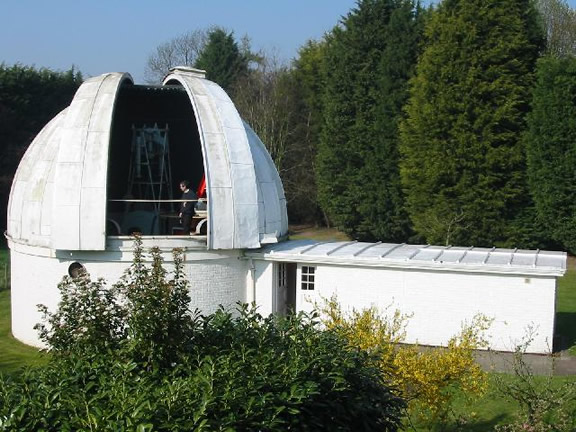
Cambridge Schmidt Camera TelescopeAfter the talk we went out to see the now unused Schmidt Camera telescope. It has not apparently been used since taking images of Halley’s Comet in 1986, and may be moved to Wales, to be used in the project for imaging potentially fatal asteroids coming towards the Earth.

The instrument itself was built in 1952 by Grubb-Parsons of Newcastle-upon-Tyne and replaced an older telescope in the existing dome, which had been made by T. Cooke & Sons Ltd. of London & York at the time of the move of the Solar Physics Observatory from South Kensington to Cambridge.

It is a `Classical Schmidt’ – the simplest and most efficient form of the ingenious wide-field camera invented in 1930 by Bernhard Schmidt of Hamburg Observatory. Light from the sky falls upon a 61 cm (24-inch) mirror with a spherical reflecting surface, at the bottom of the tube. It is reflected to a focus in the centre of the tube and half-way up it, 163 cm (64 inches) from the primary mirror. At the focus a photographic plate P 15 cm (6 inches) in diameter, which must be bent to fit a curved surface, records the star images in an area of sky 5 degrees in diameter. (The full Moon is half a degree in diameter.)

Without any further optical element the star images would be of poor quality owing to “spherical aberration”: light falling near the edge of the mirror would come to a focus too close to it, and light falling near the centre of the mirror would be focused a little too far away.

Schmidt’s invention was to place at the centre of curvature of the primary mirror, near the top of the tube, a weak meniscus lens (in this case 43 cm (17 inches) in diameter) with one aspheric optical surface: this makes the light which passes through it near the edge diverge slightly, lengthening the focus of the outer parts of the mirror, and makes the light passing through near the centre converge, shortening the focus of the centre of the mirror.

This optical combination of lens and mirror forms a fast, efficient camera giving sharp star images of uniform quality over the full 5 degrees field. It is an ideal sky-surveying instrument; by contrast the 36-inch (91.4 cm) telescope, with its paraboloidal mirror of 4.1 metres (162 inches) focal length (f/4.5), has a field of view only 7.2 arc minutes in diameter with images smaller than 2 arc seconds.

The auxiliary 15 cm (6 inch) telescope is for guiding. The exposure time is usually of the order of 10 minutes, and during this time the image can wander about on the photographic plate mainly because of irregularities in the refraction in the earth’s atmosphere. These are corrected by maintaining a star image at the intersection of the cross-wires in the guiding telescope.

The Palomar and U.K. 48-inch (1.22 metres) Schmidt cameras which were used to make the all-sky surveys (now kept in the Cambridge Astronomical Survey Unit) have apertures nearly three times as large as our telescope, but focal lengths (and tubes) only twice as long. Only one Schmidt camera (the 53-inch (1.35 metres) at Tautenburg, Germany) has ever been built larger than these two.

The reason is that, if a Schmidt camera is simply scaled up, its image size is also scaled up, and as Bernhard Schmidt himself predicted, the 48-inch Schmidts are close to the practical limit. The main image defect arises because the thin lens can correct the “spherical aberration” of the mirror exactly in only one colour of light, (usually blueish green), red light is under-corrected, and blue or ultra-violet light is over-corrected.

To minimise the length of the tube, and so the size and cost of the dome, the 48-inch Schmidts have been made with an aperture of f/2.5 (this one is f/3.7) and the “spherical aberration” of the mirror is then 3.2 times as large as in the camera.

Three of the largest Schmidt cameras have been fitted with “achromatic” lenses which reduce the residual colour errors, but astronomers now use very fine-grain emulsions, and wish to observe a wide range of colours of light, so these large Schmidts are still at the practical limit of size.

CAA Talk – Gamma-ray Bursts

The monthly Cambridge Astronomy Association talk was entitled “Gamma-ray bursts at probes of the distant Universe” by Professor Nial Tanvir.

Nial gained his PhD on the extragalactic distance scale at the University of Durham in 1992, and then came to the Institute of Astronomy where he was a postdoc. He became a lecturer at the University of Hertfordshire in 1999, and he became a professor at the University of Leicester in 2006.

Gamma-ray bursts are the most luminous events known in the Universe and can be detected at great distances. Nial described how GRBs are being used to study the first generations of stars and galaxies, and to consider prospects for pushing these studies further in the future. He also give an update on the recent record-breaking GRB 080319B, which is by far the most distant “naked-eye” source ever found.

The talk was very in-depth, but very interesting as I had seen information on how the Gamma Ray bursts are recorded and people are notified via email or SMS text message that a Gamma Ray burst has occured.  I think there was a Sky at Night program about it.

We were told how Hubble in the 1920’s proved that spiral nebulae were external galaxies to the milky way at great distances. Hubble also discovered how the entire universe seems to be expanding.

I discovered that light travels at 300,000 km per second. We were also shown the different types of wavelengths in the electromagnetic wavelength.  These are radio waves, microwaves, infrared, visible light, ultraviolet light, x-rays and gamma rays.

We also learnt the basics of how the current universe was formed in this order:

  • Big Bang (0)
  • Inflation (10-32 seconds)
  • Quark Soup (1 second)
  • Big Freeze Out (300,000 years)
  • Parting Company (1 billion years)
  • First Galaxies (12-15 billion years)
  • Modern Universe

Gamma Ray Bursts (GRBs) are detected by satellites, the main one being the SWIFT satellite. 

080319B was an extremely intense GRB with the brightest visible afterglow ever (at 5th magnitude, bright enough to see with the naked eye). It is the most energetic event detected by the Swift satellite so far and the most luminous optical source ever seen.

Overall I learnt that the Gamma Ray bursts probably originate from distant galaxies, which are difficult to see via optical systems.  The main worry is that a nearby gamma ray burst could possibly cause mass extinctions on Earth.

Introduction to Astronomy – Week 4

Week 4 of the Introduction to Astronomy course at the IOA in Cambridge saw us having a talk from Carolin Crawford entitled “The Stars, Gas and Dust of the Milky Way”.

Carolin’s talk was one of the most interesting and complicated that we have had so far on the course.  Carolin’s talk really centered around the gas, dust and dark matter that exists in our universe.

The talk began by describing the size of our universe and our place in it. It was described to us that our bulge in our universe is 6kpc wide (kiloparsec) which is about 19.5 lightyears. With the stellar disc being about 30kpc, the outer stellar halo being 50kpc and the dark matter halo being outside of this. The dark matter halo makes up 90% of our galaxy by mass. 

It was also pointed out that hydrogen is the most common element in our solar system.

We were shown that we are located in the Orion arm of the galaxy between the Sagittarius and Perseus arm.

It was good to be shown some amazing images of nebulae from the Hubble telescope, as it allowed me to record some names of nebulae worth looking out for, which included Cats Eye Nebula, Eagle Nebula, Rosette Nebula and the Iris Nebula.

At the end of the talk we went to view the moon through another of the Institutes Telescopes.  This time it was the 36 inch telescope.

The 36 Inch Telescope

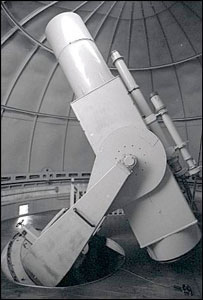
36 Inch Telescope at the Institute of Astronomy in Cambridge UKThe 36 inch telescope was built in 1951-55 by the now-defunct firm of Sir Howard Grubb, Parsons & Co. at Newcastle-upon Tyne. It replaced a much older telescope of the same aperture, which was brought to Cambridge from South Kensington when the Solar Physics Observatory moved there in 1913. That telescope was returned to its owners (The Science Museum) before the new one was installed; the Director of the Observatories at the time (Professor R.O. Redman), who in his youth had made substantial use of the old telescope, always averred that it should never have left the Museum!

The 36-inch, which is thought to be the largest telescope in the country, has three possible focal stations. There is a prime focus with a focal ratio of f/4.5; the primary mirror is a paraboloid, so no corrector is needed to obtain good images on the optical axis. In practice the prime focus has been little used: the telescope is large enough to make access to the focus difficult from the side of the tube. The other possible foci are coude, with a choice of two focal ratios, f/18 and f/30. The coude arrangement is unusual inasmuch as the light beam is directed UP the polar axis rather than downwards: that permits the shorter focal ratio to be exceptionally short for a coude, and results in a focus at a level near to that of the telescope, which is somewhat convenient for a lone observer who needs to operate both the telescope and whatever auxiliary equipment is placed at the focus.

On the other hand, the arrangement lacks part of the advantage of a conventional coude focus, which is often in a basement that enjoys good passive thermal stability (and, from the point of view of the observer personally, protection from wind and extremes of cold!).

Until recently the f/18 focus has been the favoured option, but new equipment that for the first time utilizes the f/30 arrangement has now been brought into use.

The f/30 focus is just within the dome, high up to the north of the telescope, and its use involves a further reflection. In the present application, that reflection takes place close to the focus, and the beam is turned vertically downwards by successive internal reflections within two right-angle quartz prisms cemented together.

The initial image is re-imaged at a focal ratio of f/14.5 at the position required for the auxiliary equipment. A simple plano-convex quartz field lens is cemented to the exit face of the quartz-prism assembly to image the telescope aperture upon the re-imaging lens.

In the early years of its operation, the telescope was used to send starlight into a spectrometer where the light intensities in several wavelength regions. which were accurately defined by masks in the focal plane of the spectrum, could be inter-compared.

The view through this scope was one of the moons craters, although it was not exactly clear,  I think a view of the full moon would have looked more impressive.

The telescope itself is very impressive and very large, it sits on a classic Alt type mount just like my LX200 but this also have a fixed concrete wedge underneath it as well.  The telescope itself does track, but unfortunately most of the domes require manual rotation.

Meade DSI Pro Mono Sold

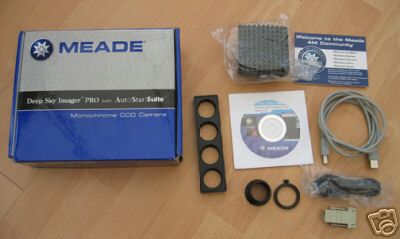
Meade DSI Pro Mono For SaleI had my Meade DSI (Deep Sky Imager) up for sale. It was the DSI Mono Pro I edition. It was complete and boxed as new.

I listed it on eBay for £225 or Best Offer, and got £200 for it, although eBay and PayPal took about £15 in fees for it.

It was a great imager and real good introduction to CCD imaging, but I have decided to upgrade to the Meade DSI Pro II in order to get some more pixels in my images, although now the Meade DSI Pro III is now available, but very expensive at around £650 (dated May 2008).

How to Find the Sun

This seems a bit of a strange blog post title, but I was finding it difficult to get my LX200 telescope to actually find and track the sun when I was undertaking some solar observing.

The first time I found the Sun it was by chance, as it’s difficult when you can’t actually look at the Sun or use the viewfinder to locate the Sun.

There are a few different ways to locate the sun, but the reason I really wrote this post is to tell you about the new piece of kit I got for my Birthday for about £20, which now makes finding the Sun really easy.

I have a Sun location file which you can upload to your telescope which allows you to have the location of the Sun in your LX200 handset, you can find it on my downloads page.

I also read somewhere that you can locate the Sun when the reflection of the telescope tripod on the ground is at it’s smallest.

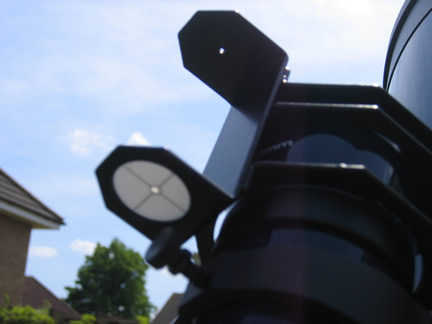
But I purchased the Astro Engineering AC466 item which turns your viewfinder into a solar viewfinder.

Astro Engineering AC466 Solar Viewfinder AttacmentAll it does is fit over the end of your viewfinder and it’s then tightened via a thumbscrew. It has a hole in one end and cross-hairs at the other end.

All you then need to do is then align the white spot, which is the Sun coming through the small hole onto the cross-hairs and the Sun is centered! Brilliant and easy for around £20.

The AC466 solar finder fits directly over the front of the standard 50mm finder of the type used on Meade®, Celestron, Sky Watcher and many other telescopes.

Introduction to Astronomy – Week 3

This week at the Institute of Astronomy in Cambridge we had a talk by Ken Day entitled “A Cook’s Tour of the Solar System” as part of the Introduction of Astronomy course I am partaking in via the Cambridge Astronomy Association.

Ken took us through all of the planets in the solar system, plus comets and asteroids. He gave explanations about each object in the solar system and backed up each item with some great full colour images in his presentation.

I picked up a new useful facts such as:

  • The word “Planet” means wanderer in Greek.
  • The Sun is 109 times the diameter of the Earth.
  • Venera 9 the Russian probe to Venus in 1975 only lasted 23 minutes once it landed due to the harsh surface environment.
  • Olympus Mons is the largest volcano in the Solar System which is on Mars.
  • There are dark “spokes” in Saturn’s rings – something that I did not know.

There was no trip out to any of the IOA telescopes tonight, a bit of a shame as it was a clear night, but instead we were joined by Green Witch the astronomy retailers from near Cambridge.  They bought a few items with them including Philip’s astronomy book, some binoculars and a Skywatcher telescope and some eyepieces.  They also handed out flyer’s offering us 5% off anything we purchased.

Green Witch set up a Celestron NexStar 5 telescope outside and they gave us the chance to view Mercury and the Moon. Everybody rushed outside after the talk so there was a queue to view Mercury, which everybody wanted to see.

Whilst the NexStar was being re-aligned on Mercury (the scope seemed to drift a lot, and not track that well) it was strange to see how similar the menu options were on the Celestron to the Meade, as I have never used or really seen a Celestron NexStar before. After two cups of coffee it was time to go home.

Children’s Astronaut Costumes

 Does your child dream of beng an astronaut with NASA? Well I found these Astronaut costumes for kids on the web in Orange and in White.

“Take one giant leap for mankind in our astronaut flight suit costumes! These high-quality flight suits are replicas of those worn by the astronauts and NASA flight crews, and feature chest and waist harness buckles, padded neck collar ring, and matching custom embroidered NASA vector cap”.

What great fun for kids for dress-ups, fancy dress parties – your very own spaceman costume.

They look really good and they fit ages 4-8 years old. They cost £35 from The Science Museum store.

There are sizes for 4-6 year olds, and then 6-8 year old sizes.

Buy a Kids Astronaut Costume here.

Introduction to Astronomy – Week 2

Week 2 of the Introduction to Astronomy course was presented by Peter Howell entitled “Sunshine and Green Cheese”. Peters talk covered details on the Moon and the Sun.

Peter started by talking about the Sun, and gave a great talk on every aspect of the Sun, including information that sunspots appear in magnetic pairs. Also that charged particles from the Sun give rise to the Northern and Southern lights. It was also interesting to hear that a supernova 10 billion years ago produced gold.

Peter then discussed in depth about the various stages of the moon, and why First Quarter is called what it is, and he pointed out all the Apollo landing sites on the Moon.  Peter also showed images of interesting areas of the Moon to look at, including Schroter’s Valley, Rupes Recta fault line and the Hadley Rille.

Peter handed out paper moon maps as well as sheets in order to allow you to construct your own sun dial (diptisch dial). It was very interesting to find out that the equation of time varies heavily between summer and winter, indicating that the Earth rotates at different speeds through out the year.

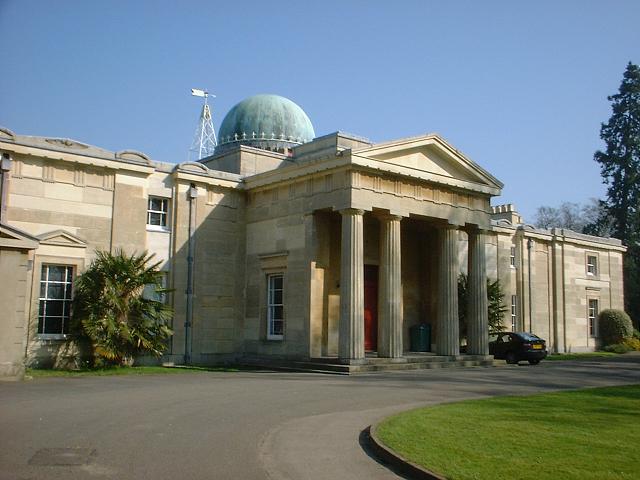
Cambridge Observatory BuildingAfter the talk was over and we had tea, we ventured out to the Institute of Astronomy’s outside Observatory building which houses the library. The library room holds a number of very old and interesting astronomy and cosmology books together with the latest astronomy journals and magazines.

Whilst in the library room we managed to see slides taken between 1945 and 1985 by the Schmidt telescope. 

The Schmidt instrument was built in 1952 by Grubb-Parsons of Newcastle-upon-Tyne and replaced an older telescope in the existing dome, which had been made by T. Cooke & Sons Ltd. of London & York at the time of the move of the Solar Physics Observatory from South Kensington to Cambridge.

It is a `Classical Schmidt’ – the simplest and most efficient form of the ingenious wide-field camera invented in 1930 by Bernhard Schmidt of Hamburg Observatory. Light from the sky falls upon a 61 cm (24-inch) mirror with a spherical reflecting surface, at the bottom of the tube. It is reflected to a focus in the centre of the tube and half-way up it, 163 cm (64 inches) from the primary mirror. At the focus a photographic plate P 15 cm (6 inches) in diameter, which must be bent to fit a curved surface, records the star images in an area of sky 5 degrees in diameter. (The full Moon is half a degree in diameter.)

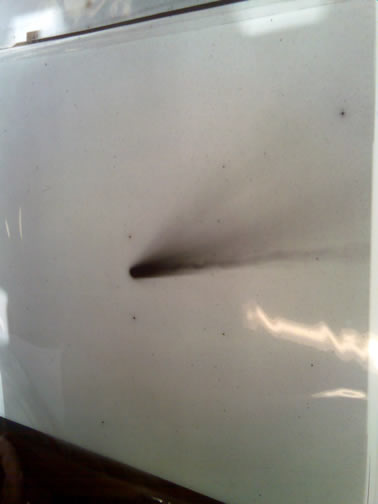
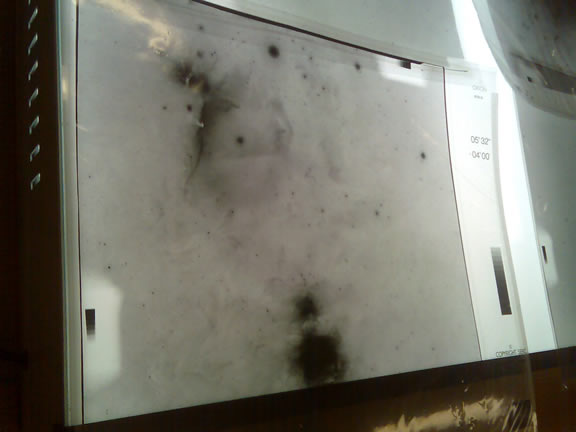
Below are some images I took with my mobile phone that were produced by the Schmidt Camera of Halley’s Comet in 1986 and another part of the cosmos.

Halleys Comet Image from Schmidt Telescope 1986 Image from Schmidt Telescope at Institute of Astronomy Cambridge

Astrophotography for the Amateur

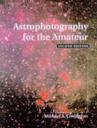
Astrophotography for the amateurThis is the second edition of Michael Covington’s Astrophotography for the amateur book.  It is nice to find a book solely on astrophotography, as that’s what interests me most, I always like to come in from the cold with some images or video to work on.

Although the title of the book is astrophotography for the amateur, I did find this book to be quite in depth and it does include non-beginner topics such as exposure tables, and lots of mathematical equations. The book does not include many colour images, only in a section in the centre of the book.

Astrophotography for the amateur is broken down into four main sections; simple techniques, advanced techniques, photographic technology and digital imaging.

The first section takes you through photographing stars without a telescope, and how to shoot eclipses, the moon, comets and meteors.

The second section on advanced techniques takes you through performing prime focus photography, which is where you connect the camera directly to the telescope.  This section also discusses dealing with tracking, vibration, unsteady air, dew and more. This section finishes off detailing piggy backing your camera on your telescope, building and using a barn door tracker, using lenses, dealing with light pollution and how to get the best polar alignment.

The third section entitled photographic technology covers using traditional SLR cameras, there is no mention of digital cameras in this section.  This section does include everything you wanted to know about SLR cameras though, such as about film, various cameras and developing and processing your shots.

The final section is all about digital imaging, including file compression, how to manipulate colour, combining images, printing, smoothing, sharpening, working with histograms and all about CCD imaging.  The CCD section talks about how CCD works, aiming and focusing, exposures and focal lengths and more.

Astrophotography for the amateur also includes six appendices, such as exposure tables, plans for an electronic drive corrector and about photographic filters as well as an appendix on mathematical analysis of polar-axis misalignment.

So as you can tell there is a lot of content in this book, and it covers lots of areas of astrophotography and it packs in a lot of information. Overall a very good book on astrophotography, just a shame that DSLR cameras were not covered in any detail, perhaps in the next edition the SLR section will be changed to a DSLR section.

Astrophotography for the Amateur is available at Waterstones