Telescope Portable Battery

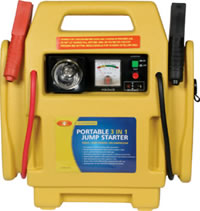
Telescope Portable Battery PowerIf you ever want to use your GoTo telescope on location then you’ll need a 12v power source.

Maplin have their Portable Jump Start and Air Compressor on offer until the end of December 2008 for just £19.99 – perfect for powering your telescope.

The perfect gift for the astronomer in your family, plus it will always do lots of other jobs around the house such as pump up tyres or jump start your car battery as well.

The original price was £44.99, so now you can save £25! Order your Battery here now!

Maplin Telescope Battery Specifications:

  • Up to 400A cranking power
  • 12V power supply output – ideal for spotlights, car vacuums, portable fridges etc
  • 200psi compressor for inflating car and cycle tyres, inflatable toys etc.
  • Unit houses a sealed 17Ah battery with meter to show battery charge
  • Built-in light for emergencies
  • Complete with heavy duty jump leads, mains power supply and car cigarette lead


Sky at Night Magazine Subscription

Sky at Night MagazineGet someone you love, preferably an astronomer, a subscription to Sky at Night magazine. The magazine comes with a CD packed full of interactive goodies every month as well as a magazine which includes astronomy news, how to’s, in-depth articles and my favourite – astronomy adverts!

The cheapest place to buy a subscription online is with Magazine Group, who currently have the subscription for:

6 months Sky at Night Magazine : £17.80

12 months Sky at Night Magazine : £35.75

That works out to be about £3 a magazine including delivery, instead of the shop price of £4.25

AstroBlast Day 2008

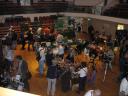
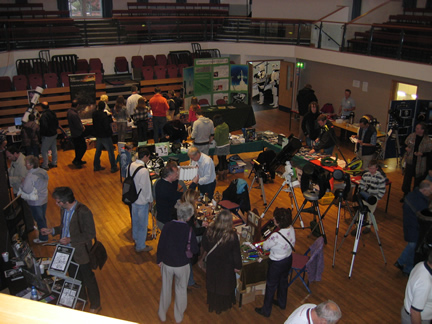
Astroblast 2008 Exhibition HallOn Sunday I travelled to Bedford for my first ever Astroblast. I got to Bedford School just in time to attend Nik Szymanek’s workshop talk on the basics of CCD imaging. I have attended a couple of Nik’s talks and at last this time he went a little further into how he gets his results, by covering his setup and how CCDs work as well as information on dark frames, flat fields etc.

I would like to hear from Nik all day long about his methods, and he does actually do some 1 day workshops now and again, so I think I shall book one of these once they are on at a venue near me.
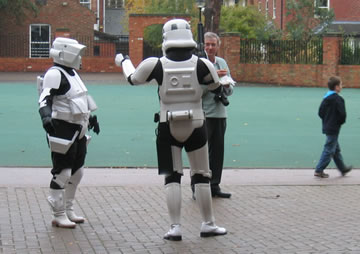
AstroBlast 2008 StormtroopersI then walked down to the main exhibition hall which contained all of the exhibitors including Green Witch, Astronomy Now and many others. I also saw a recon pair of stormtroopers from the 501st garrison who were keeping guard and directing people around.

In the afternoon I sat in on a talk by Lee Sproats from Green Witch who gave a talk entitled “Telescopes of the Future” in which Lee spoke about the present and future research telescopes.

Lee began by talking about the history of telescopes and about adaptive optics, as well as active optics and how large mirrors are actually built and transported.

Here is a list of the telescopes that Lee talked about and some of the specifications of the telescopes:

Large Binocular Telescope

  • 2 x 8.4m F/1 mirrors
  • 11.8m aperture
  • 600 ton weight
  • 3x resolution of the Hubble Telescope due to adaptive optics

Large Synoptic Survey Telescope

  • 3,200 Mp Camera
  • Paul Baker optical design
  • 1GB/sec download speed

Giant Magellan Telescope

  • 7 x 8.4m mirrors
  • 7 secondary mirrors
  • Same resolving power as a 24.5m mirror

EELT

  • 96 x 1.45m Segments (42m mirror)
  • 5,500 tons in weight
  • 6m secondary mirror

JWST (James Webb Telescope)

  • 12ft long
  • 39ft wide
  • 6.5m mirror

NASA DLR

  • A 2.5m telescope on a 747 plane which can handle flying times of 8 hours

LAMA

  • 18 x 10m mirrors
  • Mercury mirrors

TMT

  • 30m mirror F/1
  • 2m secondary mirror

OWL

  • 100m mirror
  • 130m high

It was good to see lots of activities for the children especially the rocket bulding, and I can’t wait to take my son in a few years so he can build rockets and do modelling etc.

Now I have mentioned rockets, I attended a talk by the Great British Rocketry Team, who gave an interesting talk on the different types of competition classes of rocketeering there are as well as talking about their trip to the Baikonur Cosmodrome, which holds a lot of history pieces in the space museum. They also told us that Gagarin actually had to parachute out of his capsule when re-entering the earth’s atmosphere at about 60,000 feet. He also mentioned that Russia actually had their own Space Shuttle which looks almost identical to the US version, but the Russian’s did not think much of the design, and they only flew the shuttle twice and it was never manned.

As I was leaving the Astroblast the children all gathered on the front lawn and launched their rockets which they had made during the day, they were launched two at a time with help from an air compressor, some went quite high, and you had to keep your eye on them, so you did not have one land on your head!

I have fancied getting into some rocketry, but I think I will start with some simple stomp rockets and bicarbonate rocket kits first.

Overall, a great day of free talks and exhibitors, I look forward to attending next year’s Astroblast 2009.

Green Laser Pointer Review

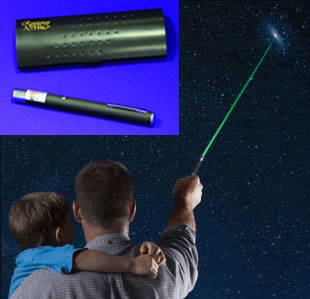
Astronomy Laser PointerI attended my first Star Party the other week and both the hosts of the party used green laser pointers to point out which celestial objects we were actually looking at through the telescopes and on the large projection screen.

The green laser pointers were amazing and the beam of light went all the way through the sky to the object, which made it look like the beam was actually touching the stars!

So I decided to get myself a green laser pointer, I chose a Revelation Green Laser Pointer from Telescope Planet, it arrived quickly and came in a presentation metal box and it included 2x AAA batteries as well as instructions.

The laser pointer has a 5 mW output and has a beam range of over 12,000 ft. The unit is of very high quality and a great present for any astronomer, especially at the price of around £30.

The laser pointer can also be used in conjunction with a universal bracket which can be fitted to most telescopes which allows the laser pointer to be used as a very capable finderscope.

You can buy the green laser pointer from Telescope Planet here.

Buy Astronaut Food Here

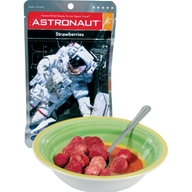
Astronaut Space FoodLooking for an unusal gift for someone? How about Astronaut Food? You can get Strawberries and Neopolitan Ice Cream.

Now you can eat the same food Nasa Astronauts eat on space missions. The foil sachets contain freeze dried strawberries or ice cream which last almost indefinitely, making them suitable for long space flights.

As they are eaten, saliva in the mouth re-hydrates the ultra-light chunks, returning them to their original state. Just Pop a Strawberry one in your mouth and it swells up magically to a full size fully flavoured succulent fruit. Brilliant for parties, perhaps Star Parties!

Each Astronaut Food packet is £2.99, you can buy the Strawberries Astronaut Food here and buy the Neopolitan Ice Cream Astronaut Food here.

“Colouring the Night Sky” Talk by Alan Aylward

Tonight’s talk at the Cambridge Astronomy Assocation was by Alan Aylward who was telling us everything we needed to know about aurorae.

Aurora can actually be seen from space, and some images demonstrated this, with views from the NASA shuttle. Aurora were actually treated with fear in historical times.

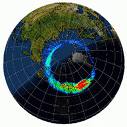
Aurora OvalEarly research showed that aurorae actually extended around the poles of the Earth in a ring ~(as shown in the accompanying image), and the ring (more commonly called the “aurora oval”) does actually move, so depending on where it is, you may see an aurora.

Aurora’s have actually been visible from the UK, and we were told that in the UK we may have the chance to see aurora up to three times a year, but cloudy nights decrease our chances of viewing one.

The Earth’s aurorae are actually triggered by the Sun, as the solar winds interaction with the magnetosphere is mapped down into our atmosphere. We were also informed that there are different colours to the aurorae. A red aurora means that the aurora is very high in the atmosphere, whilst the middle height colour is green and a low aurora provides a purple colour in the sky.

We were told that Coronal Mass Ejections (CME’s) create the Earth’s aurorae activity, but other planets also have aurorae including Jupiter which creates its own aurorae with a lot of help from the volcanic moon Io. Saturn also have aurorae as well, but they are 100x less active than Jupiter’s.

Overall we learnt, that anything with magnetic fields has aurorae. This was a great talk that told us everything we wanted to know about aurorae, and even more besides.

Impact Day 2008

On Sunday I visited the Cambridge Astronomy Association for the Impact Day 2008, which was a free day of lectures about comets and meteorites.

As well as a full day of lectures there were also a number of stalls selling astronomy books, astronomy hardware and of course a number of meteorites. I was amazed to see the actual number of meteorites that you could purchase, which included rock from the Moon and from Mars.

There were lots of activities for children, including making model craters and the children also received their own iron meteorite for a small fee.

I attended three of the five talks during the day. The first one was by Dr Caroline Smith who was from the Natural History Museum in London, and she looks after nearly 2,000 meteorites in the national collection. We were told that there are over 35,000 meteorites found so far, and that 34,000 of these have come from the Antarctic. The desert of the Antarctic is a great place to find meteorites as they stand out so well in the snow and the dry conditions enhance the preservation of the meteorites, as in a normal country within 20,000 years a meteorite can breakdown and disappear.

We were also told that meteorites can give us the age of the solar system and details on the evolution of the solar system.

It was interesting to find out that stony meteorites are broken down into two groups; achondrites and chondrites. Achondrites have undergone melting whilst Chondrites have not. It was also mentioned that Calcium Aluminium Rich Inclusions (CAI) allow you to date the meteorite.

I also attended a talk entitled “Do you come here often? Dirty snowballs: Comets” by Jonathan Shanklin and a talk by Nik Szymanek, which unfortunately I had seen before, but it was worth sitting through it again, I can’t get bored of seeing Nik’s astrophotography images.

Overall it was a great day, and even better it was all free.

Philips SPC1300 Webcam for Astronomy?

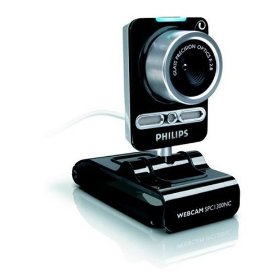
Philips SPC1300 WebcamI noticed today that Philips have released a new range of webcams, and there are a couple of Pro models. The main one to look at is the SPC1300 or SPC1330 as it’s called on the Philips web site. The SPC1300 is said to be a 2 Megapixel webcam, unlike the SPC900 which is a 1.3 Megapixel camera.

The major downside of the new SPC1300 is that the sensor is a CMOS sensor where as the SPC900 is a CCD sensor. But will this make a lot of difference when undertaking astrophotography?

Is the SPC1300 the new SPC900? Can the SPC1300 be taken apart and the lens removed and a standard plastic lens adaptor be screwed in? I suppose the only way to find out is to purchase one and try and take it apart.

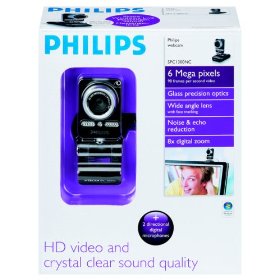
Philips SPC1300 Webcam BoxThe cheapest place to buy from seems to be Amazon or Pixmania for around £50.

The weight of the webcam is only 110g and the fixed lens is f/2.8

If anybody has more information on this, or has one and has adapted it, I would love to know about it, so please leave some comments about it.

Canon 450D Digital SLR Camera Review

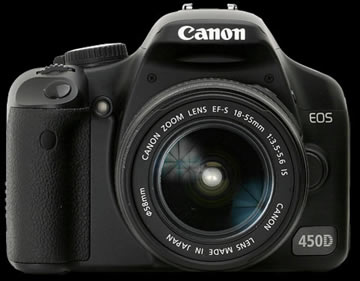
Canon 450D CameraMy first DSLR purchase was a Canon 400D, which I purchased in July 2007, so about 14 months ago. A great camera and the only reason I bought it was to use it for astronomy. But once I heard about the new 450D being released, I thought why not upgrade? Well I left it a while then after hearing a talk be Nik Symanchek I decided to go for it.

I ended up selling my 400D camera on Amazon and then purchased my new Canon 450D from Dixons, for £446 which luckily included a £50 cashback offer from Canon as well as free delivery at the time.

The main reason for the upgrade was the Live View mode, my main problem with doing astrophotography for me was getting the object in focus in the small cameras viewfinder. I did invest in a right angled viewfinder with 2x magnification, but even that was not that easy to use, but it did help.

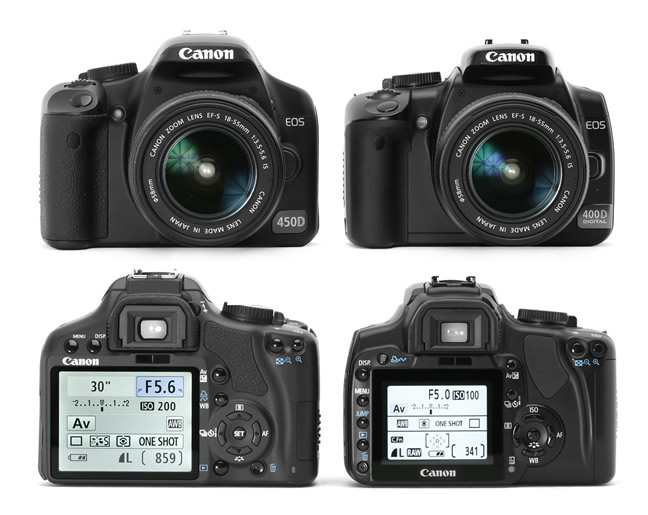
Canon 400D vs Canon 450DThere is not a great deal of difference cosmetically between the cameras. The menus and layout of the camera are very similar. If you already have a 350d or 400d then you will find using the 450d really easy.

The new 450D is lighter than the 400D, it also has a nice feel to the grip now, with a kind of mottled effect. The 450D now comes with a Image Stabilised lens (IS) which is a nice touch.

On the back of the 450D are the biggest changes, with the buttons moved around in order to accommodate the new slightly larger 3 inch screen.

The Canon battery type has changed and the Compact Flash card slot has been replaced with an SD card, which is useful, as it seems most cameras have now gone back to SD cards, as my HD camcorder also takes SD cards.

The 450D now has 12 mega-pixels instead of the 10 mega-pixels in the 400D.

The Live View mode works in all modes except in Automatic mode, so don’t expect to use the live view just like a compact digital camera. After pressing the “Set” button to enter Live View mode you can zoom in on the object by 5x or 10x magnification, which should help with focusing whilst doing astrophotography. I think you can also get a live view through a PC or laptop, even more useful.

The standard ISO settings are still there. I would have thought we would have seen an ISO setting of 3200 available, but maybe that will be on the next model, 500D? I also think the next model will have 15 megapixels and probably an HD video recording facility. But we will have to wait and see.

Overall the 450D seems worth upgrading to if you really think you need an extra 2 megapixels or the live view mode, otherwise stick with the 400D if you have it. If you don’t have a DSLR then the Canon 450D is a great camera and worth a purchase.

The best price for the Canon 450D Digital SLR Camera seemed to be from either Dixons or Amazon when I was looking.

Federation of Astronomical Societies Convention 2008

I decided to attend my first Federation of Astronomical Societies Convention which provided me with my first whole day of astronomy talks, held at the Cambridge Institute of Astronomy on Saturday 21st September 2008.

The first talk was by Andy Fabian entitled “The Power of Black Holes”. Andy talked about the possibility of their being a black hole in the middle of our galaxy which can be viewed on ly in infrared as there is a bulge in the middle of our galaxy. He went through the history of who discovered black holes, such as John Michel who in 1784 was the first to work on the possibility of a black hole. He also talked about astrophysical black holes which have olny mass and spin and about gravitational red shift.

The second talk was by Nik Szymanek entitled “Photographing the Night Sky”, which was really why I attended the whole day, and his talk did not disappoint, with lots of amazing astrophotography images in the talk and his talk also contained an 8 minute video. I think in the future I would like Nik to get a bit more technical and actually tell us exactly how to take his type of magical photographs.

Another talk was by Barrie Jones entitled “The Seach for Extra-Terrestrial Life”. This talk covered the search for Exoplanets, which are mainly found by radial velocity. He also told us about what needs to exist on the planet to allow us to find a habitable planet, such as temperature, carbon and water together or ozone and oxygen photosynthesis or oxygen and methane.  For us to find technically intelligent aliens they need to have binocular vision, hands and brains.

The final talk was by Somak Raychaudhury entitled “Einstein’s Outrageous Legacy – Black Holes, Cosmic Illusions and Dark Energy”, but I did not stay for this, as I think I had already seen the speaker at a Cambridge Astronomy Association night.

There were lots of stalls in the main foyer, including stalls from Astronomica, Green Witch, Cambridge University Press, Nik Szymanek and many other book stalls as well as stalls from the national and other local astronomy clubs.

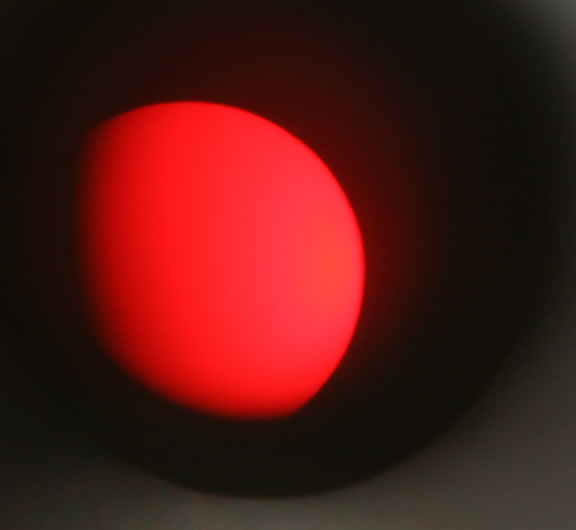
The Sun through a Coronado PST TelescopeGreen Witch set up a Coronado PST telescope outside which many people used to get their first view of the Sun, this is the image I managed to get by putting my Canon 400d up to the eyepiece of the Coronado PST.  There was a really good solar flare coming from the Sun but this does not seem to have come out on the photograph.

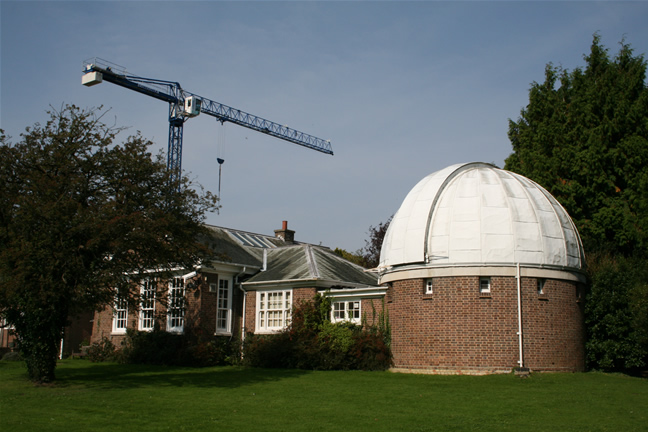
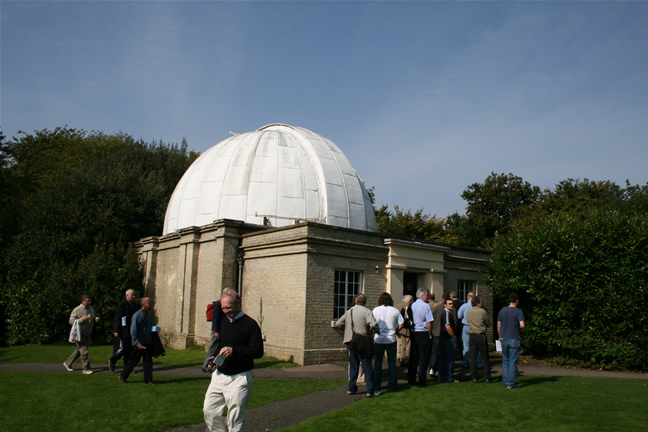
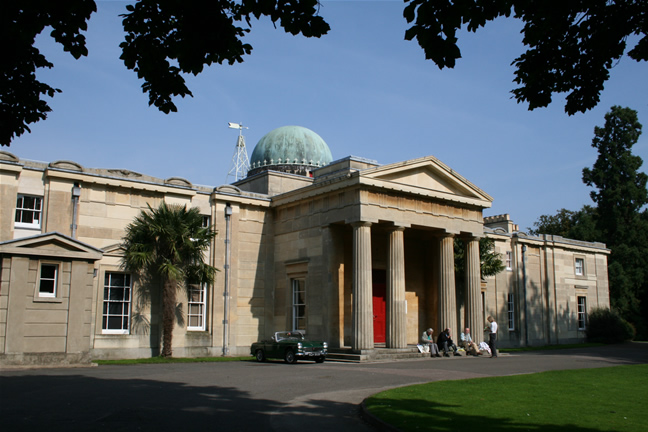
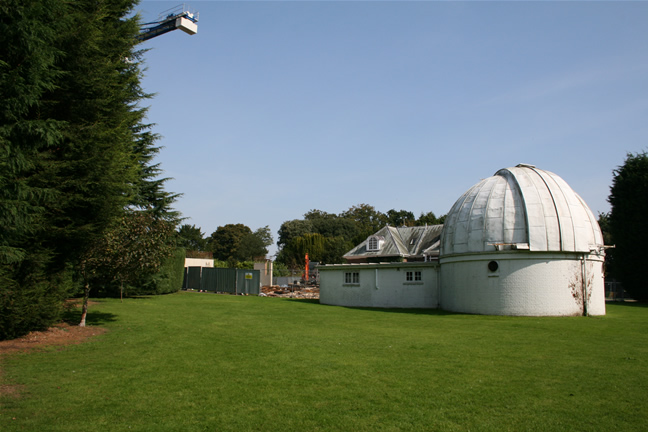
Tea, Coffee, soft drinks and biscuits were served all day long, never have I drunk so much tea in one day! The weather was perfect and during lunch there was a tour around the on-site telescopes. Here are some photographs I took of the various domes, namely the Northumberland, 32 inch, Schmidt camera telescopes as well as the Institute of Astronomy library building.

Schmidt Camera Dome Northumberland Telescope Dome Institute of Astronomy Library Building 36 Inch Telescope Dome

There was also an imaging competition, as well as a raffle. Overall a good day out and I am glad I attended, especially as the location of the day was local for me.