
Cosmic Challenge Book Review
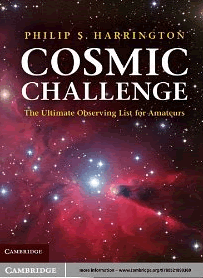 Cosmic Challenge contains nearly 500 pages and lists over 500 star targets for you to find. The book is aimed at both beginners and advanced astronomers alike, as the book contains a mix of Solar System and deep-sky targets to hunt for.
The first 25 pages of the book tell us about our own eyes and how they work, as well as information on binoculars, collimation, using baffling/flocking, eyepieces, the best filters to use on what objects and the things to think about when it comes to your observing site. This includes information on the jet stream, the Pickering seeing scale, the Bortle scale of darkness and more.
Cosmic Challenge is then split into objects you can hunt out with your naked eyes, binoculars, small telescopes (3 to 5 inch) and giant binoculars, medium telescopes (6 to 9.25 inches), large telescopes (10 – 14 inches) and very large/monster telescopes (15+ inches).
I think it was a great idea to divide the book up this way, as you don’t want to find yourself looking for an object like Palomar 1 with a 3 inch telescope. Having the naked eye chapter also means you don’t even need a telescope to benefit from Cosmic Challenge. Then if you do decide to invest in some large binoculars or a larger telescope you can then come back to this book and try hunting some more elusive targets.
There are also then subsections within each size of telescope required, informing you in what season the object is visible.
Each of the 188 targets in the book are well laid out and begin with a large title with RA and Dec co-ordinates, the name of the constellation and magnitude information. There is then a diagram within the constellation (if applicable) of where to find the object. Each target also contains a very nice description of the target and it’s background plus tips on how best to view it.
There are three appendices. The first appendix is called the cosmic challenge, this displays all of the 188 targets into a large table for easy reference. The second appendix is a guide of suggested further reading whilst the last appendix supplies you with 100 challenging double stars to try and locate.
Cosmic Challenge is a very fun book, what makes it so good is that the layout is very pleasing on the eye and objects are really easy to find in the book (maybe not so easy in the sky!). Another great thing about Cosmic Challenge is that the book has longevity as I mentioned before. As you could use the book at various times of the year as the sky changes, and again if you decide to upgrade your telescope aperture. Also you don’t even need any astronomical hardware to use this book, just your own eyes as it contains 21 naked eye challenges.
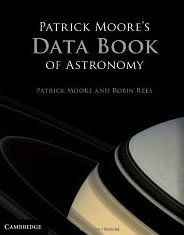 This is a very heavy and solid book which includes an enormous amount of detail within its 575 pages. This is the latest edition of Patrick Moore’s book and it’s the first time I have seen an astronomical book of this type containing so much data.