Search:

Archive for June, 2010

ISS Photograph with DSLR

25th Jun, 2010

Two nights ago I had a go at videoing the ISS with my telescopes by manually moving them myself to get the ISS on the CCD chip, only trouble a couple of nights ago was that the ISS was not very bright and it was not visible for very long.

So last night I decided to instead just capture the ISS light trail with my camera on a tripod.

I began by visiting Heavens Above and finding out when the International Space Station would be passing my location. You should always look to see how long the ISS is visible for (the longer the better) and how bright it will be (brighter the better).

I set my camera up on my tripod and set it the the manual setting and set the exposure to be 30 seconds with a 2 sec timer delay, so I did not record me shaking the camera by pressing the shutter button. I also opened my widest lens to 18mm.

The great thing about the ISS is that if you can look out for it on the horizon and see it coming, you can then get yourself ready, especially if the ISS is in sight for a number of minutes.

From my images below you see that 30 seconds is not really long enough in order to catch the trail across the whole width of the field of view. Next time I shall go to the bulb setting and choose my own exposure length, perhaps it will end up being about 1 to 1.5 minutes.
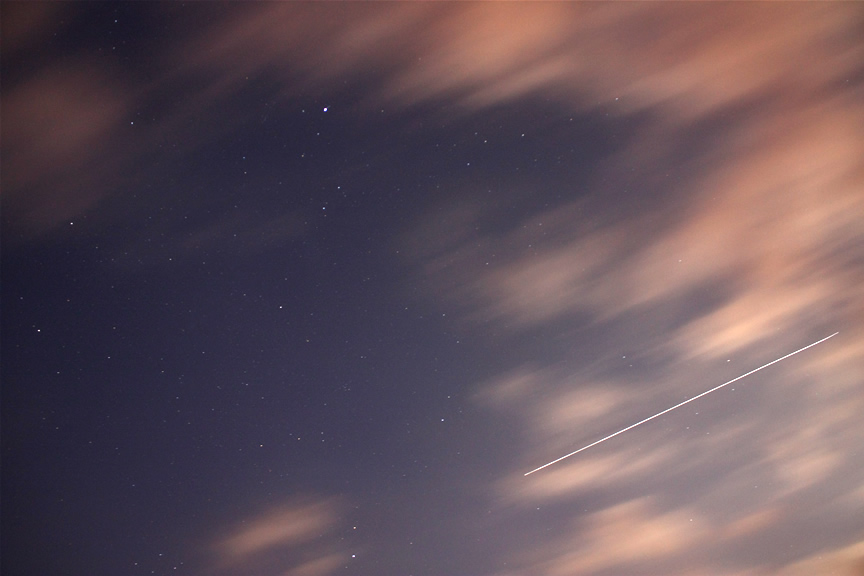
International Space Station Trail

The interesting thing about the second photograph is that a jet also came overhead and you see that light trail as well. It was fairly cloudy at the same time but the ISS actually flew lower than the cloud layer so was still visible throughout the shot.
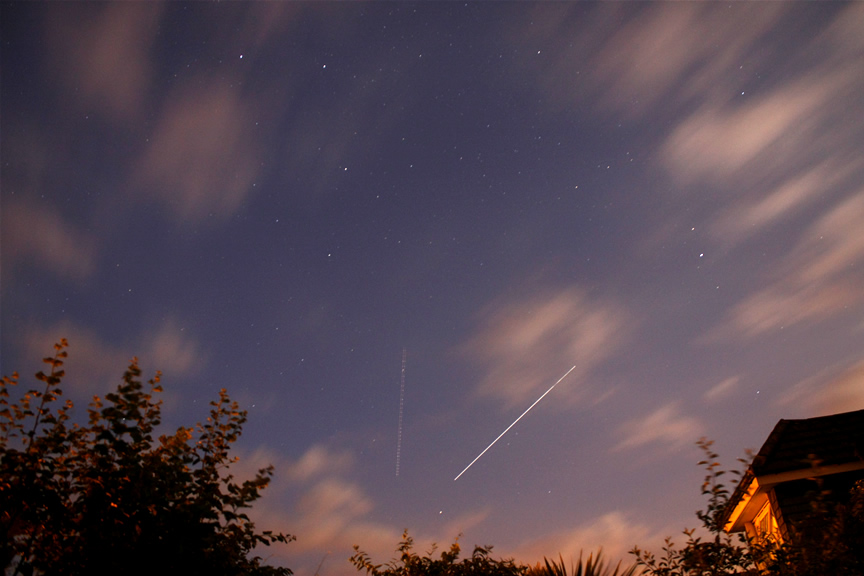
ISS Light Trail Image

After buying my A4 sheet of Baader solar filter paper I have been making all sorts of filters.

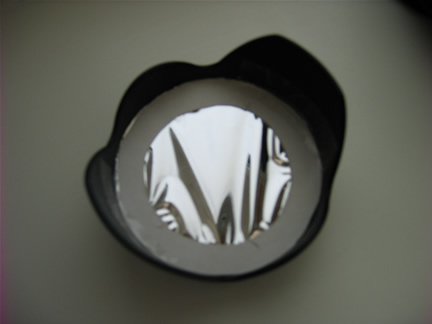
The last of which has been a solar filter for my Canon 450D digital SLR camera, but my method of construction will work for any SLR camera, as its really simple.

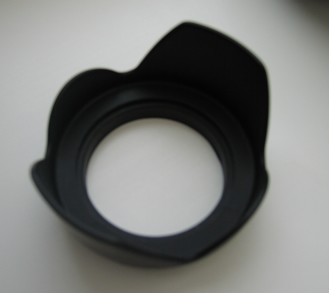
I started with a flower shaped lens hood. I bought the lens hood a while back cheaply from someone in China on eBay, I think it only cost a few pounds.

DSLR Flower Shaped Lens Hood

I then cut out two circular pieces of cardboard to put either side of the circular solar filter paper. I cut them to fit just inside the lens hood. I then cut out the circular solar paper.

Cutting the solar paper can be a pain, it is best to cut the filter paper between two other sheets of paper and then remember that there is a really thin piece of transparent film on the solar paper which needs to be removed once the shape has been cut out.

I previously used scissors to cut out the solar paper, but for this attempt I used a very sharp scalpel.

I then placed squares of double sided sellotape around the cardboard circles, in order to hold the cardboard onto the solar paper, be careful not to get fingerprints on the solar paper.

Then place the filter into the lens hood and I just used standard sellotape to tape the cardboard part of the filter to the plastic sides of the lens hood.

Homemade SLR Digital Camera Solar Filter

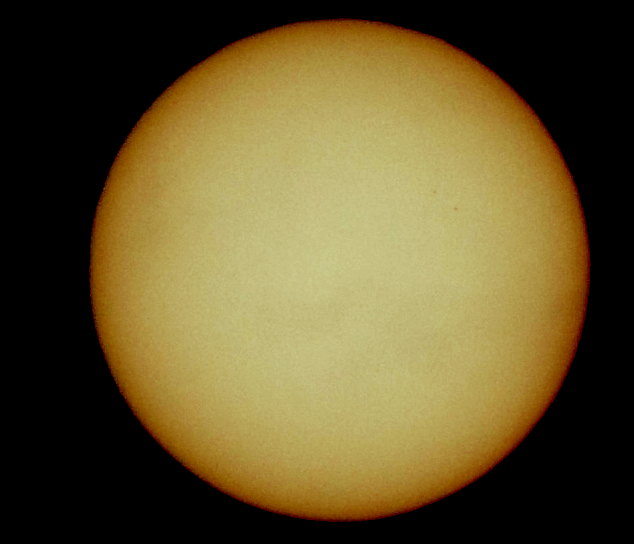
I then screwed on my new solar filter and took an image, usually I would take video of the sun with a CCD camera and then stack the results to get a final image. This time I took the sun image below with my DSLR at a setting of 1/4000th second at ISO100 with my 300mm lens.

I then played about a little with the brightness and contrast and colour levels with a photo editor program.

Sun with homemade solar filter on a DSLR camera

You can just make out two sunspots (1080) on the top right handside.

observing the universe bookObserving the Universe, A Guide to Observational Astronomy and Planetary Science is a full colour astronomy book which has been compiled by a team of experts from The Open University. The book has been designed for students who are undertaking observational work in astronomy and planetary science, but is suitable for amateur astronomers.
The book begins with looking at the basics of our planet and its rotation together with the orbit of our planets in the solar system. There is a small section on how to use astronomical software programs as well as planispheres. The next section describes the different types of telescopes and how they work as well as the different types of telescope mountings.

There is a section on spectrographs and astronomical detectors, which are really CCD cameras. There are some interesting sections on reducing CCD data including details on bad pixels, bias and dark subtraction and even flat fielding.

The next sections of the book are about photometry and spectroscopy, there are scary equations in this section. Photometry is the technique of measuring the brightness of astronomical objects.

The second half of the book is given over to preparing for practical work in astronomy. This section really is for students or amateurs who want to start doing astronomical maths so to speak. This section instructs you how to keep observation records, and how to deal with experimental uncertainties, such as calculating standard deviations. There is also information on how to use calculators and computers and how to make use of graphs for astronomical research.

The back of the book contains answers to the questions asked at the end of every section and chapter of the book, there is also an extensive glossary.

Overall, Observing the Universe is a very good book, and it’s in colour. This makes it a great beginners astronomy book or for a student or someone who wants to get further into astronomical science and start to gather and work with astronomical scientific data.

Observing the Universe is available from Amazon now.

I managed to do a bit of imaging today as the Sun was out all day. I went and purchased a sheet of A4 Baader Solar Filter paper from Green Witch the other day, they were the cheapest place I could find, plus I got my SPA discount as well. It also gave me my first chance to visit them in Dry Drayton.

Anyway, I produced a couple of solar filters for my LX200 and my ED80 Pro from the paper sheet so was dying to try them out (which was a nightmare trying to cut, as I couldn’t stop my fingers leaving fingerprints on the paper, plus you need to remember to remove a really thin piece of plastic that is attached to the filter paper).

Both worked really well, I have also just purchased a 2nd hand DMK21 camera, which is so much better than my SPC900 webcam, which I about to sell. So imaging with this was fun as the more practice I get on the DMK21 the better. I also used my Baader Solar Continuum filter which I have had for ages but never really got to use as I did not think that the SPC900 gave enough brightness of the object to use a dark green filter, but the DMK21 handles it with ease as you have a lot more control over your gain, exposure and gamma settings.

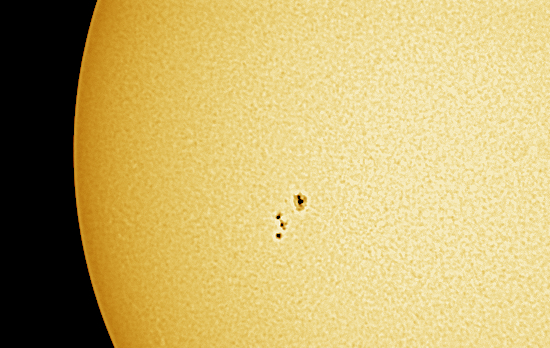
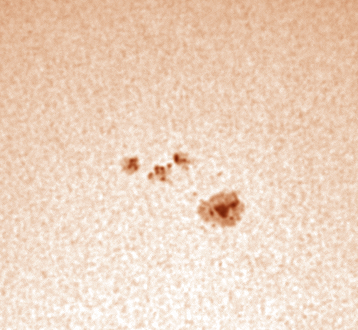
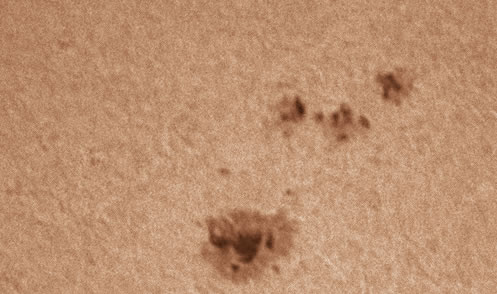
The great thing was that I was able to record granulation on my images, something I could never do with the SPC900 webcam, maybe it’s the Baader Solar Filter paper that made it possible, but I think it was really the DMK21 camera.

I processed them all in Registax 5 and then added some false colour in Fireworks. The distant image was taken with a Skywatcher ED80 Pro and the close-up shots with my 10″ LX200.

Sunspots via Skywatcher ED80 Pro

Sunspots via DMK21 and 10" LX200

Sunspots on 3rd June 2010 using 10" LX200