Archive for October, 2009

Since getting my guiding telescope on top of my Meade LX200, I have run out of space to put other items around the telescope.

When you first get an LX200 telescope, you think there are lots of screws to use to add extras, but they soon get all used.

I currently have the Meade finder on the left hand side of the scope, the guiding scope in the middle on a rail and rings, on the right I have my Telrad.

The Telrad was originally stuck to the tube with some sticky padding although I wish I had never done this, so instead I drilled some holes into the Telrad base and screwed this into the tube. Because of all these items on the top of the scope, I then required weights on the underneath of the scope.

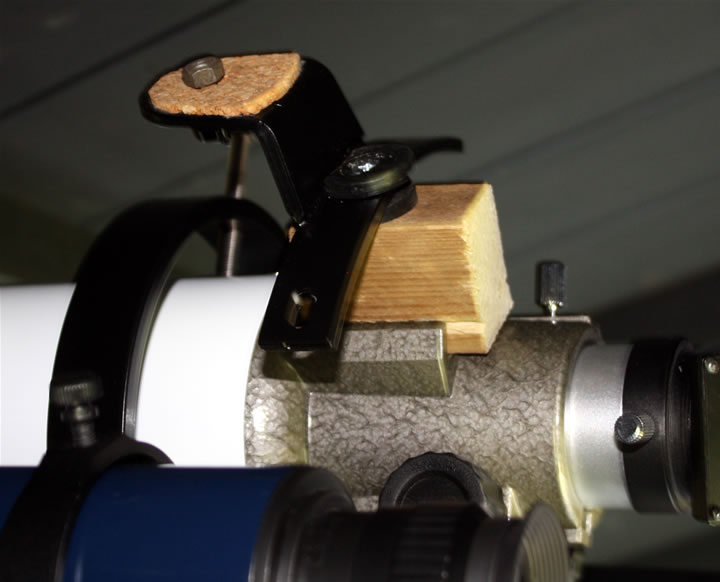
So, this means there is no space left for my DSLR camera, a bit of a pain if I want to do some normal widefield photography using my camera lenses. To get around this I decided to build a camera mount that would slot into the finder slot on the guiding telescope, which I was not using.

To do this I got myself a small piece of (1.5″ x 2″) wood which was about 2.5″ long.

I began by using a chisel to take out a line of wood where the finder mount would slide on, you could also do this with a screwdriver. The wood block will stay in place by using the screw on the finder mount on the telescope.

I then used the current metal camera mount I had and screwed this to the block of wood, between the metal camera mount and the piece of wood I did also add two rubber washers.

And that’s it, a simple way to add your camera onto your guiding scope.

Wooden Camera Mount in Finder Slot

I have seen these pleasing images where the stars have spikes coming out of them, most notably on the pleiades (seven sisters) images.

I want to be able to get these in my images as well, and now I have found out how to get them by using a diffraction mask on my LX200.

Today I decided to make some by using some plywood left over from my observatory build.

Here is a list of the raw materials I used:

  1. Plywood
  2. 8x Screws
  3. Spare length of wood (24″)
  4. 2ft Washing Line
  5. Black Wood Paint (optional)

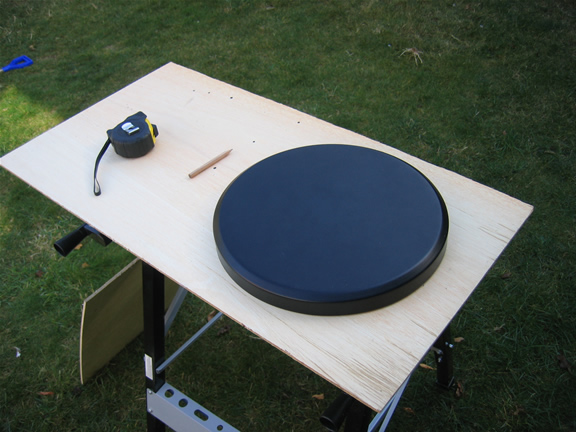
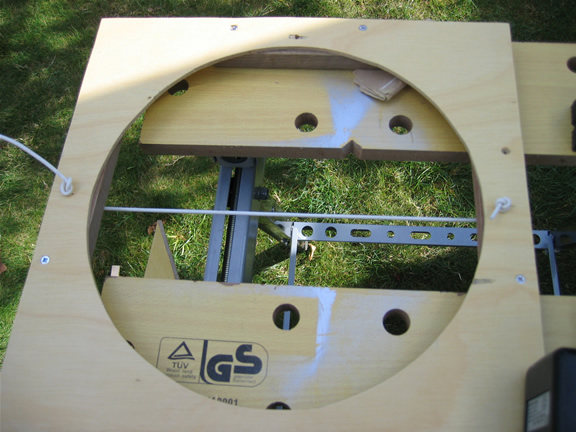
Cutting out the wrong size maskCutting the right size maskI began by taking the LX200 telescope metal cover and drawing a circle around that thinking that would be just right, although after then cutting it out with a jigsaw I found out that it was far too big.

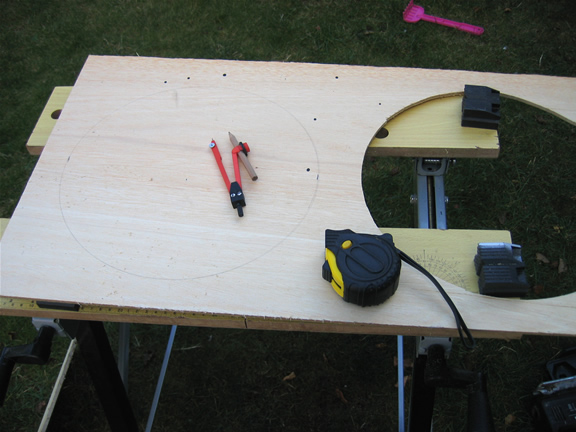
So I went back and just measured the diameter of the telescope and then found an old style school compass to draw the circle on the wood.

I then cut out the circle using my electric jigsaw.

I then cut down the piece of plywood into one manageable piece, with about 1.5 inches to spare around the sides of the hole.

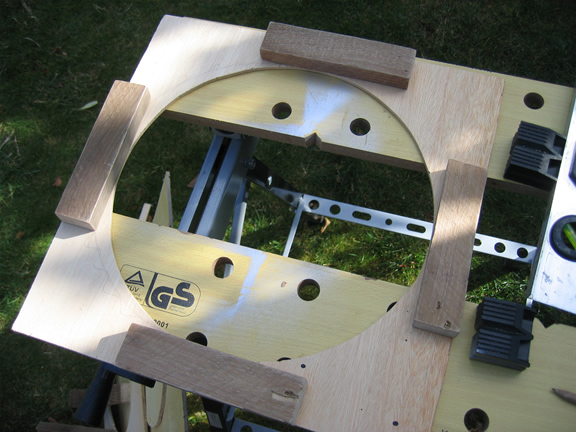
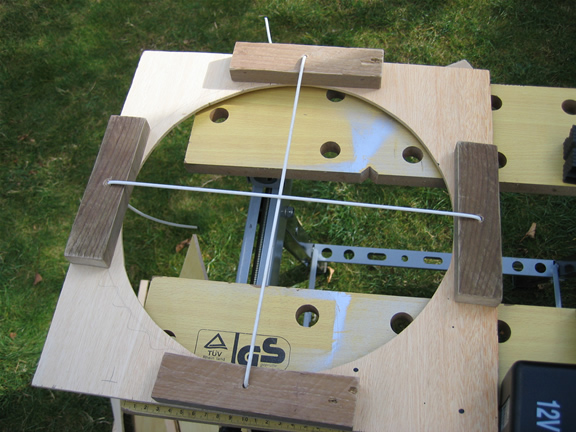
Adding all side woodNext I cut four lengths of some rough timber I had spare which was used on a previous gardening job. You don’t have to add this part, but I did because I wanted the mask to sit back from the front of the telescope, plus these pieces of wood at every side allowed me to make the mask fit snugly around the scope.

I then screwed the pieces of wood with 2 screws on each of the 4 pieces of wood, although I only used 1 screw on 2 pieces of wood so that I could still move the pieces of wood once the mask was on the telescope to fit them even more snugly against the scope.

Now go back to the telescope and place the mask on the front and mark on the blocks of wood you have just attached to the mask where the screws are on the LX200. You should have a screw in each of the four corners of the cover that holds the main front glass in place on the front of the telescope.

Doing this will mean that your washing line crosshairs will be exactly in the centre on the mask.

Adding washing line crosshairsI then cut 2 feet of washing line from our main home washing line, although you could go out and buy this. I then cut the 2 foot piece into 2 x 1ft pieces.  I tied a knot at one end of each pieces of the washing line.

Now drill holes with an electric drill all the way through the blocks of woods at the location you previously placed your telescope screw marks.

Thread the washing line through one of the holes. To hold the other end of the washing line in place I could have used wing nuts or bolts, but I did not have any, so I used a piece of dowelling, and hammered this into the holes to hold the washing line in place.

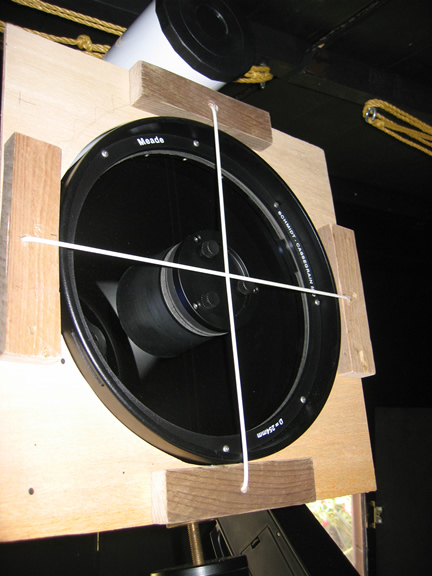
Diffraction spike mask completed unpaintedDiffraction spike mask on lx200I then tried the mask on the LX200 to make sure the washing line crosshairs were exactly centered.

On my first attempt they were not so I had to re-drill some more holes and re-thread the washing line, then they were perfect.

Here is the unpainted mask on my 10″ LX200 telescope.

I then painted the mask by using some black wood paint from Wilkinsons.

Hopefully I will now get the chance to try the diffraction spike mask out and see what images I get.

Hi, Just returned from a day at the Cambridge Federation of Astronomical Societies Annual Convention. It was quite a nice and quiet day at the Cambridge campus.  I arrived just after the Dr Hayley Gomez talk, to be told on the door that Damian Peach was ill and would not be presenting.

It was really strange, as I was thinking what would I do if he did not show up, on my way to Cambridge in the car. Would I just ask for my £8 back and go home and do something else? Because I had only turned out to see Damian, but I stayed anyway and had a quick look around the stalls and luckily Jerry from Loughton AS stood in and gave a good old fashioned slide presentation instead.

After lunch, Chris Lintott spoke on Galaxy Zoo, the same talk he gave at Herstmonceux, but luckily I did not attend that talk. After that I then came home without waiting for Martin Ree’s talk.

I hope that the FAS still publish Damian Peach’s talk on the web as I would still like to read it, but I was gutted he did not show up along with several other people.

As you probably know I purchased an Astro Engineering Pro Pier and drilled the holes for the pier bolts at the time I laid the slabs for the base of the shed.

I had thought I was going to secure the bolts at the same time of laying the slabs, but I must admit got a bit scarred about doing it, and then kept putting it off. I then thought about doing it before the shed was erected, but then ended up doing it once the shed was completed inside and out, so in fact I made this the last of my jobs.

I used a bolt kit from Pulsar Optical which was around £35, it includes the four pier bolts, with washers, nuts and dome nuts. It also comes with a tube of gunk which has to be used with a mastik type gun.

I had previously hired an STS drill to drill out the holes, so I began by cleaning out the holes. To do this I attached a small tube to the end of an old vacuum cleaner to get to the bottom of the holes I had drilled.

Next I unscrewed the end of the gunk and found a metal clip around the inner plastic sleeve. I cut this metal clip off and then re-attached the nozzle and place the tube into the dispensing gun.

Now for me, on the first attempt the gunk did not set at all. I was deemed to have been very unlucky as inside the tube there are two colours which must mix together before they are squirted into the pier bolt holes.

For me, this not happen on my first attempt, it looked like one of the chemicals was restricted from leaving the tube. So I thought everything was ok ,so left it overnight and came back in the next day at lunchtime to find the bolts had not set in the groud at all. So off I went back to Pulsar Optical who were straight onto the phone to the manufacturers of the gunk and the MD of the company even phoned them back. The company offered to send a new tube of gunk and some metal cleaning brushes so that I could get the unset gunk out of the pier bolt holes. James at Pulsar Optical also provided me with another set of clean bolts, which was really good of them.

The next day I went back to pick up the cleaning brushes and the new tube of gunk. That evening at about 7.30pm I began again. Once I had cleaned out the holes I cut the metal end of the gunk off and put it in the gun holder. I then made sure this time that I could see the two chemicals mix inside the nozzle. Now it did take at least two full trigger squeezes in order to get a good mix of the chemicals.

I squirted the gunk into the holes one at a time, starting with the nozzle at the base of the holes and filled them to about 50% full. I then took my electric screwdriver and added an attachment so that I could screw the bolts into the gunk in the holes which is now very dense. This allows the gunk to get into the grooves of the bolts.

I repeated this for each of the four bolts in turn. You will find that a lot of gunk will spill over the holes, you just need to have a rag ready to clean this up.

I then lifted the pier over the bolts to make sure the bolts were in the right location. I then left the bolts overnight, and in the morning returned to find the bolts were completely rock solid in the ground.

I then cleaned the bolts up as some had some glue around them which would stop the nuts from been tightened. I just took a stanley knife and chipped away at the glue to clean them. I also removed the pier again, so that I could make sure I cleaned the bolts all the way to the floor as I did not want the glue on the bolts to stop the nuts being tightened as much as possible.

I then placed the pier back on the bolts and tightened them up. Job Done!

There are many different ways of completing this job, as I was advised not to lift the pier on and off the bolts, as the weight of the pier could dent the grooves on the bolts and render them useless, but for me this was not a problem. You could always make a wooden template and use that as a guide. I was worried that the bolts would not set in the correct position, as there is really no room for error, so placing the pier on top of the bolts seemed the most reliable method to me.