Turn Left at Orion Book Review
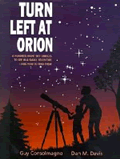 Turn Left at Orion has become a very famous book, one which has had lots of positive reviews on book sites such as Amazon and other astronomy web sites, so it was good to get hold of a copy to see what this book is all about.
Turn Left at Orion is really about how to find 100 objects in the night sky using binoculars or a small telescope, the book cover actually mentions using a 50-70mm aperture telescope.
This version of the book is the seventh printed edition from 2007 and all data in this book has been updated to the year 2011. The start of the book tells you the basics about viewing the night’s sky and how to use the book.
The moon is mentioned in this book in sections of the lunar cycle with each page giving you an image of the view of the moon you will see in the sky and the main areas to look for. There is then a list of worldwide lunar eclipse dates.
Turn Left at Orion also contains details on all the planets with a couple of pages for each, telling you what to look out for, and how to find the planets.
The main parts of the book are given over to looking at objects in the sky. There are four main sections which are given over to each season of the year, and what you can find in the sky.
Each page tells you what the conditions need to be like to see the object, the eyepiece you will need to use and in what months you can view the object. There are also symbols telling you if you can see the object with binoculars or a telescope.
The page then tells you where to look in the sky, and what you need to find in your finder scope before you view the object in the telescope. There are then comments on the object and information on what you are actually looking at.
At the rear of the book is a chapter on how to run a telescope, detailing the basics of different type of telescope and how to use your telescope and get the best out of it, by learning how to use your telescope mount, when to observe and to remember to cool down the telescope as well as how to store and maintain your telescope.
There is also a small two page glossary and a full table of objects that are described in the book, which provides you information on the RA and Dec positions, the type of object, what type of sky it needs to be to see the object, and which eyepiece to use.
There is a small section on objects in the Southern Hemisphere, useful if you go on holiday to the Southern Hemisphere you will be able to recognise objects not visible in the Northern Hemisphere.
Overall Turn Left at Orion does appear to be a very useful book for beginners and is suitable for all ages. I am sure Turn Left at Orion will help you but I think that some colour photos of the night sky could help or by displaying the main stars joined up in constellations can sometimes also help or give a wider view of the nights sky in each image could have helped to direct people to home in on the location they need to be looking.
Although finding objects in the sky is never easy and it is really easy to give up, but if you stick with it, finding objects can be really rewarding, all you have to do is learn one constellation a night and you will soon get know lots of objects in the night sky.