Archive for August, 2007

Whilst in town this morning waiting for the bank to open, I wandered into WHSmith and looked at the astronomy magazines. There only seems to be two astronomy magazine choices either The Sky at Night or Astronomy Now.

The Sky at Night is slightly more expensive as it comes with a CD/DVD disk on the cover, but after flicking through the content Astronomy Now seemed to be the better purchase at £3.25

After looking through it, it’s typical that the new copy comes out tomorrow! Isn’t that always the way!

Annual subscriptions are £33 a year for Astronomy Now and £38 for Sky at Night, should I subscribe to either?

I’ve got to say I like the content in Astronomy Now and the images are brilliant and the articles look easy to digest.

Prime Focus is the name given when you take the lens off of the camera and insert it directly into the telescope. In order to do this you will require a number of extra astronomy adaptors.

T-Ring

The first one is the T-Ring which screws directly into the neck of the camera. Not an expensive part to purchase, mine for my Canon 400D was around £10. But they do all differ, so make sure you get the correct make and model to match your camera.

Check out Pixmania who stock T-Ring adaptors for Nikon and Canon SLR Cameras.

1.25″ Camera Adaptor

This optional adaptor is used for prime-focus and eyepiece-projection astrophotography with SCTs and refractors. It can also be used successfully with many Newtonian telescopes that either have removable sections on the eyepiece holder (to allow the camera to reach focus), or by employing a 2x Barlow lens to extend the focus point.

The rear section screws onto the nosepiece and is designed to hold a 1.25” eyepiece (ideally a mid-focal length Plossl, say a 12.5 to 20mm) for eyepiece-projection photography, with a thumb screw to lock the eyepiece in position, or you can just leave this part on without an eyepeice inserted.

The 1.25″ adaptor comes with the nosepiece and cost me around £15.

The image below shows how the pieces fit together, with the camera, then T-ring, the 1.25″ camera adaptor and then the nosepiece adaptor.
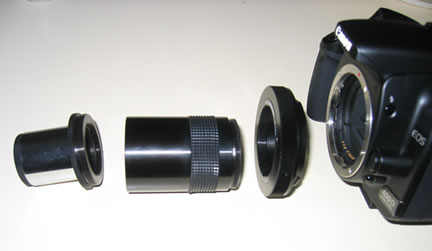
SLR Camera Parts in a row with eyepiece adaptor

Nosepiece Adaptor

This adaptor can either be used together with the 1.2″ Camera Adaptor above (and it usually comes with the above adaptor anyway) or on it’s own with the T-Ring.

This nosepiece adaptor allows any digital or film interchangeable lens SLR (single lens reflex) camera to be attached to any 1.25” eyepiece holder. So you just slot this part into the telescope.

The front nosepiece section - which is usually threaded can also take standard filters. Using the nosepiece alone allows simple prime-focus photography and you can also use it with a Barlow lens to increase the image scale.

You can purchase a nosepiece separately (the chrome part) and it will cost about £6.

The image below shows the SLR camera then the T-Ring and the nosepiece, I also have a moon filter at the front of the nosepiece:
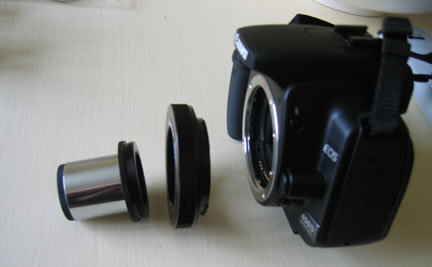
SLR Eyepiece Camera Adaptor

So all in all the cost of adapting your camera for telescope photography is not expensive at all and really easy to setup, it’s just the cost of a good SLR digital camera in the first place is the expensive bit.

At the beginning of the evening of the 12th August, I thought we we’re going to have cloudy skies as at around 9pm the heavens opened and it was raining heavily, but at around 11pm when I looked out the sky was crystal clear.

I managed to stay up until 00:30am and then I ventured outside, I stayed out until about 2am, but I must say I was slightly dissapointed as I thought there would be lots of meteors every couple of minutes, well enough to allow me to put my SLR onto bulb and run it for 30 seconds a time and hopefully catch a meteor on film, but alas this did not happen.

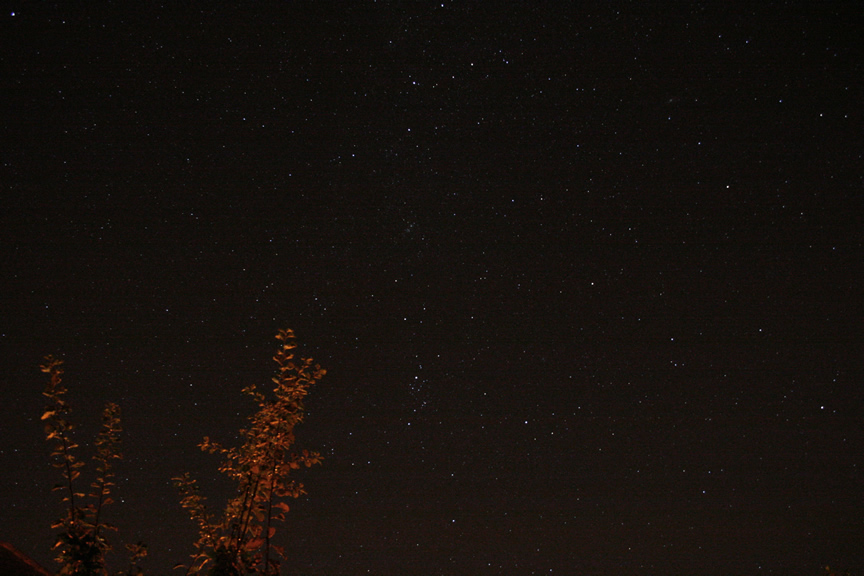
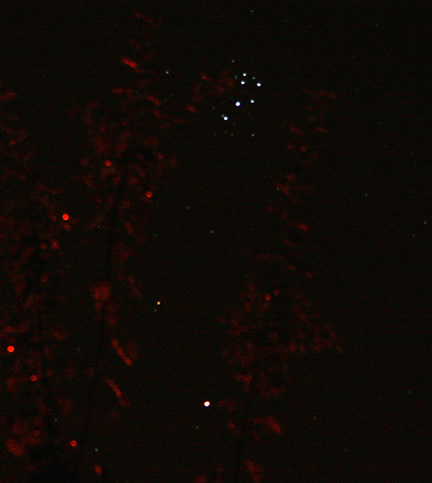
I eventually think in about 90mins I spotted about 12 meteors. It was nice to stay up late and watch Mars and the Pleiades rise over the horizon and I managed to take a picture of this below:

Pleiades and Mars 12th August 2007Pleiades at the top of the image, with Mars at the bottom, shown in between my plum tree in my garden.

After getting up today at 8.30am I noticed the postman had delivered my BBC “The Cosmos” posters from the Open University together with a OU magazine. The posters are ok, nothing amazing, there is a nice photo of the moon landing on one of them.

Perseid Meteor Shower Sky

There are 2 free posters accompanying the BBC series called “The Cosmos“.

They can be obtained by telephoning: 0870 900 0312

Calls do cost, so get the bill payers permission, but it took me only about 1.5mins to record my details.

Or you can go to the Open University website: www.open2.net

Saw Adam Hart-Davis discussing his new series entitled The Cosmos on BBC Breakfast TV this morning, from the clips it looks really good and a definite must watch for us astronomers.

The series spans five weeks.

First Episode of The Cosmos - Tue 7 Aug, 7:30 pm - 8:00 pm

Life in the Cosmos

Are we alone? In this edition of the cosmos-exploring series, Adam Hart-Davis joins alien hunters at the huge new telescope in California dedicated to receiving the first message from intelligent beings. He meets Frank Drake, pioneer of the search for extraterrestrials, who has calculated just how many aliens might be out there. And he reveals why microbes from Devon are being sent into space to find out if life could once have survived an interplanetary trip.

Also, Janet Sumner investigates a new way to detect life on Mars, using a probe made with living material from Earth. Dr Doug Vakoch of the Interstellar Messaging Composition Group who is working out how we should reply to a message from space. And Adam asks: what if the aliens are listening to us? He finds out how far into the cosmos our ancient broadcasts have travelled.

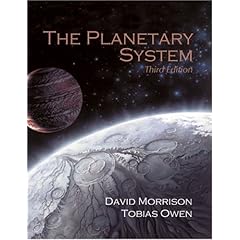
The Planetary SystemThe Planetary System ( ISBN 080538734X ) gives you a complete overview of the solar system. It gives you a great introduction to watching the sky together with the theory behind orbits, eclipses and the history of major researchers of astronomy.


Each chapter in turn in The Planetary System then discusses each planet in turn and other major sky items, such as satellites, asteroids and meteorites.


Within each chapter in The Planetary System is what you would see when looking at the object. Seasonal cycles of the planets are discussed, together with the topography and geologic features of the surfaces of the planets. Craters and surface views are also included as are intricate details about the planets atmosphere.

The end of every chapter includes a summary with key terms learnt. It also includes review questions, quantitative exercises and additional reading.

The Planetary System is quite a large book which contains a lot of information and some great photos and illustrations in a mixture of black and white and colour.

The Planetary System includes a lot of theory and some intricate science and formulae.


This may be a little advanced for a lot of us astronomers, but the book does give you specific insights into a lot of information about our solar system and our solar systems planets. If you want to learn a lot more about our solar system and the planets then The Planetary System is a great book.


The Planetary System also comes with Voyager SkyGazer College Edition software on CDROM.


The Planetary System Book can be purchased from Amazon.